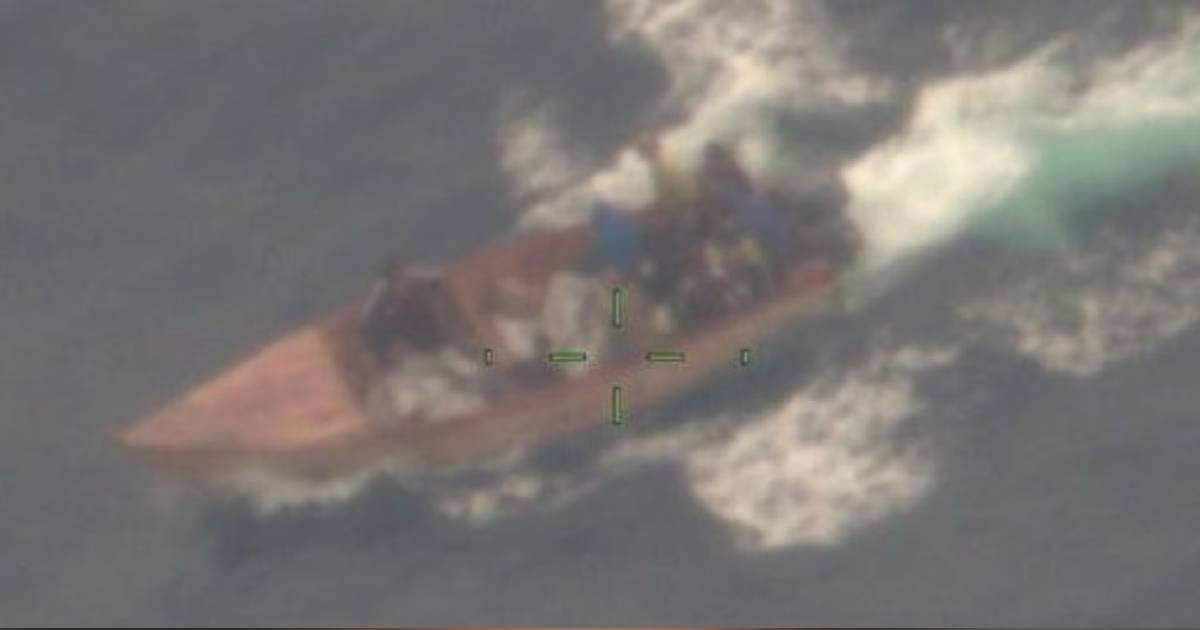
The United States Coast Guard successfully repatriated 16 Dominican nationals on Thursday after intercepting an overloaded makeshift boat in the waters of the Mona Passage, just off the coast of Puerto Rico.
The operation commenced on Monday when a Coast Guard HC-144 Ocean Sentry aircraft spotted the 22-foot makeshift boat, described as "grossly overloaded," off the coast of Aguadilla.
A U.S. Customs and Border Protection (CBP) multi-role surveillance aircraft joined the effort, maintaining aerial surveillance while the Coast Guard Cutter Richard Dixon carried out the interdiction.
The rescued group included 19 individuals: 14 men, three women, and two minors, all of whom claimed to be Dominican nationals according to the report.
Fourteen of the adults were repatriated at sea to the Dominican Navy vessel Bellatrix, while the two minors were brought ashore and handed over to representatives from the National Council for Children and Adolescents (CONANI) in the Dominican Republic.
Lieutenant Commander Michael D. Torgesen, in charge of the Richard Dixon, praised the collaborative effort: "The aerial assets from CBP and the Coast Guard precisely guided the crew of the Richard Dixon to the scene, allowing us to stop this overloaded and unfit vessel, ensuring maritime safety successfully."
Commander Matthew Romano, the response chief for the Coast Guard's San Juan Sector, issued a stern warning to those considering such voyages: "Do not take to the sea! These journeys are extremely perilous, relying on inadequate and overloaded vessels without any life-saving equipment. Additionally, those caught face potential criminal charges or immediate repatriation."
The operation is part of the Homeland Security Task Force – San Juan Region (HSTF), established under Executive Order 14159, aimed at combating human smuggling and irregular maritime migration.
The Mona Passage, a 60-nautical-mile channel separating the Dominican Republic from Puerto Rico, is notorious for being one of the Caribbean's most dangerous migration routes due to its strong currents and waves that can exceed 20 feet in height.
This marks the third repatriation operation of Dominicans conducted by the Coast Guard in the area during 2026: In March, 60 migrants were returned after being intercepted near Mona Island, and in June, 32 were repatriated following the interception of a vessel carrying 36 Dominicans, three Haitians, and one Uzbek near Desecheo, Puerto Rico.
Between October 2022 and January 2024, the agency intercepted 2,941 individuals across 91 vessels in the waters between the Dominican Republic and Puerto Rico, illustrating the magnitude and persistence of this phenomenon along the route.
Understanding Maritime Migration and Safety in the Mona Passage
Why is the Mona Passage considered a dangerous route?
The Mona Passage is known for its strong currents and high waves, which can reach over 20 feet, making it extremely perilous for small and overloaded vessels attempting to cross.
What are the consequences for migrants intercepted in the Mona Passage?
Migrants intercepted in the Mona Passage face potential criminal charges or immediate repatriation, as highlighted by the Coast Guard's commitment to ensuring maritime safety and preventing unlawful migration.
How does the Coast Guard coordinate with other agencies during these operations?
The Coast Guard collaborates with agencies like U.S. Customs and Border Protection, utilizing their aerial assets for surveillance and guidance, which is crucial in successfully intercepting overloaded and unsafe vessels.