A team of scientists has uncovered remarkable geological evidence in Viñales, Pinar del Río, revealing the intense earthquakes triggered by the Chicxulub asteroid impact approximately 66 million years ago. This catastrophic event is closely linked with the mass extinction that wiped out non-avian dinosaurs and numerous other species.
Dr. Reinaldo Rojas Consuegra, a scholar in Geological Sciences and a leading researcher at the Center for Petroleum Research (CEINPET), announced the discovery, which was reported by Granma. Rojas heads the Cuban project examining formations related to the Cretaceous-Paleogene boundary.
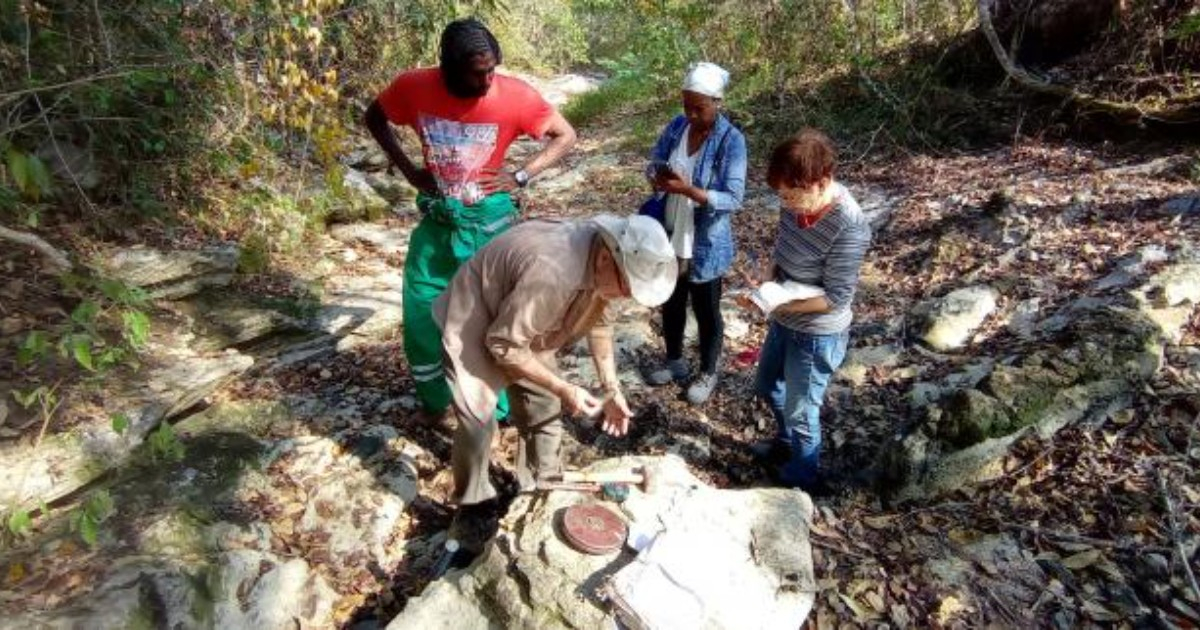
The findings were located at Arroyo Las Piedras in the Valley of Pons, Viñales. Here, the researchers discovered a wide array of rock deformations caused by seismic activities following the impact, which took place in present-day Yucatán Peninsula.
Unique Seismic Record from the Ancient Caribbean
These results were published in the Journal of South American Earth Sciences under the title "Record of seismites linked to the Chicxulub impact in deep-water deposits: Evidence from western Cuba." The authors claim this as the first documentation in Cuba of seismites directly attributed to the Chicxulub impact, offering a unique record of those seismic events in the ancient Caribbean.
The study identifies faults, fractures, folds, and numerous deformation structures in soft sediments extending over 70 meters thick. These structures, known as seismites, are interpreted by scientists as the result of intense seismic activity generated by the Chicxulub impact.
Preserved Geological Evidence
The analyzed rocks originally formed in a deep marine environment of the ancient Caribbean. The earthquakes caused processes of liquefaction and sediment mobilization, resulting in deformations preserved for tens of millions of years, now exposed in western Cuba.
Dr. Rojas explained, "We obtained an exceptional record of the earthquakes that shook the planet following the asteroid collision," marking the end of the Mesozoic era and the beginning of the Cenozoic.
Such violent movements would have forcefully displaced ocean floor sediments. According to Rojas, some of the liquefied material was expelled similarly to geysers or mud volcanoes, combining fossils and other sedimentary materials.
Significance for Future Research
The scientific article describes large extrusions akin to mud volcanoes and deposits containing a mixture of Late Cretaceous microfossils, resulting from significant alterations to the seabed caused by seismic activity.
This research is part of the project "Complex Clastic Unit of the Cretaceous-Paleogene boundary in Cuba and its relationship with geological evolution," led since 2024 by CEINPET in collaboration with the Geology Department of the University of Pinar del Río.
Researchers from other institutions, including the National University of Colombia, also contributed to the study, as reported by Granma.
The discovery adds to decades of research on Chicxulub's impacts in Cuba. Since the 1990s, Cuban, Japanese, and Spanish specialists have documented significant rock formations related to the Cretaceous-Paleogene boundary across the country.
Evidence from this period has been found in Pinar del Río, Artemisa, Havana, Matanzas, Villa Clara, Sancti Spíritus, and Holguín. Previous studies identified marine deposits associated with earthquakes and tsunamis generated by the impact.
Given the new site's scientific value, researchers propose that Arroyo Las Piedras be protected as a new geosite within the Viñales National Geopark. Conservation efforts would preserve the area for future research, educational activities, and scientific outreach.
Beyond reconstructing one of Earth's most catastrophic events, the study offers insights into the geological evolution of western Cuba, subsurface mapping, and processes related to hydrocarbon exploration.
Insights into the Chicxulub Impact and Its Geological Effects
What is the significance of the Chicxulub impact in geological history?
The Chicxulub impact is significant because it is associated with the mass extinction event that ended the era of the dinosaurs and many other species, marking a major turning point in Earth's biological and geological history.
Where were the geological evidences of the Chicxulub impact found in Cuba?
The geological evidence was found in Arroyo Las Piedras, located in the Valley of Pons, Viñales, Pinar del Río, where scientists discovered various rock deformations caused by seismic activities following the impact.
What are seismites and how are they related to the Chicxulub impact?
Seismites are structures formed in sediments as a result of seismic activity. In the case of the Chicxulub impact, they are evidence of the intense seismic activities and ground movements triggered by the asteroid collision.