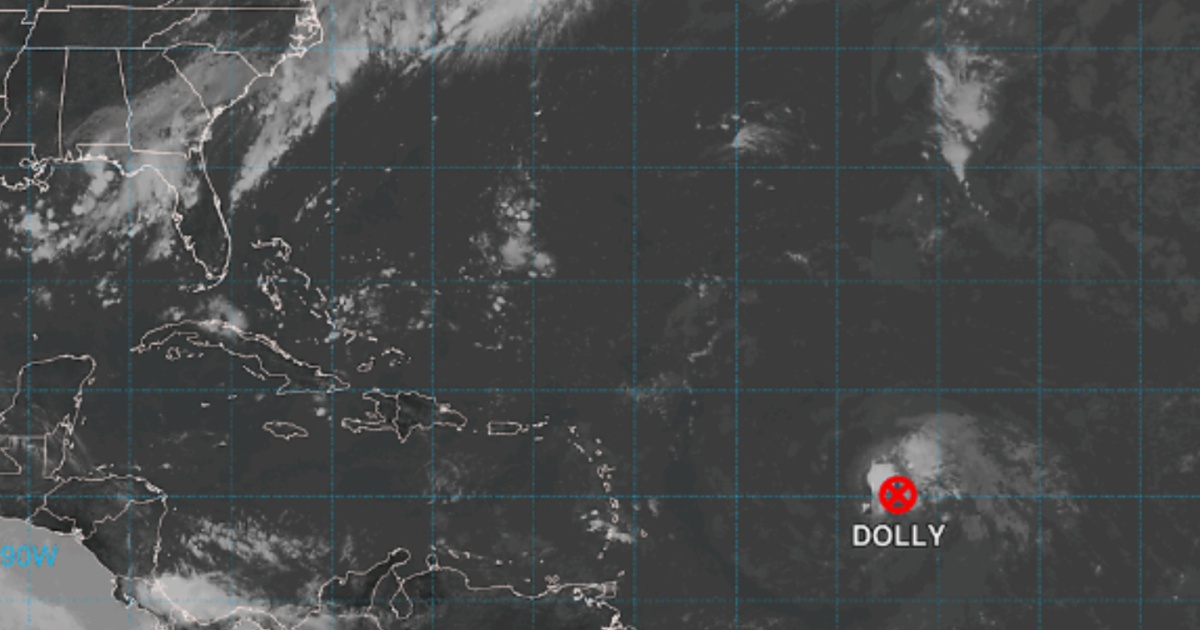
The Cuban Institute of Meteorology (INSMET) has declared the tropical storm Dolly downgraded to a tropical wave as of Friday morning. This announcement was made in their Tropical Cyclone Advisory No. 3, which will be the final update concerning this system.
INSMET detailed that Dolly encountered "unfavorable atmospheric conditions" which facilitated its gradual weakening as it moved swiftly westward across the central Atlantic.
At 11:00 a.m. on Friday, the center of Dolly was positioned at 15.0 degrees latitude North and 46.9 degrees longitude West, approximately 1,610 kilometers east of the Lesser Antilles arc.
During its peak intensity, Dolly's maximum sustained winds were recorded at 65 km/h, with a minimum pressure of 1,007 hPa, never reaching hurricane status.
Future Path and Impact
The Cuban agency noted that the tropical wave will continue its westward trajectory, nearing the northern Lesser Antilles arc on Saturday night and into Sunday.
However, forecasts remain pessimistic about Dolly's redevelopment: "Throughout its path, the atmospheric conditions will stay unfavorable, so the system is not expected to regain any tropical development," INSMET stated.
The degradation of Dolly was primarily caused by strong wind shear from the southwest and dry air presence, factors also confirmed by the United States National Hurricane Center in their analyses.
Current Threats and Historical Context
There are currently no coastal watches or warnings, and Cuba faces no direct threat from this system.
The primary concern is the potential for heavy rain and flash flooding in elevated areas of the Lesser Antilles, the Virgin Islands, Puerto Rico, and Hispaniola between Sunday and Monday.
Dolly was the fourth named storm of the 2026 Atlantic hurricane season, following Arthur in June, and Bertha and Cristóbal in August, the latter also having no impact on the Island.
Dolly's swift dissipation aligns with forecasts of a below-average hurricane season, largely attributed to the influence of El Niño, a phenomenon that heightens vertical wind shear in the Atlantic, hindering cyclone organization.
In May 2026, INSMET predicted around 11 tropical cyclones for the Atlantic basin, with five potentially becoming hurricanes, two of which could be of significant intensity, and a 40% chance that at least one hurricane would impact Cuba before the season concludes on November 30.
Frequently Asked Questions About Dolly's Dissipation
Why did Dolly dissipate so quickly?
Dolly dissipated rapidly due to encountering unfavorable conditions like strong wind shear from the southwest and dry air, which prevented further development.
Is there any threat to Cuba from Dolly?
No, Cuba is not under any direct threat from Dolly as it has dissipated and there are no coastal warnings in effect.
What is the main risk associated with Dolly now?
The main risk is potential heavy rainfall and flash flooding in the Lesser Antilles, Virgin Islands, Puerto Rico, and Hispaniola from Sunday to Monday.