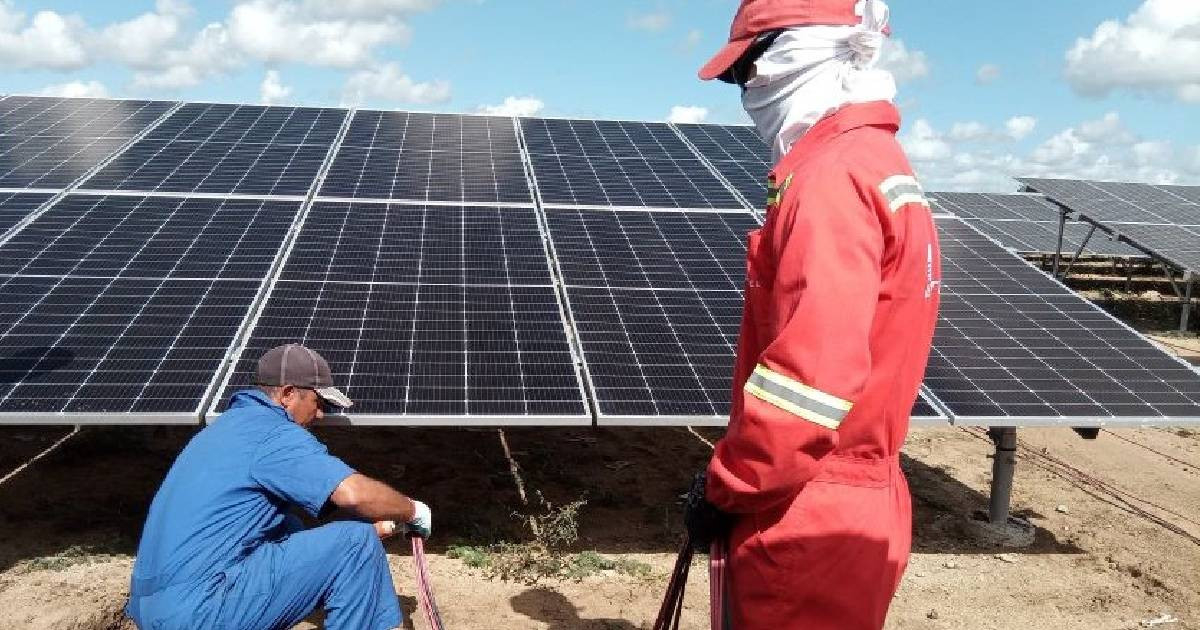
In the province of Las Tunas, eight solar photovoltaic parks have been completed, boasting a theoretical installed capacity of 64.8 megawatts. However, this infrastructure barely provides an average of just two and a half hours of electricity daily to its municipalities, acknowledged the local Electric Company’s director.
"With the available energy, we can ensure an average of two and a half hours of electricity during the day in the municipalities," stated Anisley Santiesteban Velázquez, the general director of Las Tunas Electric Company, in an interview published by the state-run newspaper 26 on Thursday.
This figure starkly contrasts with the triumphant tone of the state media, which describes the province as "a leader in Cuba’s energy transition."
Despite the solar expansion, residents of Las Tunas continue to face daily blackouts, part of a national electrical crisis with generation deficits exceeding 2,300 MW this year.
Solar Parks and Their Challenges
The most significant solar parks include Nueva Línea in Puerto Padre, the 220 kV Substation in the main municipality, and Veguita, which is still under construction. Smaller parks, ranging from 2.2 to 5 MW, are located in Manatí, Puerto Padre, Blanca Rosa, and Punta Brava.
When Veguita is completed, the provincial capacity might reach approximately 85 MW, but its completion depends on Granma’s Renewable Energy Sources Company.
As of January, the seven solar parks synchronized with the National Electric System contributed 53 MW collectively. The eighth park, located in Punta Brava in the Amancio municipality, raised this theoretical capacity to the current 64.8 MW.
Protective Measures Amidst Power Shortages
Due to shortages, the Electric Company has implemented protective schedules for essential services. On Saturdays, around six hours are allocated to Jobabo municipality for water pumping from Birama. On Sundays, the TK47 circuit in Puerto Padre receives between five and seven hours to supply the La Micro area.
Tuesdays are reserved to support pumping in Vázquez, benefiting Manatí and Puerto Padre as well. The three main pumps in the provincial capital—Piedra Hueca, Rincón, and Cayojo—are covered by solar power 24/7, according to the source.
"Every day, there is a significant level of protection that coincides not only with water but also with some health services in the municipalities," Santiesteban highlighted.
Technical Limitations and Future Prospects
The director also explained the technical limits of solar energy during system disruptions. "Clouds cause significant fluctuations. A cloud passes by, and power drops rapidly; when it clears, the power rises again. These fluctuations cause system instability, leading to its collapse," he explained. To mitigate this, inverters are limited to one MW each, ensuring a stable output of seven MW per park.
Southern municipalities, such as Jobabo, Colombia, and Amancio, often remain without coverage during these events. The Punta Brava park has a one MW battery that, once operational, could guarantee a micro-grid for Amancio’s main circuit, securing communications, water pumping, and the local hospital, the director noted.
Meanwhile, the province is progressing with the La Herradura Uno wind park, which began assembling 22 wind turbines with a maximum capacity of 34 MW this year, following over a decade of delays since its initial announcement in 2012.
The Minister of Energy and Mines, Vicente de la O Levy, pledged in late April that the project would be completed by 2026.
Santiesteban also discussed the aspiration to replicate in Las Tunas the experiment of daytime territorial self-sufficiency with renewables, tested in Pinar del Río.
"We are prepared to improve the system's conditions when decided, to start an experiment that might not meet 24-hour demand but would provide more energy to the different municipal circuits during the day, allowing everyone to enjoy electricity," he anticipated.
Understanding Las Tunas' Energy Challenges
Why can't Las Tunas provide more electricity despite having eight solar parks?
The solar parks have a theoretical capacity of 64.8 megawatts, but technical limitations and natural factors like cloud cover cause fluctuations that reduce effective power output.
What measures are being taken to manage electricity shortages in Las Tunas?
The Electric Company has established protective schedules for essential services, including water pumping and health services, to ensure they receive power during critical times.