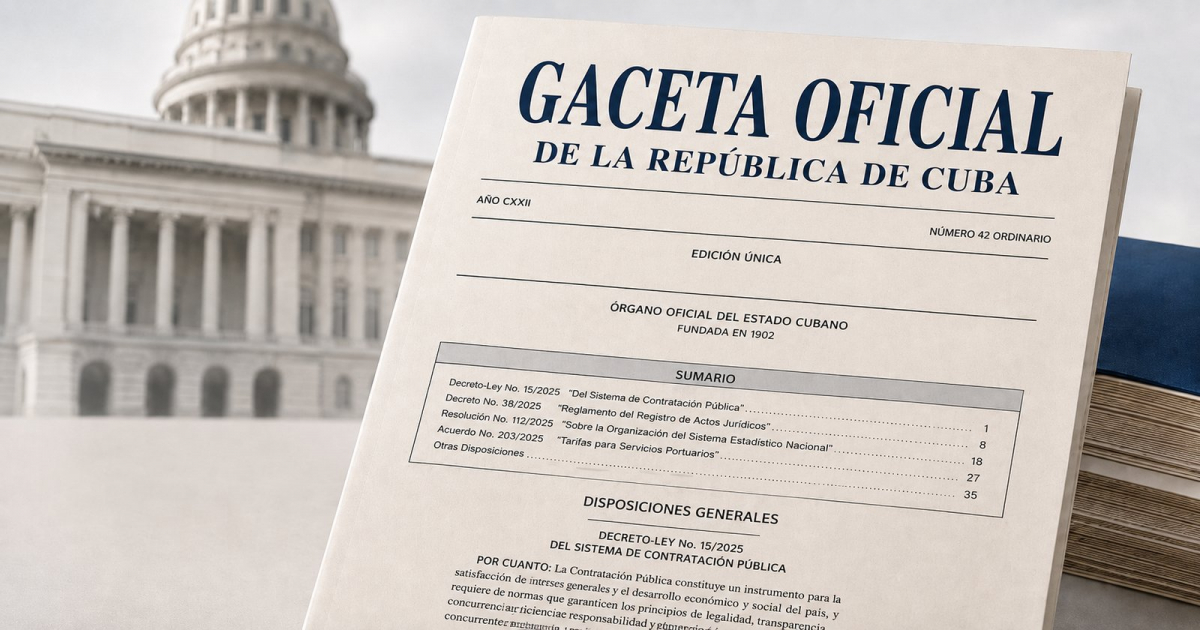
This past Friday, Cuba's State Council enacted Decree-Law 129 of 2026, effectively nullifying Decree-Law 155, which had been in place since September 28, 1994. This previous law allowed for the confiscation of goods due to violations of regulations established by the Central Commercial Registry.
The new legislation was signed in Havana on July 28, 2026, by Juan Esteban Lazo Hernández, who serves as the President of the National Assembly of People's Power and the State Council. It became effective upon its publication in the Official Gazette No. 69 Ordinary of 2026, on pages 2 and 3, under the identifier GOC-2026-466-O69.
Initially, Decree-Law 155 of 1994 empowered authorities to seize tools, equipment, goods, or effects from individuals and entities as additional punishment for offenses against the Central Commercial Registry. This registry, administered by the Ministry of Domestic Trade, mandates that all establishments engaged in commercial activities or service provision in Cuba register with it.
This law worked in tandem with Decree 184 "On the Central Commercial Registry," established in August 1993, forming the backbone of Cuba's domestic trade regulations for over three decades.
The legal foundation for rescinding Decree-Law 155 lies in two more recent pieces of legislation: Law 177 "On the General Regime of Violations and Administrative Sanctions," approved on July 17, 2025, which launched a new framework for administrative sanctions, and Decree 168 dated July 12, 2026, which updated the regulation of the Central Commercial Registry and repealed Decree 184 of 1993.
With these updated norms in place, Decree-Law 155 no longer had legal standing. Decree-Law 129 notes, "The approved Economic and Social Transformations promote the update of the regulatory framework of internal trade in the country, thus necessitating the repeal of Decree-Law 155."
The new legislation includes a transitional provision to safeguard ongoing administrative processes: "Cases under processing at the time this Decree-Law comes into effect will continue to follow Decree-Law 155," ensuring no legal proceedings are left unresolved.
Decree-Law 129 is not the sole regulation featured in this Friday's Official Gazette No. 69.
The edition encompasses a collection of eight regulations related to the reform of internal trade, including Decree 167 on Internal Trade, Resolution 15 from the Ministry of Domestic Trade regarding wholesale trade flexibility, and Resolution 25 from the same ministry concerning maximum service fees for the Central Commercial Registry.
Together, these reforms reshape the landscape of Cuba's domestic trade under the umbrella of the "Economic and Social Transformations" unveiled by the government in 2026.
Understanding the Changes in Cuban Trade Laws
What is the significance of Decree-Law 129 of 2026?
Decree-Law 129 of 2026 nullifies Decree-Law 155, which allowed for the confiscation of goods due to violations of the Central Commercial Registry, as part of a broader update to Cuba's internal trade regulations.
How does the repeal of Decree-Law 155 affect ongoing cases?
The repeal includes a transitional provision ensuring that ongoing cases at the time of the new law's enactment will continue under the regulations of Decree-Law 155, preventing any legal gaps.
What other reforms were included in the Official Gazette No. 69?
The Official Gazette No. 69 also published a series of eight reforms, including Decree 167 on Internal Trade and resolutions from the Ministry of Domestic Trade about wholesale trade and service fees for the Central Commercial Registry.