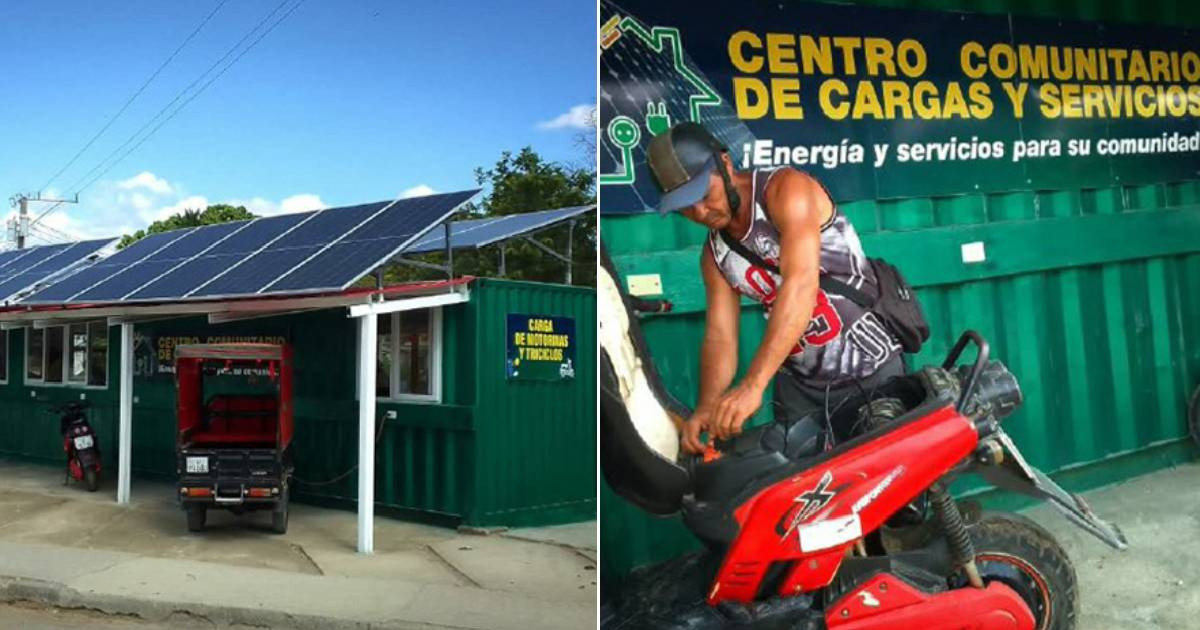
The province of Guantánamo has already established five community charging centers, colloquially known as "solineras," in the municipalities of Maisí, Imías, and the provincial capital. Plans are underway to expand this network to approximately 30 locations across the province.
These facilities are primarily set up in repurposed shipping containers, each equipped with a 400-watt solar panel kit, three inverters, and four 15-kilowatt batteries. This setup allows for charging services and food preparation during the extended power outages that frequently plague the region, as reported by the official newspaper Venceremos.
The first of these centers opened on July 25 in the provincial capital at the intersection of Crombet and Martí streets, managed by the private business Sabor Auténtico. A second location in the San Justo Popular Council began operations on August 12 and currently serves up to 50 people daily, according to the report.
Administrator Santiago Kindelán explained their pricing strategy. While charging an electric motorbike costs 300 pesos per hour and an Ecoflow 200 CUP, he noted, "We don’t charge for fans and lamps because we understand they might be essential for the sick, children, or the elderly—often vulnerable individuals we consider until they don't have to pay."
Beyond charging, these centers offer food cooking services using rice cookers and multipurpose appliances, refrigerated storage for perishable goods, takeout meals, coffee for 20 pesos, and a traditional stew called caldosa for 50 pesos.
Local resident Aida Limonta Lara appreciated the service, saying, "We come here to charge our phones and fans for free, which allows us to sleep comfortably. Anyone who wants can enjoy a coffee or hot chocolate, and they make a good caldosa."
Retiree Virgen Pérez also highlighted an added benefit. "Since the project started, I've been able to collect my pension twice here—an excellent idea for the community, saving us from long bank lines," she stated.
The initiative has moved faster than provincial authorities initially announced in early August when they planned to build around 15 stations in eight out of ten Popular Councils in the capital, with a joint investment from state companies and private micro-enterprises nearing 25 million pesos.
These efforts underscore the severe energy vulnerabilities in Guantánamo, a province reliant on a single 110-kilovolt transmission line from Santiago de Cuba to connect to the national grid. This vulnerability was starkly revealed in June when a fault in the line left the entire province without power, with some areas enduring up to 33 consecutive hours without electricity.
The "solinera" concept is spreading across various Cuban provinces as a decentralized response to Cuba's worst energy crisis in decades. Villa Clara now boasts 46 solineras across its 13 municipalities, prioritizing communities facing power cuts of 20 hours or more daily.
While the official narrative attributes these initiatives to coping with the U.S. embargo, it overlooks that most are operated by private micro-enterprises, not the state. The structural energy crisis is largely due to decades of government mismanagement and a heavy reliance on imported fuel.
Understanding Guantánamo's Solar Initiatives
What are solineras and why are they important?
Solineras are solar-powered community charging centers essential for providing electricity during frequent power outages in Cuba. They help residents charge devices, cook food, and store perishable goods.
How do solineras operate in Guantánamo?
Solineras in Guantánamo operate using solar panels, inverters, and batteries installed in modified shipping containers. They provide essential services like device charging and food preparation during power outages.
What challenges do Guantánamo residents face regarding energy?
Residents of Guantánamo face significant energy challenges due to reliance on a single transmission line from Santiago de Cuba, resulting in potential long periods without electricity during outages.