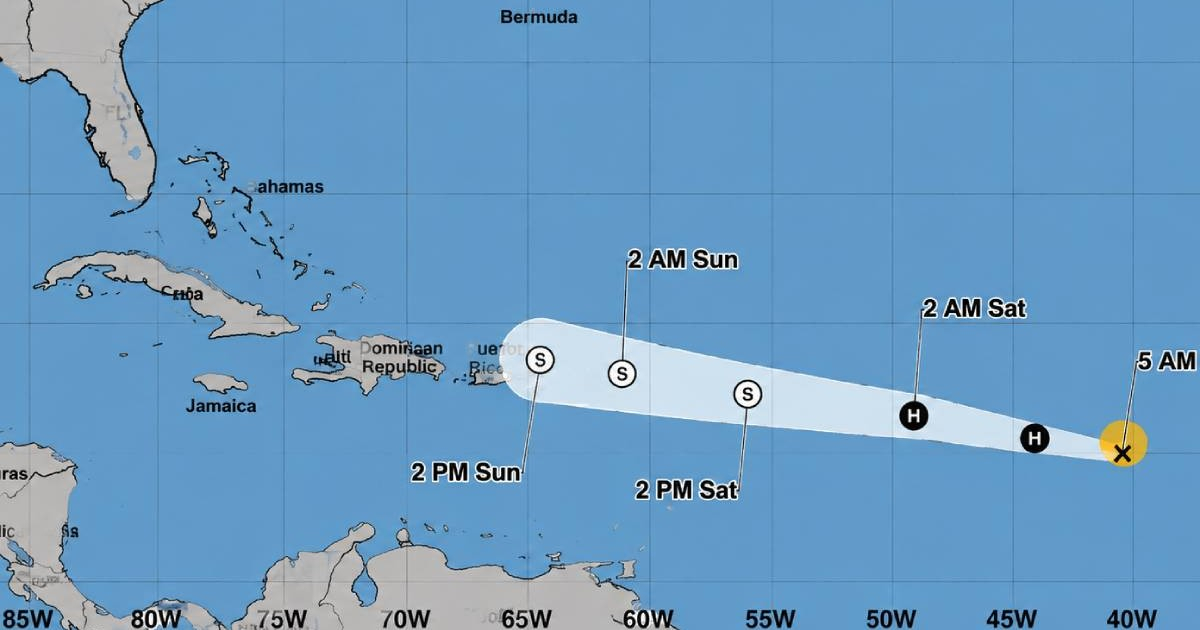
The tropical storm known as Dolly, the fourth named system of the 2026 Atlantic hurricane season, has weakened into an open tropical wave as of Friday. However, its potential threat is not entirely gone.
The National Hurricane Center (NHC) has issued a warning that the remnants of Dolly could bring heavy rainfall to the eastern Caribbean beginning Saturday.
According to the NHC's fifth advisory, released at 11:00 a.m. AST on Friday, August 28, Dolly's remnants were positioned near latitude 15.0 North and longitude 46.9 West, moving westward at approximately 25 mph (41 km/h).
This westward motion is expected to persist over the next 48 hours. The advisory confirmed the system's downgrade to a tropical wave, though its maximum sustained winds remain at 40 mph, anticipated to fall below tropical storm strength by Saturday, August 29.
Flooding Concerns for Elevated Areas
The primary concern lies in the potential for flash flooding. According to the NHC, these floods are likely to impact higher elevation areas most significantly. The Leeward Islands are expected to be the first to experience these conditions from Saturday night into Sunday, August 30, with possible spread to the Virgin Islands, Puerto Rico, and Hispaniola between Sunday and Monday.
Cuban meteorologist José Rubiera had already highlighted the system's potential impact on Thursday, aligning with the NHC's forecast of its probable weakening before reaching the Caribbean.
"It might not arrive here as a tropical storm but instead as a weaker entity, possibly a strong tropical wave," Rubiera remarked.
Stay Alert Despite Weakening
Despite its weakening, Rubiera emphasized the importance of vigilance: "Residents of the Lesser Antilles, especially in the northeast and to a lesser extent Puerto Rico, should pay close attention to this tropical system's developments, as it heads toward their region."
Dolly originated on Thursday, August 27, from the tropical wave 96L, which had a 90% chance of becoming a tropical cyclone just hours earlier. From its inception, the NHC noted that conditions were not conducive to significant strengthening, a prediction that was confirmed with its rapid downgrade within 24 hours.
Currently, forecasts do not indicate a direct threat to Cuba, but residents are advised to stay informed, as the Atlantic hurricane season extends until November 30.
The Cuban Institute of Meteorology (INSMET) had predicted in May a less active season than usual, with expectations of 11 tropical cyclones, including five hurricanes and two major hurricanes. They estimated a 75% chance that at least one tropical storm will affect the country during this period.
Understanding Tropical Storm Dolly's Impact
What is the current status of Tropical Storm Dolly?
Tropical Storm Dolly has weakened into an open tropical wave, but its remnants may still cause heavy rainfall in the eastern Caribbean.
Which areas are most at risk from Dolly's remnants?
The Leeward Islands, Virgin Islands, Puerto Rico, and Hispaniola are most at risk, particularly in higher elevation areas where flash flooding is a concern.
Is there a threat to Cuba from Dolly?
Currently, there is no direct threat to Cuba from Dolly, but residents should remain vigilant as the hurricane season continues.