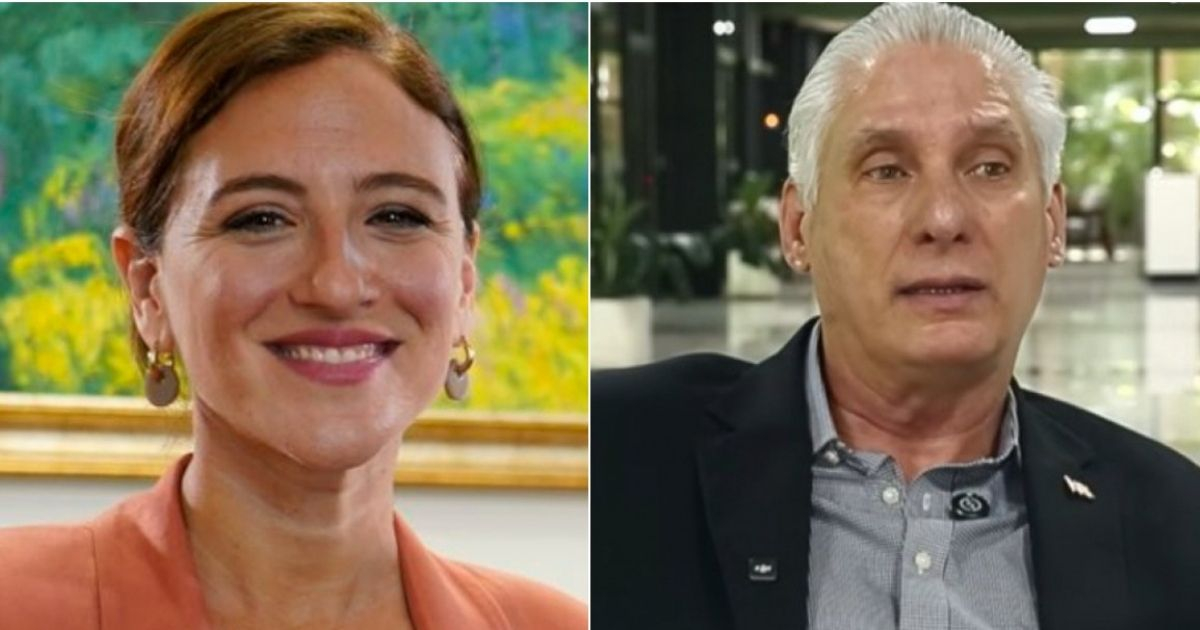
Argentine journalist Carolina Amoroso has openly challenged the narrative presented by Miguel Díaz-Canel, suggesting that the Cuban people's willingness to defend the revolution is far from the truth she observed while documenting life on the island. She encountered individuals who identify as revolutionaries yet express a desire for free elections.
During her appearance on Telemundo 51's "Virtual Encounter with Gloria Ordaz," Amoroso contradicted Díaz-Canel's statements made to the Brazilian newspaper Folha de São Paulo, where he claimed that "millions of Cubans" are willing to sacrifice their lives for the revolution and that the citizens would not allow a return to capitalism.
Amoroso, who works as a correspondent for TN and Canal 13, managed to enter Cuba as a tourist in late March to clandestinely film the documentary titled "Cuba: The Island That Fades." Her time on the island revealed a society pushed to its limits. "I don't recall meeting anyone who ate more than one meal a day," she shared with Gloria Ordaz, adding that for many Cubans, commuting to work seems illogical due to the high costs involved.
The Discrepancy Between Official Rhetoric and Reality
When asked if Díaz-Canel's recent comments align with what she witnessed in Cuba, Amoroso was unequivocal: "They don't match at all."
What struck Amoroso the most was the disconnect between the official discourse and the actual situation, even among those who support the government. "Even the most staunch Castro supporter I interviewed expressed a desire for elections, for Cubans to have the ability to choose their representatives. Imagine the urgency for change," she remarked.
However, the journalist acknowledged the difficulty in translating this urgency into collective action. "It's not because the need for profound change in Cuba isn't there, but because people are too focused on mere survival," she explained.
The Dire State of Havana
In May, Amoroso painted a grim picture of Havana, describing it as resembling a war-torn city, with numerous buildings reduced to rubble in the neighborhoods she visited.
This material collapse stands in stark contrast to Díaz-Canel's narrative of resilience. Although he denied to Folha de São Paulo that Cuba is on the brink of collapse, he did admit the situation is "extremely complex."
For Amoroso, this discrepancy highlights how the regime is "at odds with reality and truth," with its leaders not experiencing the same hardships as ordinary citizens.
Implications for Political Change in Venezuela
During the discussion, Amoroso extended her analysis to Venezuela, warning of the dangers of delaying political change in favor of those seeking to maintain power indefinitely. "These regimes are experts at buying time," she noted, urging the acceleration of any electoral timetable in the country. "They excel at creating illusions of economic openness. Demands for change must be made now," she asserted.
Understanding the Cuban Sociopolitical Landscape
What did Carolina Amoroso document about daily life in Cuba?
Amoroso documented a society on the brink, where many people struggle to afford more than one meal a day and find commuting to work too costly.
How does Amoroso describe the difference between Díaz-Canel's claims and Cuban reality?
Amoroso describes a significant gap between the official rhetoric of resilience and the dire conditions she witnessed, which include calls for free elections even from revolutionaries.
Why does Amoroso believe change is difficult in Cuba?
She believes the difficulty lies in the population's focus on survival, which hinders collective action despite the urgent need for change.