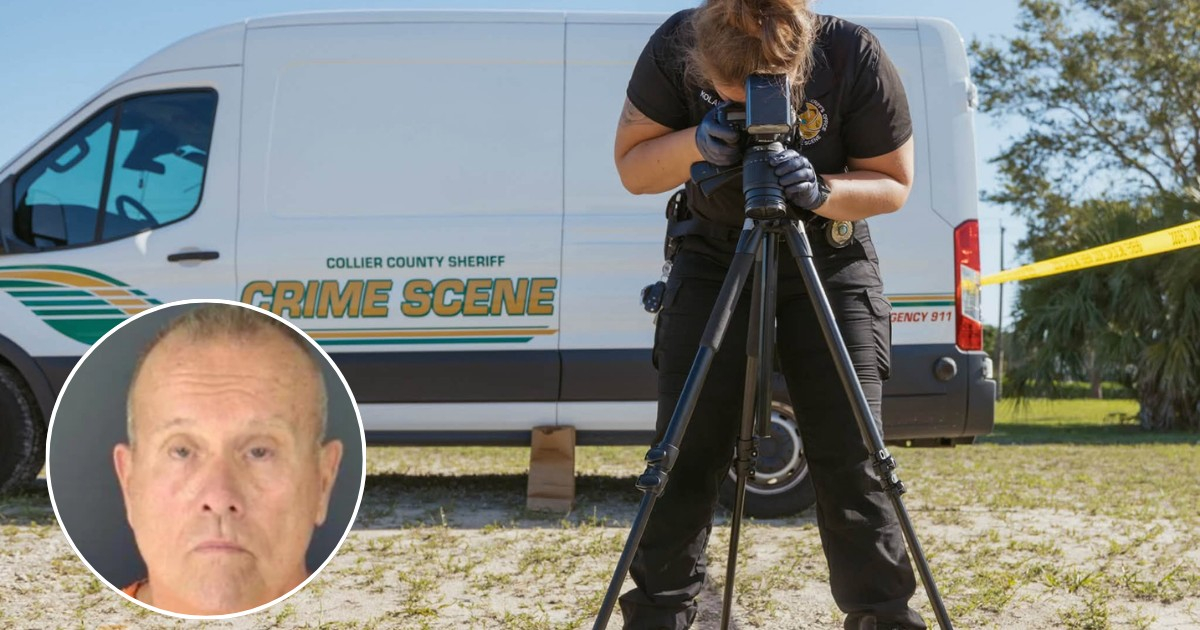
A fork used at an Arizona restaurant has led authorities to identify and arrest a 71-year-old man for a sexual assault committed 27 years ago in Florida.
Terry Lynn Denton was apprehended on Wednesday following a warrant issued by the Collier County Sheriff's Office (CCSO) for an alleged sexual assault that took place in 1999, as reported by CBS12.
The assault occurred on the night of June 2, 1999, when a woman was returning alone to her apartment in North Naples after enjoying a jazz performance at a club in Bonita Springs. As she opened her door, an unknown assailant grabbed her from behind, covered her mouth, and dragged her inside, where he sexually assaulted her before fleeing.
After the attack, the victim was examined at a hospital where specialists retrieved DNA from the perpetrator. However, the genetic profile did not match any in the FBI's CODIS database, leaving the case unresolved for decades.
Key Breakthrough from a Fork
The breakthrough came in August 2025 when investigators sent the evidence to a specialized lab to employ forensic genetic genealogy, a technique that merges genetic data with genealogical research to trace relatives of unknown suspects.
By February 2026, results narrowed down the investigation to two persons of interest, including Denton, who was located in Glendale, Arizona.
Detectives then coordinated a surveillance operation with the FBI. While Denton dined at a restaurant, federal agents waited until he left and collected several items he had used: a glass, a straw, a spoon, and a metal fork.
It was the fork that provided the crucial evidence.
On June 18, the Florida Department of Law Enforcement (FDLE) confirmed that the DNA obtained from the utensil matched the DNA collected from the forensic examination of the victim in 1999. According to investigators, it was over 700 billion times more likely that the genetic profile belonged to Denton than to an unrelated individual chosen at random.
Authorities later secured a court order to take a direct buccal swab from Denton. A subsequent analysis in July confirmed the match.
Legal Proceedings Await
Denton denied having lived in Collier County in 1999 when questioned by detectives. However, investigators discovered records of a Florida driver's license issued in 1998 with a Naples address, indicating he lived less than a mile from the victim at the time.
"For 27 years, the victim waited for answers," stated Sheriff Kevin Rambosk, highlighting the determination of the investigators and the collaboration with the FBI. The arrest marks the first time CCSO has resolved a case using forensic genetic genealogy, adding to the list of criminal cases in the United States solved decades later.
Denton remains in Sarasota County Jail, awaiting transfer to Collier County to face judicial proceedings.
Understanding Forensic Genetic Genealogy
What is forensic genetic genealogy?
Forensic genetic genealogy is a technique that combines DNA analysis with genealogical research. It helps trace familial connections of unknown suspects to solve criminal cases.
How did authorities identify Terry Lynn Denton?
Authorities used forensic genetic genealogy to narrow down suspects, leading them to Terry Lynn Denton. They confirmed his identity through DNA collected from a fork he used at a restaurant, which matched DNA from the 1999 crime scene.