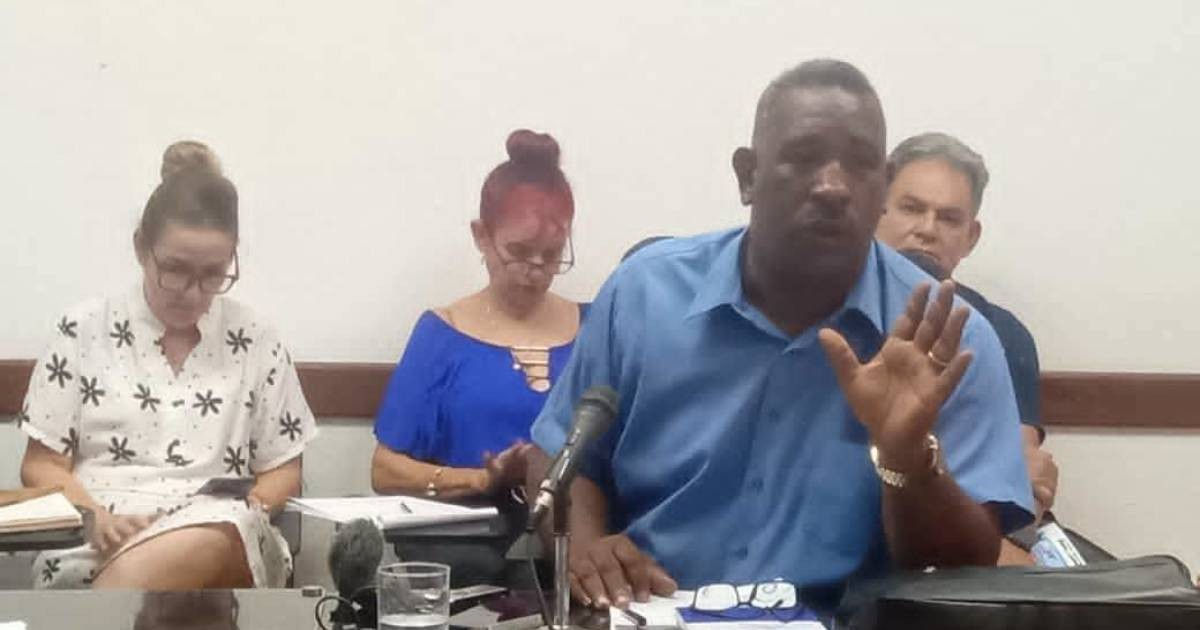
Walter Simón Noris, the first secretary of the Communist Party of Cuba (PCC) in Camagüey, has triggered a wave of criticism and mockery on social media after declaring that the commencement of the school year on September 1st represents a "blow to imperialism."
"No one can imagine the political impact we are dealing to Imperialism by starting classes this September 1st in #Camagüey," Noris posted on his Facebook profile.
He further claimed that "all available resources in the province will be devoted to the school year" to ensure educational quality.
Social Media Reacts to Political Rhetoric
This statement prompted numerous reactions contrasting the political rhetoric with the reality many children face as they begin school.
"All resources, he says, so basically, NOTHING," one user mocked. Another commented, "On the first day of school, kids probably won't have a glass of milk or a piece of bread for breakfast. Most likely, there won't be electricity at school either."
Critics also pointed to power outages, water scarcity, issues with school uniforms, and the high cost of purchasing shoes, backpacks, and school supplies for many families.
Challenges of the New School Year
In Nuevitas, school uniforms have yet to be distributed. "What should we do? Should we call on imperialism for a donation, as it seems to be the trend? Almost everything is coming from there," questioned another internet user.
The controversy arises just days before the start of a school year plagued by severe shortages. The Cuban educational system is short by at least 24,000 teachers, equating to 12.5% of the required positions.
Uniform shortages persist as well. Only 2.2 to 2.3 million pieces were produced for the start of the school year, compared to the 3.6 million needed.
The food crisis compounds the issue. According to the World Food Program, 48.5% of Cuban children aged six to 11 do not receive meals or snacks at school.
Impact of Energy and Economic Crisis
Power outages and fuel shortages will also impact classes. The previous school year ended early in numerous centers, and this new period will see universities adopting semi-presential or remote modalities.
This situation has led some Cuban mothers to declare they will not send their children to school unless there are minimum conditions of electricity, water, food, and rest.
One comment on Noris's post encapsulated the stark contrast his statement provoked: "When children can sleep comfortably, eat without limitations, and parents can buy shoes, backpacks, and supplies without relying on 'imperialism,' then you can speak with authority."
The controversy once again highlights the official rhetoric that frames everyday actions as political triumphs over the United States, while families struggle to meet their children's basic needs.
Understanding the Cuban School Year Controversy
Why did Walter Simón Noris's statement cause backlash?
Noris's statement was seen as out of touch with the reality faced by many Cuban families, who are struggling with shortages and basic needs, making his claim appear disingenuous.
What are the main challenges facing Cuban schools?
Cuban schools are dealing with significant teacher shortages, uniform deficiencies, food crises, and problems with power and fuel supplies, all of which impact the educational environment.
How are families coping with the school year start?
Many families face difficulties acquiring basic school necessities like uniforms and supplies, and some have expressed reluctance to send their children to school without adequate conditions.