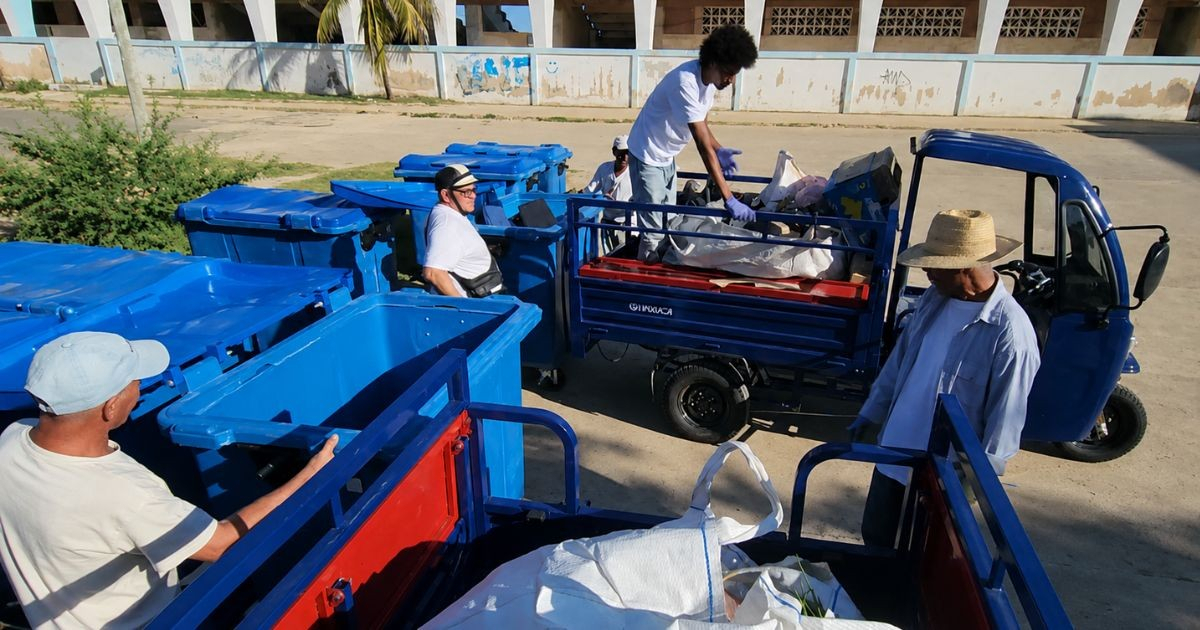
The initiative to collect garbage using electric tricycles in the Rampa Popular Council in Havana has not achieved its intended goals, according to admissions from the council's own president. He highlighted issues with charging the vehicles and delays in finding alternative solutions.
Pedro Lizardo Garcés Escalona acknowledged on Tuesday the challenges facing the local development project, El Rampeño. "Regrettably, the original idea and objective for collecting solid waste with electric tricycles have not been realized," he stated.
Among the reasons cited was the unfinished "solinera" at 23 and J, which was planned to supply energy to the electric vehicles. Garcés also mentioned "sluggishness in seeking alternatives" as a significant hurdle the project must overcome, particularly in light of the country's energy needs.
Although some institutions and workplaces have assisted by providing charging options for the tricycles, this help has not enabled the project to operate as initially envisioned. The vehicles were part of a donation led by the Central Committee of the Communist Party of Cuba and the central government for El Rampeño.
Less than two months following the pilot project launch in July, the official now concedes that the initial plan has yet to be fully implemented as intended. During a meeting with El Rampeño's leadership, attended by the municipal mayor, Garcés expressed hope that recent agreements will soon address the difficulties.
Despite the project's setbacks, Garcés claimed that the popular council is "mostly clean," though he admitted it is not yet at the "optimal" conditions he believes the residents deserve. He also attributed some hygiene issues to what he termed "social indiscipline," describing it as "a cancer slowly consuming us."
In this context, he specifically urged residents near areas such as 25 and G, 19 and J, 19 and I, 17 and L, 17 and M, Línea and J, Línea and M, 21 between L and M, 27 and N, and J at the corner of 27 to "increase vigilance and take action" against those littering.
Garcés affirmed there is "governmental intent" and commitment from the project to continue efforts, but he questioned the community's response in some zones.
"Nothing and no one will prevent our Rampa Popular Council from continuing its aim to be the cleanest, healthiest, and most beautified council in the capital of all Cubans," he concluded.
The initiative was initially introduced months ago, promising 30 electric tricycles to collect waste door-to-door in 14 districts, alongside a solar-powered charging station at 23 and J. From the start, residents expressed skepticism, with some reacting with "hopefully, it's true," given the persistent difficulties in waste collection across the capital.
In early July, the project's launch spurred criticism and irony on social media. At that time, only five of the planned 30 tricycles were available, leading one online commentator to summarize their reaction with the phrase, "Only country where garbage collection is news."
A few days later, a pilot test began with two daily routes, one at 7:00 a.m. and another at 8:00 p.m. The service introduced a monthly fee of 100 pesos per household and starting from 15,000 pesos for private businesses, microenterprise, and state entities, with exemptions for vulnerable individuals.
At that time, Garcés had positively assessed the initial results: "It has been an exercise that allowed us to make some adjustments, but initially, it worked very well," he had remarked.
Challenges and Future of Garbage Collection in Havana
What were the main obstacles faced by the electric tricycle project?
The project encountered significant challenges, including the unfinished solar charging station meant to power the tricycles and delays in finding alternative solutions to the energy problem.
How did the community respond to the garbage collection initiative?
The community's response was mixed, with some expressing skepticism and others questioning the effectiveness of the project due to persistent waste collection issues in Havana.
What is the future outlook for the Rampa Popular Council's cleanliness efforts?
Despite current difficulties, there is governmental intent and project commitment to continue efforts to improve cleanliness, though achieving optimal conditions remains a challenge.