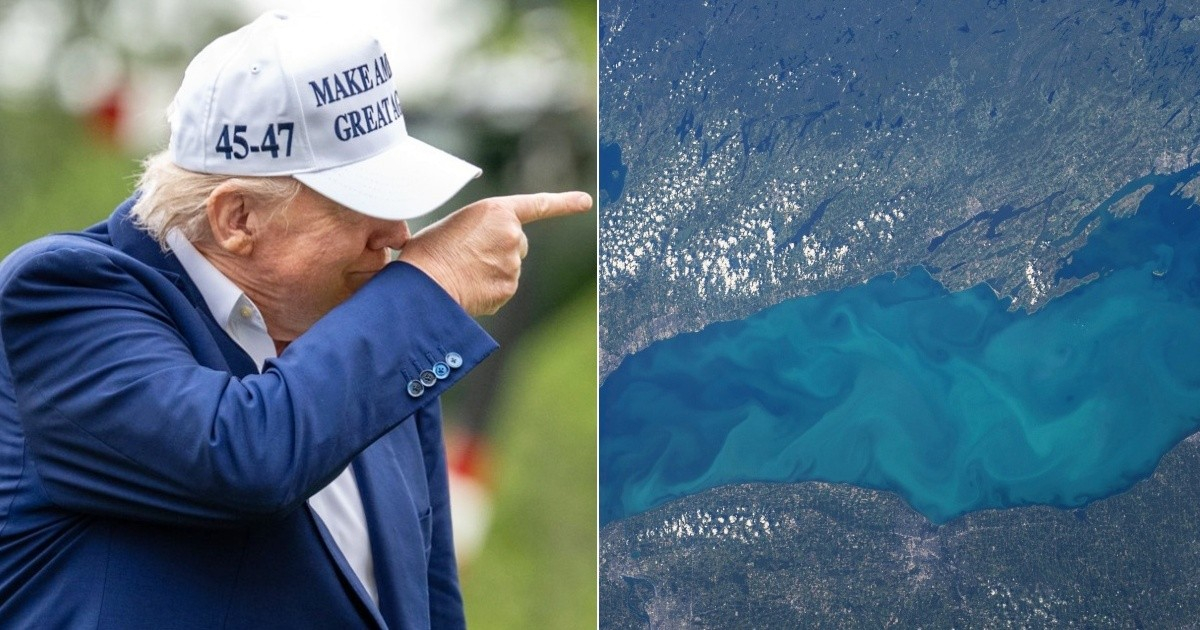
On Wednesday, Donald Trump intensified his threats to rename Lake Ontario as "Lake America," emphasizing that he was "not joking" amidst the most severe trade conflict between the United States and Canada in recent history.
Trump initially floated the idea on Tuesday via Truth Social, as reported by the Associated Press, showcasing an image where the lake's original name was crossed out and replaced with bold golden letters. His brief reasoning was, "The United States doesn't foresee much business with Ontario in the future."
Trump Doubles Down: "Maybe I Wasn't Joking"
During a conversation on Glenn Beck's radio show, the 80-year-old leader likened the renaming initiative to the Gulf of Mexico's rebranding: "People thought I was kidding. Maybe I wasn't, because the last they saw was the Gulf of Mexico; now it's the Gulf of America. So now we've got a Gulf and a lake."
In the same discussion, he dismissed concerns about the trade war harming the U.S.: "They don't have anything we need. It's time to show Canada they can't keep doing this."
Trade Tensions Escalate with Tit-for-Tat Tariffs
The suggestion follows the breakdown of bilateral talks on August 22, when Washington imposed a 50% tariff on Canadian imports valued at approximately $20 billion. Canada retaliated with equivalent measures on U.S. goods, effective September 8, alongside a $7.5 billion Canadian aid package for affected workers.
Canadian Reaction: From Dismissal to Direct Insults
Canada's Industry Minister Mélanie Joly was unequivocal: "We will always call it Lake Ontario. Period."
Ontario's Premier, Doug Ford, went further, previously labeling Trump a "dictator," "bully," and "king of bankruptcies." He dismissed the renaming proposal as "a lot of rhetoric" and asserted that Ontario would not "back down."
On the U.S. side, Malik Evans, the mayor of Rochester—the largest American city on the lake's shore—dismissed the notion outright: "I haven't given any thought to the president's latest publicity stunt. It's yet another attempt to distract the public from critical issues causing real harm to low- and middle-income consumers."
Historical Misstep: The Indigenous Origin of Lake Ontario’s Name
The proposal is also based on a historically inaccurate premise: Trump suggested the lake's name is derived from the Canadian province, whereas the truth is the opposite.
Daniel Macfarlane, a professor at Western Michigan University and a researcher of cross-border waters, clarified to WXXI News, "Ontario is an indigenous name. It's an anglicization of an Iroquois word meaning something like great lake, or shining and sparkling water."
The lake was named centuries before the province came into existence.
Macfarlane reacted with disbelief: "I laughed out loud and facepalmed... because it's simply ridiculous." He also noted that "the Canadian side of Lake Ontario far surpasses New York's in terms of population. The lake is significantly more important to Canada than to the United States."
Legally speaking, Trump could instruct federal agencies to adopt the new name—similar to what he did with the Gulf of Mexico in January 2025—but he lacks the authority to enforce this change on Canada or international organizations overseeing the lake.
The Economic Impact: Decline in Canadian Tourism
Beyond the symbolic gesture, the trade war has tangible repercussions. Researchers from the University of Toronto estimated a 42% drop in Canadian visits to U.S. metropolitan areas since Trump took office.
In Florida, Canadian tourism decreased by nearly 14% in the first half of 2026, while New York experienced a 26% decline in 2025.
"Our tourism economy cannot afford another year of trade wars with Canada that drive away our most important international visitors," warned Vijay Dandapani, president of the Hotel Association of New York City, emphasizing that Canada is the city's leading tourism partner.
Key Questions About the Lake Ontario Renaming Controversy
What prompted Trump to propose renaming Lake Ontario?
Trump proposed the renaming amid escalating trade tensions with Canada, suggesting the U.S. would not engage in much future business with Ontario.
How has Canada reacted to Trump's proposal?
Canada's officials have been dismissive, with strong statements from leaders like Doug Ford and Mélanie Joly condemning the proposal as rhetoric.
What are the historical origins of Lake Ontario's name?
Lake Ontario's name is derived from an indigenous Iroquois word, meaning great lake or shining water, pre-dating the Canadian province by centuries.
What economic impacts has the trade war had on tourism?
The trade war has led to a significant decrease in Canadian tourism to the U.S., with notable declines in states like Florida and New York.