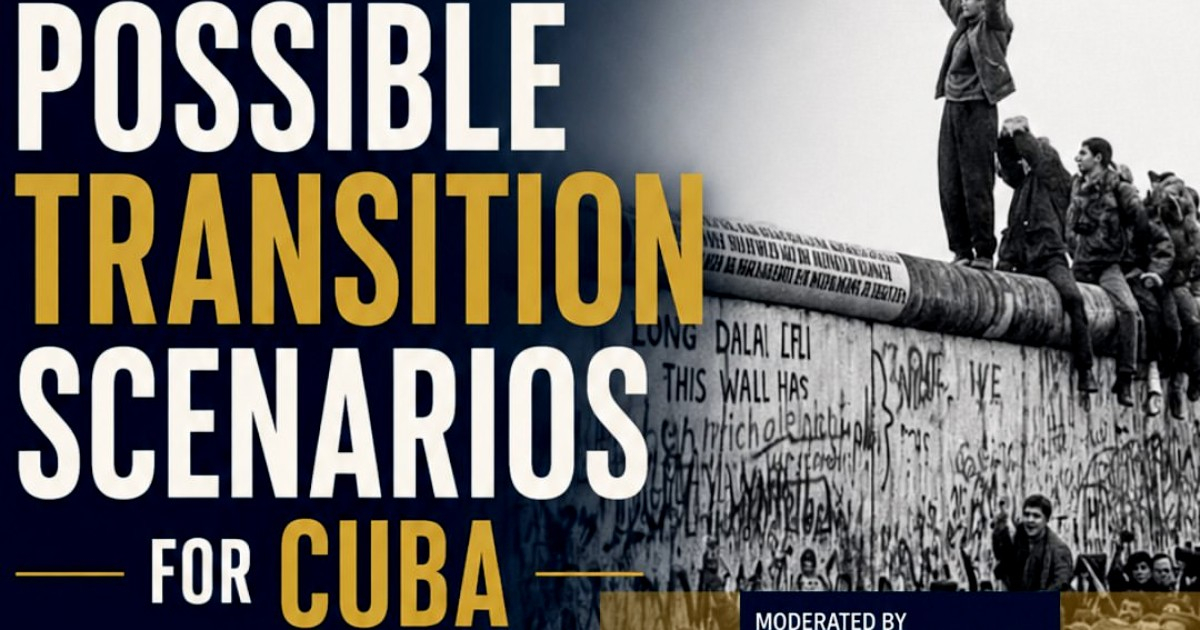
The Florida International University (FIU) is set to host a panel discussion this Friday focusing on the potential pathways for Cuba's transition amid unprecedented pressure from Washington on Havana.
This event, organized by the Cuban Studies Institute and the Jack D. Gordon Institute for Public Policy, is scheduled for August 28 at 7:00 PM at FIU's Modesto A. Maidique campus in Miami, specifically in room 102 of the SIPA II building.
The discussion will explore three primary avenues: negotiation, regime collapse, and military intervention. The official announcement characterizes the Cuban regime as being "on the brink of inevitable change" due to a combination of economic downfall, political legitimacy crisis, and the tightening of U.S. sanctions.
Key Figures in the Debate
Leading the conversation will be three panelists with diverse expertise. Carolina Barrero, founder and executive director of Citizenship and Freedom, recently relocated to Miami to pursue a Ph.D. in literary studies at the University of Miami. As an activist and art historian, she argues that the fall of the dictatorship alone does not ensure a consolidated democracy, emphasizing that civil society must play a role in any negotiations regarding Cuba's future.
Armando Chaguaceda Noriega, a political scientist and historian born in Havana in 1975 and residing in Mexico since 2008, serves as a researcher at Government and Political Analysis AC (GAPAC) and holds a Ph.D. in History and Regional Studies. An author of over 30 academic articles, he specializes in processes of autocratization in Cuba, Nicaragua, and Venezuela, describing the Cuban regime as a "party dictatorship." His analyses on Cuba's situation have gained prominence in academic discussions.
Brian Fonseca, FIU's Vice Provost of Research in National Defense and Security and Director of the Jack D. Gordon Institute, brings a national security perspective. In June, he co-authored an analysis titled "Cuba's Crisis: Four Near-Term Scenarios" with Liany Diaz Gonzalez, identifying four distinct paths: humanitarian intervention, limited coercive action, internal regime fracture, and negotiated concessions. The document warns that the judicial processing of Raúl Castro and five co-defendants "establishes a judicial framework that could be used to justify coercive measures, similar to those preceding the capture of Nicolás Maduro."
Context of Heightened U.S. Pressure
The panel will be moderated by Sebastián Arcos, Director of FIU's Cuban Studies Institute, a former Cuban political prisoner, and a veteran human rights activist who joined the university in 1995. The event takes place against the backdrop of significant pressure from the Trump administration on Havana. Between January and August 2026, Washington imposed over 240 new sanctions targeting Cuba, focusing on energy, finance, and the military conglomerate GAESA.
On May 1, Trump signed an executive order expanding those measures and introducing secondary sanctions against third parties dealing with sanctioned Cuban entities.
FIU is no stranger to leading such discussions. In February, it hosted the conference "Cuba: The Day After Tomorrow," where analysts presented five transition scenarios and estimated that immediate stabilization of the island would cost between $180 and $270 million in the first 180 days, with total recovery potentially reaching between $275 and $375 billion over 10 to 15 years.
The event is free and open to the public. Those interested in attending in person may email ics@fiu.edu or call (305) 348-1991 to confirm their attendance.
Fonseca succinctly captured the moment: "Cuba is at a decisive crossroads. The confluence of economic deterioration, growing social discontent, intensified U.S. pressure, and increased international scrutiny has created a new array of possible outcomes."
Understanding Cuba's Transition Scenarios
What are the main scenarios being discussed for Cuba's transition?
The main scenarios include negotiation, regime collapse, and military intervention.
Who are the key panelists involved in the discussion?
The panelists include Carolina Barrero, Armando Chaguaceda Noriega, and Brian Fonseca, who each bring diverse expertise to the discussion.
How has the Trump administration's policy impacted Cuba?
The Trump administration has imposed over 240 new sanctions targeting Cuba, focusing on energy, finance, and military sectors, significantly increasing pressure on the regime.