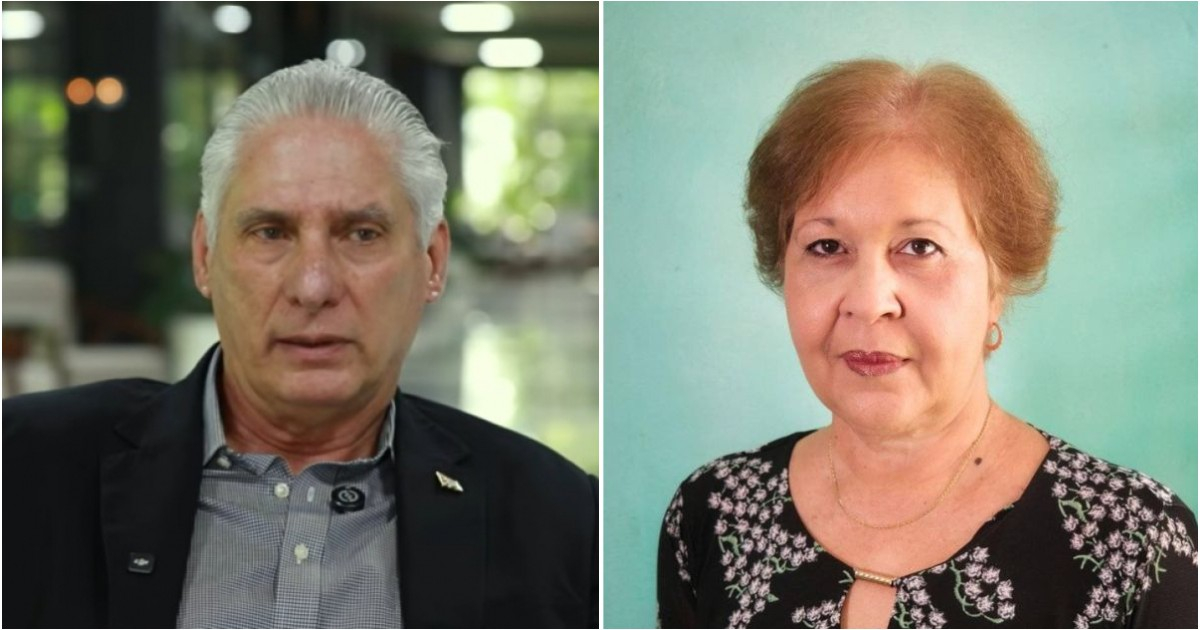
Renowned Cuban philosopher and historian Alina Bárbara López Hernández shared her thoughts on Facebook regarding an interview conducted by Brazilian journalist Mônica Bergamo with Miguel Díaz-Canel for the newspaper Folha de Sao Paulo. López Hernández believes the interview's greatest achievement was exposing the regime's unsolvable contradictions.
In her critique of Díaz-Canel, she was blunt: "There was nothing new: the same lack of oratory skills, charisma, and arguments; the same cynicism and arrogance; the same old lies, though now more brazen and infuriating. No amount of rhetoric can disguise such ineptitude."
López Hernández, a prominent intellectual from Matanzas, observed that Díaz-Canel "remained defensive throughout, displaying discomfort in both his verbal and non-verbal expressions." She contrasted this with his ease when speaking to sympathetic media like Russia Today or Al Jazeera, where he appears more relaxed. However, with the Brazilian reporter, he seemed "out of sorts."
According to López Hernández, Bergamo unsettled Díaz-Canel at two pivotal moments: when she bluntly stated that the embargo narrative as the primary cause of the crisis was unconvincing, and when she emphasized that the 176 economic measures, which include private banking and foreign investment, are capitalist in nature, contradicting the regime's socialist identity.
"By exposing this contradiction, she practically knocked him out," the activist noted.
The professor also highlighted a shift in the times: "During Fidel Castro's era, without the Internet, social media, or independent press, no journalist could have told the 'historic leader' that they had spoken with many people on the island, conducted research, and that the data didn't align."
In contrast, López Hernández remarked that today there is "a democratization of dissent," and for a journalist seeking truth, "all it takes is stepping onto the streets, observing, engaging with any citizen, and the truth emerges with the force of a category 5 hurricane."
She pointed out that Cuba has been a focal point in international media for five months since the Trump administration tightened the energy blockade, drawing journalists from Spain, France, Italy, Germany, the Netherlands, the United States, Mexico, and Colombia. Many arrived with preconceived notions that transformed upon witnessing that the crisis is "clearly longstanding" and stems from "serious internal economic, political, and social issues."
López Hernández, who has faced multiple arrests for attempting peaceful monthly protests in Matanzas, concluded with her thoughts on Bergamo's work: "Exposing that image is, in my view, the greatest success of the Brazilian journalist's interview for Folha de Sao Paulo, Brazil's second-largest newspaper."
Key Insights on Díaz-Canel's Interview and Cuba's Crisis
What did Alina Bárbara López Hernández think about Díaz-Canel's interview?
López Hernández criticized the interview, stating that it exposed Díaz-Canel's lack of oratory skills, charisma, and arguments, as well as his cynicism and arrogance. She found the lies more brazen and infuriating than before.
How did the interview reveal contradictions in the Cuban regime?
The interview highlighted contradictions by questioning the embargo narrative and pointing out the capitalist nature of recent economic measures, which contradict the regime's socialist identity.
Why has Cuba been a focus in international media recently?
Cuba has drawn international media attention due to the Trump administration's enhanced energy blockade, which has brought journalists from various countries to report on the longstanding and severe internal issues.