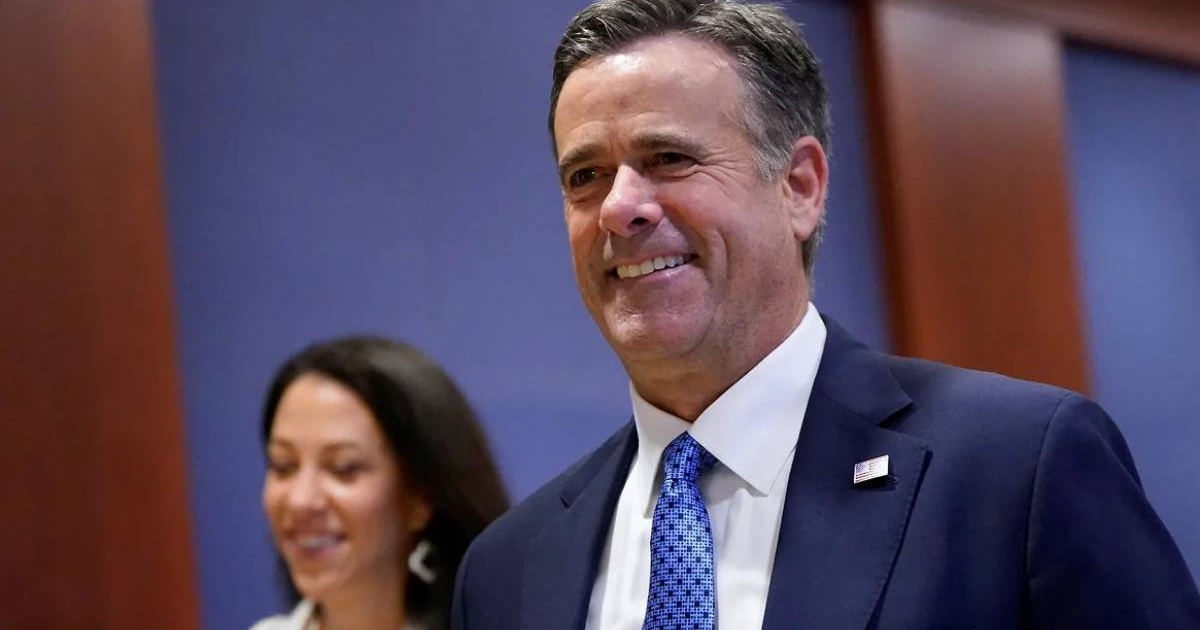
In a surprise move, John Ratcliffe, the head of the Central Intelligence Agency (CIA), traveled to Moscow on Tuesday for a series of unpublicized meetings with Russian officials. This unexpected visit was confirmed by a U.S. team member familiar with the journey, as reported by CNN.
The official refused to disclose the specifics or the agenda of the meetings, and the CIA has not issued any comments regarding the trip.
The presence of Ratcliffe in Russia was uncovered through the flight-tracking website Flightradar24, which recorded the landing of a U.S. military transport aircraft, a Boeing C-17 Globemaster III, at Moscow's Vnukovo International Airport early in the morning.
The flight reportedly originated from Joint Base Andrews in Maryland.
CBS News was the first to break the story about Ratcliffe's appearance in Russia, followed by other outlets such as Axios, Reuters, and CNN. None of these sources provided information on who the CIA director met with or confirmed if any meetings took place at the Kremlin.
The Kremlin's Reaction and Historical Context
Kremlin spokesperson Dmitri Peskov stated he was unaware of the aircraft's arrival or the visit itself, and mentioned that no meetings with U.S. representatives were scheduled for that week.
This marks Ratcliffe's first known visit to Russia since he assumed his role under President Donald Trump. Additionally, according to Reuters, it is the first known visit by a CIA director to Moscow since William Burns' meeting with Vladimir Putin in November 2021, which occurred during a period of heightened tensions preceding Russia's invasion of Ukraine.
Geopolitical Implications and Recent Developments
The trip coincides with stalled negotiations aimed at resolving the ongoing conflict between Russia and Ukraine, an effort driven by the Trump administration. Recently, Moscow has sent mixed signals: on August 14, Russian Foreign Minister Sergei Lavrov indicated that Russia would not refuse talks with U.S. envoys Steve Witkoff and Jared Kushner if they visited, while a senior Russian diplomat on August 21 suggested that Moscow was "open to listening to new proposals," provided they acknowledged "realities on the ground."
Ukrainian President Volodymyr Zelensky announced on August 11 that Ukraine had presented concrete proposals to U.S. negotiators to end the conflict with Moscow.
Broader Strategic Context and Previous Diplomatic Efforts
Ratcliffe's visit also comes a day after Treasury Secretary Scott Bessent unveiled "Operation Economic Outcast," a new sanctions strategy aimed at economically isolating Iran by pressuring countries and entities that continue to do business with Tehran. Russia, being a strategic trading partner of Iran, adds a layer of geopolitical complexity to Ratcliffe's presence in Moscow.
Having an active intelligence diplomacy profile, Ratcliffe visited Havana in May this year. This marked the first known visit by a CIA director to Cuba, where he met with officials from the Ministry of the Interior and conveyed a message from Trump linking any dialogue to "fundamental changes" by the Cuban regime. This visit to Havana was similarly detected through tracking of the official U.S. Air Force aircraft, a pattern now repeated with the Moscow trip.
The last time a CIA director visited Moscow, in November 2021, William Burns met with senior Kremlin officials and spoke with Putin by phone to warn about the consequences of a potential Ukraine invasion. Three months later, Russia launched its full-scale offensive.
Key Questions About Ratcliffe's Visit to Moscow
What was the purpose of John Ratcliffe's visit to Moscow?
The exact purpose of the visit has not been disclosed by the CIA or U.S. officials, and details of the meetings remain confidential.
How was Ratcliffe's trip to Moscow discovered?
The trip was discovered via Flightradar24, a flight-tracking website, which recorded the landing of a U.S. military aircraft in Moscow.
Has any CIA director visited Moscow recently before Ratcliffe?
The last known visit by a CIA director to Moscow was by William Burns in November 2021 during a period of increased tensions before the Russian invasion of Ukraine.
What is the significance of Ratcliffe's visit in the context of U.S.-Russia relations?
The visit is significant against the backdrop of stalled negotiations to end the Russia-Ukraine war and recent geopolitical tensions involving Iran, a close ally of Russia.