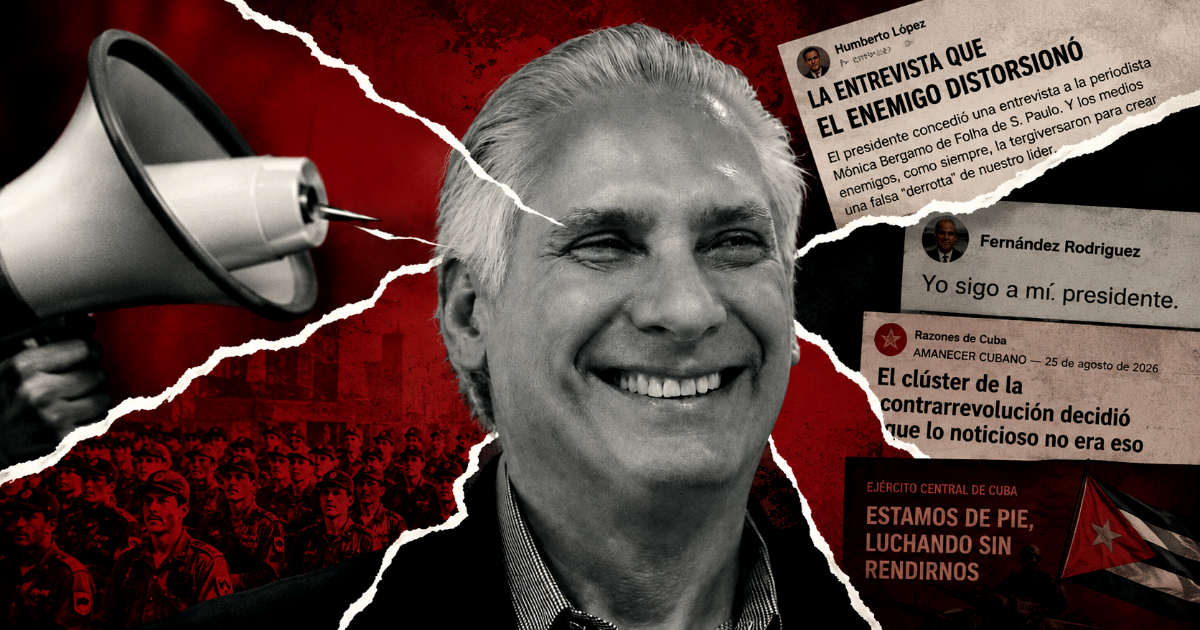
The recent interview between Miguel Díaz-Canel and Brazilian journalist Mônica Bergamo has triggered a familiar reaction from the Cuban regime: when the leader is faced with challenging questions, loyalists quickly emerge to claim that the issue lies not with his answers, but with those who heard, analyzed, or published them.
Since Tuesday, pro-government voices have been rallying to support Díaz-Canel, criticizing the coverage by independent media and journalists of the conversation published by Folha de S.Paulo.
State Media Defends the Narrative
Humberto López, a well-known presenter on state television and frequent defender of the regime, expressed one of the most direct responses. Under a headline encapsulating his message, "THE INTERVIEW THAT THE ENEMY TWISTED," López accused "enemy media" of distorting Díaz-Canel's words to fabricate a false "defeat" using "sensationalist headlines," "decontextualization," and "editorial judgments as news."
López specifically called out CubitaNOW and journalist Magdiel Jorge Castro, criticizing him for describing Díaz-Canel as "off-balance" and "dishonest."
"The president's interview was not a 'defeat.' It was a firm defense of Cuban sovereignty against a journalist trying to impose her narrative," López argued.
Diplomatic Echoes
Support for Díaz-Canel's position was echoed by Luis Mariano Fernández Rodríguez, Cuban ambassador to Syria, who shared López's defense on his Facebook profile.
The diplomat didn't stop at reposting López’s message. He later published his own statement, accompanied by a photograph of a young Díaz-Canel, portraying him as a man of "principle" and "the dignity of a patriot."
"I follow my president," wrote Fernández Rodríguez.
The ambassador used the defense of Díaz-Canel to launch an attack on former U.S. President Donald Trump, labeling him a "stupid dictator" and accusing him of bringing the world "to the brink of destruction" and of believing himself "the owner of the universe."
Official Platforms Join the Fray
The pro-government page Razones de Cuba also dedicated its "Amanecer Cubano" segment to reinterpret the interview’s impact.
Their argument was consistent: the issue wasn't what Díaz-Canel said, but what the media chose to highlight. "The counter-revolutionary cluster decided that the news wasn't that," the publication stated, criticizing the focus on "the President's face," his silences, and moments like when Lis Cuesta adjusted his hair with saliva before the interview.
"When you can't refute the argument, you attack the gesture. When the political response is uncomfortable, you editorialize the face that says it," the text concluded, arguing that such coverage "is not journalism."
Analyzing Díaz-Canel's Statements
Media like CiberCuba didn't just focus on gestures or close-ups in their coverage. They extensively reported Díaz-Canel's statements on key issues facing Cuba.
For instance, Díaz-Canel defended the single-party system, rejecting the notion that political pluralism is a democratic necessity. He questioned Bergamo if she genuinely believed multiple parties equate to more democracy, asserting that the Communist Party exists to "lead the Revolution," even if it isn't an official electoral party.
He also denied that Cuba is on the brink of collapse, despite acknowledging severe issues: prolonged blackouts, fuel shortages, a lack of medicines, and significant economic hardships. When the "internal blockade" was mentioned, he again pointed to external factors as the crisis's main cause.
On economic matters, Díaz-Canel dismissed suggestions that expanding private business spaces equated to capitalist reforms. This stance drew criticism, including from comedian Ulises Toirac, who questioned why an economic policy's value should be assessed by its ideological label rather than its outcomes.
Military Voices Support
Adding to the media defenses, the Cuban Central Army publicly stated that the Armed Forces "embrace these statements as their own."
The military leadership shared an image from the Ministry of the Revolutionary Armed Forces featuring Díaz-Canel with the slogan "We stand firm, fighting without surrender."
"The stance taken by comrade Miguel Díaz-Canel Bermúdez is not an isolated gesture: it reaffirms that Cuba does not negotiate its dignity or self-determination," declared the Central Army.
The military's message did not directly criticize the media covering the interview but rounded out a day in which various state and pro-government voices felt compelled to publicly defend the leader's actions.
A Familiar Reflex
It's unclear if these publications are part of a coordinated effort, nor is it necessary to suggest so to observe the phenomenon.
The evidence is straightforward: following an interview by a foreign journalist that generated uncomfortable headlines for Díaz-Canel, familiar figures from state television, a propaganda platform, an ambassador, and a military entity all stepped forward to defend the leader or his statements.
Much of the defense falls back on a well-worn formula: the U.S. as the primary cause of the crisis, independent media labeled as "enemies," and criticisms of the leader framed as manipulation.
Perhaps one of the paradoxes of this reaction is that if the interview truly demonstrated the strength and clarity described by its defenders, it shouldn't require numerous subsequent interpretations.
The conversation with Mônica Bergamo is available to the public. The questions are there. So are Díaz-Canel's responses.
Understanding the Reaction to Díaz-Canel's Interview
Why did the Cuban regime defend Díaz-Canel after the interview?
The Cuban regime defended Díaz-Canel to counteract what it perceived as distortion and misrepresentation of his statements by independent media, portraying coverage as manipulation by "enemy media."
What did Díaz-Canel say about Cuba's political system?
Díaz-Canel defended Cuba's single-party system, arguing that political pluralism is not a requirement for democracy and that the Communist Party's role is to lead the Revolution.
How did Díaz-Canel address Cuba's economic challenges?
Despite acknowledging severe economic issues, Díaz-Canel denied that Cuba is on the verge of collapse and attributed the crisis primarily to external factors, rejecting the notion of capitalist reforms.