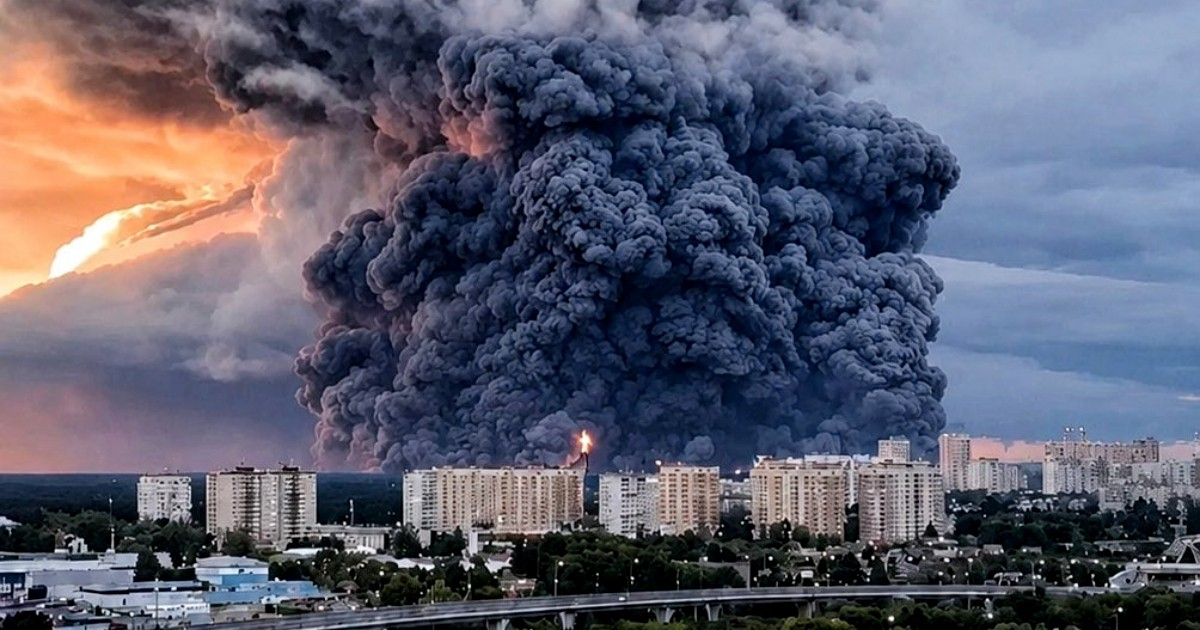
Russian President Vladimir Putin has enacted a decree allowing the Russian government to temporarily take over critical private infrastructure if owners fail to defend it from Ukrainian drone attacks or refuse to rebuild after such strikes, as reported by the Associated Press.
This move, announced on Monday, underscores the significant impact the war is having on the Russian economy.
The directive targets key sectors including energy, fuel, electricity, industry, communications, transportation, logistics, and public services. Its potential reach is vast, from oil refineries frequently bombarded to major e-commerce entities like Wildberries and Ozon, whose warehouses have been systematically targeted by Ukrainian drones.
The Kremlin has attempted to downplay the significance of this measure. Deputy Prime Minister Denis Manturov explained that it is not a nationalization or change in ownership, but rather "state involvement in the management of a company to address specific security challenges."
Strategic Sectors Under Threat
He emphasized that this mechanism is not intended for widespread use, stating that selective and carefully considered decisions will be made at the highest level.
However, presidential spokesperson Dmitry Peskov hinted at the underlying pressure of the decree, noting that "often, company owners do not pay enough attention to taking measures to ensure security, especially against drones."
Russian political analyst Abbas Gallyamov, a former speechwriter for Putin, interpreted this as a veiled ultimatum. On his Telegram channel, he noted that owners of refineries hit multiple times are reluctant to invest in repairs due to the risk of future attacks: "Why spend billions if they’ll just attack again tomorrow?" His conclusion was blunt: the government is effectively saying, "If you don't fund the restoration of the refineries, we'll take them over."
Economic Pressure Intensifies
The strain on the Russian economy is both real and escalating. Ukrainian attacks on Russian refineries have drastically reduced hydrocarbon revenues, which plummeted by 45.4% in the first quarter of 2026. The federal deficit surpassed the full-year target during the same period.
In the early hours of Tuesday, Ukrainian forces struck the Afipsky refinery in the Krasnodar region, which had previously been hit in June and July, causing a fire. That same night, the Novoshakhtinsk refinery in Rostov was forced to halt operations following another attack.
The decree is part of a rapid trend of renationalization that reached unprecedented levels in the first half of 2026. According to the agency AK&M, the Russian state seized assets worth $10.16 billion in 15 cases, accounting for 42.2% of the entire mergers and acquisitions market during that period, nearly matching the total for all of 2025. The largest transaction was the transfer of the Rusagro agro-industrial holding, valued at $7.7 billion.
A Broader Strategy of Control
Putin admitted on state television days ago that Moscow "must and will improve the air defense system and strengthen its capabilities," urging for "faster coordination between defense, law enforcement, and civil agencies at all levels."
With this new decree, such coordination may lead to the government taking the reins of private companies that, faced with relentless Ukrainian drone campaigns, choose not to risk their capital on repairs that could be undone overnight.
Understanding Russia's Economic Challenges Amidst Conflict
What sectors are affected by Putin's decree on infrastructure control?
The decree affects strategic sectors such as energy, fuel, electricity, industry, communications, transportation, logistics, and public services.
Why is the Russian government taking control of private companies?
The Russian government is assuming control to address specific security issues, particularly those arising from Ukrainian drone attacks, and to ensure the restoration and protection of critical infrastructure.
How have Ukrainian drone attacks impacted the Russian economy?
Ukrainian drone attacks have significantly reduced revenues from hydrocarbons, contributing to a 45.4% decline in the first quarter of 2026 and a federal deficit that surpassed the annual target.