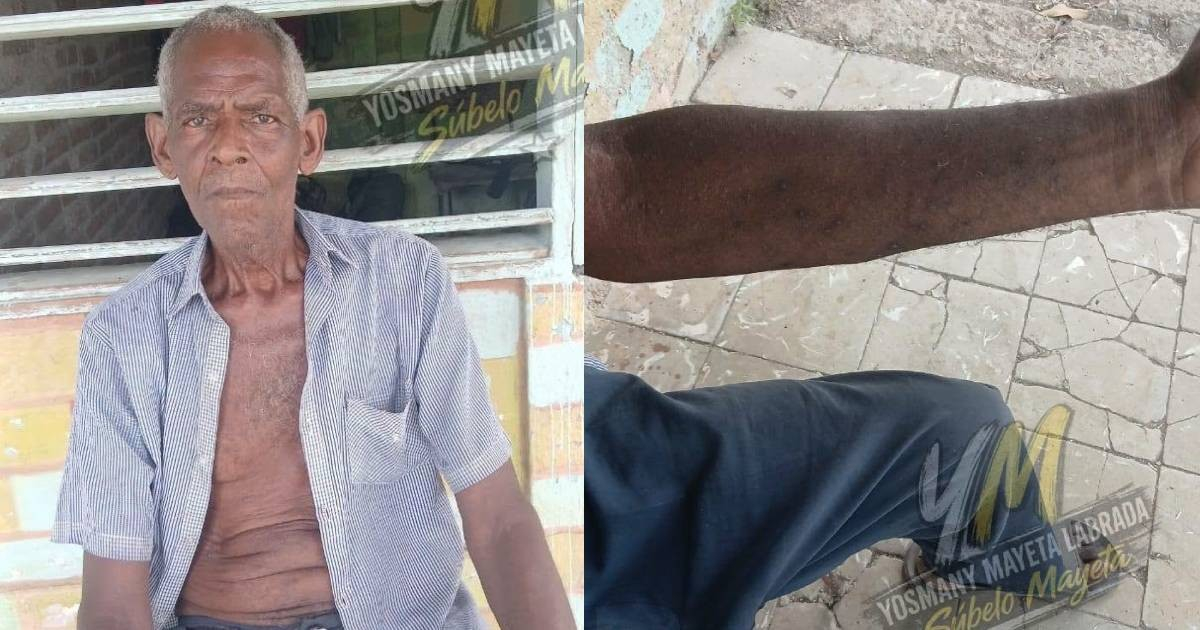
Independent journalist Yosmany Mayeta Labrada revealed on Monday a troubling situation faced by his elderly father in Santiago de Cuba. After being prescribed several medications that were unavailable in state-run pharmacies, he was advised to find them through unofficial channels.
"Find it on the outside," was the stark advice given to Agustín Mayeta Pérez during his medical consultation, according to his son's post on Facebook.
Struggles with Medication Availability
Yosmany explained that his father visited the doctor seeking solutions for his health issues. However, instead of a thorough examination, he received prescriptions for stomach issues and a scabies treatment, including Permetrina, Cimetidina, and Buscapina, as outlined in the handwritten prescription shared online.
The real challenge emerged when it came to acquiring these drugs: they were nowhere to be found in the official system, and the suggested alternative was to search for them "on the outside."
High Costs in the Informal Market
Mayeta pointed out that while some medications could be sourced from the black market, the costs are exorbitantly high, especially for an elderly person reliant on Cuban pesos.
"Is this the medical powerhouse that is so often touted?" he questioned.
Widespread Drug Shortages
This complaint highlights a dire situation acknowledged by the Cuban government itself. This month, Miguel Díaz-Canel confessed that only about 30% of the essential medicines are available in the country.
The scarcity is even more pronounced in certain regions. In Ciego de Ávila, mid-August reports indicated a mere 10% availability, while in Villa Clara, 368 out of 636 essential drugs were missing.
Infrastructure Challenges and Public Outcry
Compounding the drug shortage is the decline of healthcare facilities. In Santiago de Cuba, the Juan Bruno Zayas Hospital has faced complaints about critical sanitary conditions, lack of supplies, rat infestations in the Perinatology department, and even a bedbug problem so severe that a nurse resorted to setting a chair on fire.
Mayeta has publicly called on the Santiago de Cuba General Health Directorate, Social Workers, and the Communist Party authorities to ensure care for his father.
Yet, he emphasized that his complaint extends beyond a personal issue.
"Today, I speak out because it's my father, but there are thousands more—parents, grandparents, children, men, and women in Cuba—who endure similar hardships, awaiting proper consultations, diagnostics, medications, or simply humane treatment," he expressed.
"I’m not seeking special treatment for my father. I’m advocating for a right that should be afforded to every Cuban upon entering a health institution," he added.
Mayeta concluded with a poignant message capturing the essence of his grievance: "Today, I raise my voice for him because he is my father. Tomorrow, it could be anyone's father. His health cannot wait."
Understanding Cuba's Healthcare Crisis
What is the current situation of medication availability in Cuba?
Currently, only about 30% of the essential medications are available in Cuba, with some regions experiencing even greater shortages.
How are Cubans managing to obtain necessary medications?
Many Cubans resort to the informal market to obtain necessary medications, although this often comes at a high cost that is unaffordable for many.
What other challenges are affecting the healthcare system in Cuba?
In addition to medication shortages, the healthcare system is also struggling with deteriorating infrastructure and insufficient sanitary conditions in hospitals.