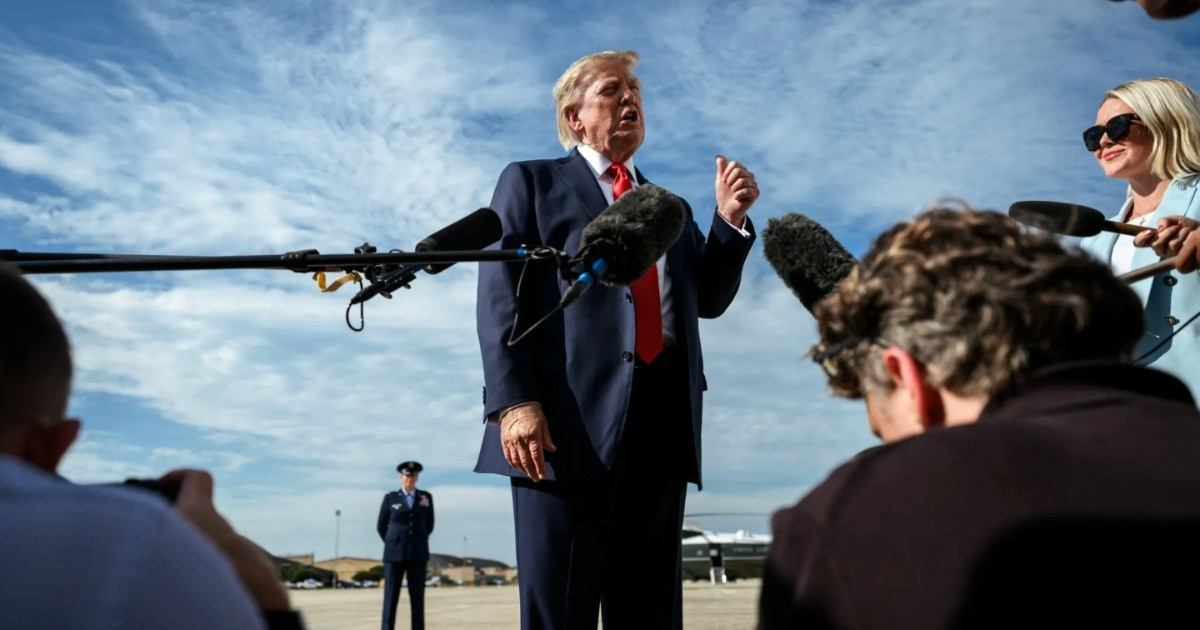
On Monday, Donald Trump took to his Truth Social platform to assert that "Iran is completely collapsing!" as the U.S. administration unveiled a stringent new set of economic sanctions against Tehran. This comes as the ongoing conflict approaches its six-month mark.
U.S. Treasury Secretary Scott Bessent described the measures as "the largest financial offensive ever launched against an adversary," according to EFE.
"The President has orchestrated a strategy to mobilize every agency and deploy all tools at our disposal that many thought we would never use. Our aim is to sever every economic lifeline sustaining the tyrannical regime, leaving Tehran entirely isolated," Bessent stated.
The President's comments coincide with Washington's intensifying pressure on the Islamic Republic to end the conflict and reopen the Strait of Hormuz, a key artery for global oil commerce.
The conflict began on February 28, 2026, with joint U.S.-Israeli aerial strikes on Iran. In retaliation, Tehran sealed off the Strait of Hormuz, slashing naval traffic by 97%, stranding nearly 2,000 ships and 20,000 sailors, and sending Brent crude oil prices soaring from $67 to over $126 per barrel.
In April, the U.S. imposed a naval blockade on Iranian ports, lasting until mid-June when Trump announced a deal with Tehran and lifted the blockade. However, the agreement unraveled by July, prompting U.S. forces to resume the blockade and attacks.
By August, oil flow through Hormuz had plummeted from approximately 20 million barrels per day to estimates between eight and 12 million, with 80% of recent traffic classified as "dark," meaning unidentifiable. On August 15, only two vessels navigated the strait in an entire day, compared to the pre-war daily average of 130 to 140 ships.
Financial Offensive Intensifies
Leading the financial assault, Secretary Bessent characterized the strategy as a "1-2 punch": a naval blockade coupled with unprecedented financial sanctions. In mid-August, he vowed "never-before-seen" measures against Iran, and on August 20, announced what he dubbed "the toughest sanctions in history," targeting oil smuggling, currency transfers, exchange houses, ship registries, and shell companies.
On the same day, Bessent urged China to join the economic pressure against Tehran, while Trump warned of "huge economic consequences" for any nation continuing to offer vital assistance to the Iranian regime.
The legislative backing for the offensive arrived on August 7, when the U.S. Senate passed the Lindsey O. Graham Iran and Russia Sanctions Act of 2026 by a vote of 86 to 11, extending sanctions on Iran's energy and military sectors through 2031.
This economic strategy has deeper roots: In January 2026, Trump announced a 25% tariff on any nation trading with Iran, formalized by executive order in February. On August 20, the administration publicly unveiled "Operation Economic Fury," active since April, as "the most crushing economic operation ever undertaken against any country."
In response, Iran has stipulated that any reopening of the strait is contingent upon the end of the U.S. naval blockade, perpetuating the stalemate as maritime traffic in Hormuz remains nearly at a standstill and economic pressure on Tehran reaches unparalleled levels.
Understanding the Impact of U.S. Sanctions on Iran
What are the new sanctions against Iran?
The new sanctions target oil smuggling, currency transfers, exchange houses, ship registries, and shell companies in an effort to isolate Tehran economically.
How has Iran responded to the sanctions?
Iran has insisted that it will only reopen the Strait of Hormuz if the U.S. lifts its naval blockade, maintaining a firm stance amidst the economic pressure.
What is the significance of the Strait of Hormuz?
The Strait of Hormuz is a crucial passage for global oil shipments, and its closure has severely impacted maritime traffic and oil prices worldwide.