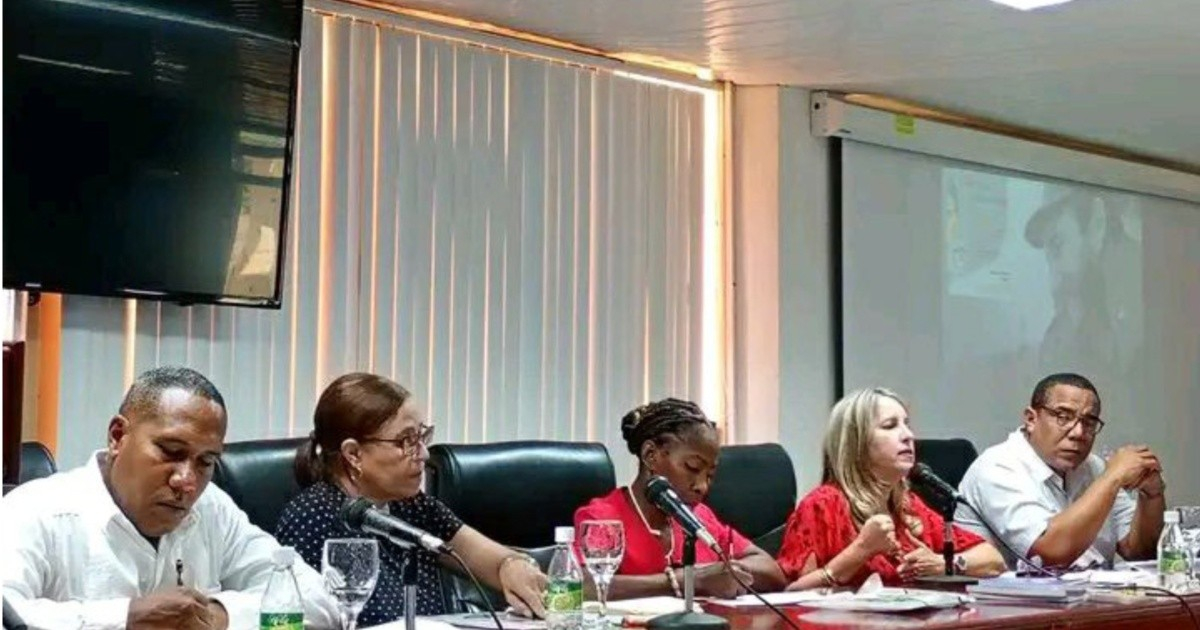
Naima Ariatne Trujillo Barreto, Cuba’s Minister of Education, paid a visit to the province of Guantánamo this past Sunday to oversee preparations for the 2026-2027 academic year. She announced to state media that the start of classes on September 1st will be a "grand celebration in Cuba."
Accompanying her were Yoel Pérez García, the First Secretary of the Communist Party in the province, and Alis Azahares Torreblanca, the governor, as they toured the 10 municipalities in the easternmost region of the island.
Despite acknowledging that the nation is in a "challenging situation," Trujillo Barreto expressed confidence that educational needs for children and teens will be met "in line with the reality of each institution and community."
Antonio Tamayo Romero, the General Director of Education in Guantánamo, stated that over 79,000 students will commence the new academic year in 818 educational institutions, with a teaching staff coverage of 93%—a figure he identified as a major challenge.
The minister highlighted that five educational institutions in the province have completed their energy matrix transition, and work is ongoing on 35 additional projects. She noted a "favorable" situation regarding the distribution of uniforms for initial grades, although some are still in the process of being sold.
The official optimism starkly contrasts with the reality Cuban families face. Nationally, Trujillo Barreto admitted days earlier that only 20% of students will have new uniforms at the start of the school year, as production reached only 2.2 to 2.3 million garments of the 3.6 million needed.
The educational system also suffers from a structural deficit of at least 24,000 teachers, equivalent to 12.5% of the planned positions, due to migration and low salaries.
A teacher from Urbano Noris, Holguín, publicly complained that educators in that municipality have not received their salaries since May 2026—over three months without pay—despite a government-approved salary update in July, with ranges from 6,130 to 7,735 Cuban pesos monthly.
School meals add another layer of hardship: the World Food Program reports that 48.5% of Cuban students aged six to eleven receive no food or snacks at school. Providing breakfast and snacks for a child can exceed 10,000 pesos monthly for families.
The previous school year ended early, between June 15 and 30, due to fuel shortages and prolonged blackouts, leading the government to cancel entrance exams for higher education and send 7,879 scholarship students back to their municipalities.
In this context, Cuban mothers have warned on social media that they will not send their children to school if minimum conditions are not met. "My kids are just children; they shouldn't have to make any sacrifices. If there's no electricity, they won't go; if there's no snack, they won't go; if there's no water, they won't go; if there's no uniform, they won't go," one mother wrote.
While the minister called for September 1st to be celebrated as a "day of festivity," another internet user summed up the situation with a widely shared phrase: "In this country, the abnormal is normalized."
Challenges Facing Cuban Education System
What is the current teacher deficit in Cuba?
Cuba is currently facing a structural deficit of at least 24,000 teachers, which represents 12.5% of the planned teaching positions.
How many students will start the new school year in Guantánamo?
Over 79,000 students are expected to begin the new academic year in 818 educational institutions in Guantánamo.
What percentage of students will have new uniforms for the school year?
Only 20% of the student body will have new uniforms at the start of the school year, as production fell short of the necessary 3.6 million garments.