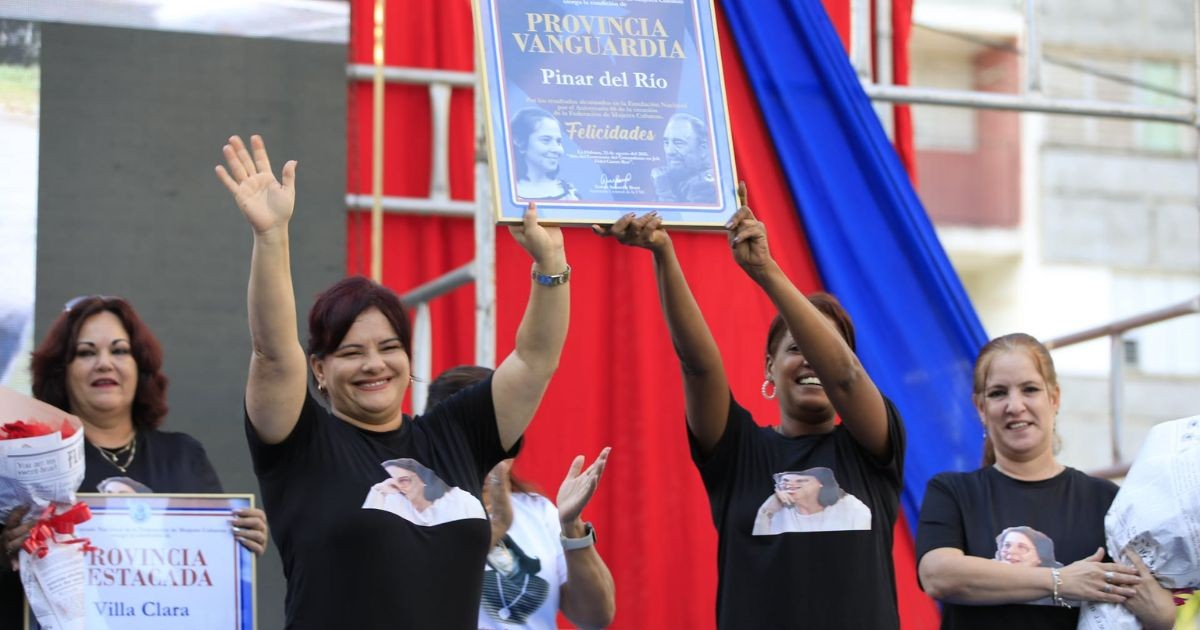
On Sunday, the Federation of Cuban Women (FMC) marked its 66th anniversary with a national ceremony held in the Hermanos Cruz district of Pinar del Río. The official narrative was rich with euphemisms, as the provincial Electric Company declared on Facebook that Cuban women are a "bastion of love, an example of dignity, and a constant inspiration for the nation," using the hashtag #PinarForNewVictories. Ironically, this is the same company managing the power outages that plague the province.
The irony was not lost on the public. One internet user mocked the official title—"Cuba's strength and heart have a woman's face!"—with a more biting take: "Cuba's strength and heart have the face of a blackout." Another commenter labeled the post as "the epitome of absurdity."
Official media outlet Periódico Guerrillero reported that the event was led by Teresa Amarelle Boué, a member of the Communist Party's Political Bureau and FMC's general secretary. She invoked the legacy of notable women from Pinar del Río, such as Isabel Rubio, Adela Azcuy, and Magdalena Peñarredondo, asserting that these 66 years have seen Cuban women transition from spectators to actors in their own stories.
Cuban Women's Struggles Amidst Official Celebrations
While they are indeed central figures, Cuban women continue to face challenges like lack of water, medicine, and frequent blackouts. Amarelle Boué highlighted their majority presence in sectors such as Education, Health, and Science. However, she also conceded in an interview with state-run Prensa Latina that some initiatives to support vulnerable women "could not be fulfilled due to budget and resource constraints," and gender violence counseling services are ineffective in several municipalities.
With unusual candor for the celebratory tone, she admitted, "It's not just the blackout; when there's a blackout, there's no water either." The FMC's proposed solution is to teach women to "escape" vulnerability through family agriculture, sewing brigades, and food preservation.
Harsh Reality Behind Official Rhetoric
What the regime failed to highlight during the official ceremony is that about 70% of essential medications are missing from pharmacies as of 2026, due to decades of state neglect and lack of investment in the healthcare sector.
Pinar del Río was recognized as a "National Vanguard Province" in the FMC's competition, with Artemisa, Matanzas, Cienfuegos, and Villa Clara also receiving accolades. Last Thursday, President Miguel Díaz-Canel led a ceremony awarding distinguished women—based on regime criteria—with titles like Heroine of Labor and the Mariana Grajales Order, which also faced ridicule on social media.
The reality for Cuban women, trapped between power outages and water shortages, starkly contrasts with the official narrative. By 2026, Cuba has experienced seven complete collapses of the National Electric System, causing power cuts exceeding 2,000 MW and outages lasting more than 20 hours daily, often extending beyond two consecutive days in some provinces.
The Alas Tensas Gender Observatory documented 44 femicides by July 27, 2026, up from 18 in the same period in 2025, with a total of 359 cases since 2019—a statistic that no FMC award can obscure.
Frequently Asked Questions About Cuban Women's Struggles
What is the current status of essential medications in Cuba?
As of 2026, approximately 70% of essential medications are unavailable in Cuban pharmacies, due to long-term state neglect and insufficient investment in the healthcare sector.
How frequent are power outages in Cuba?
In 2026, Cuba has experienced seven total collapses of the National Electric System, resulting in power outages exceeding 20 hours daily, often lasting more than two days consecutively in some areas.
What initiatives are proposed to help Cuban women in vulnerable situations?
The FMC suggests that women can overcome vulnerability through family agriculture, sewing brigades, and food preservation, although implementation is hindered by resource and budget constraints.