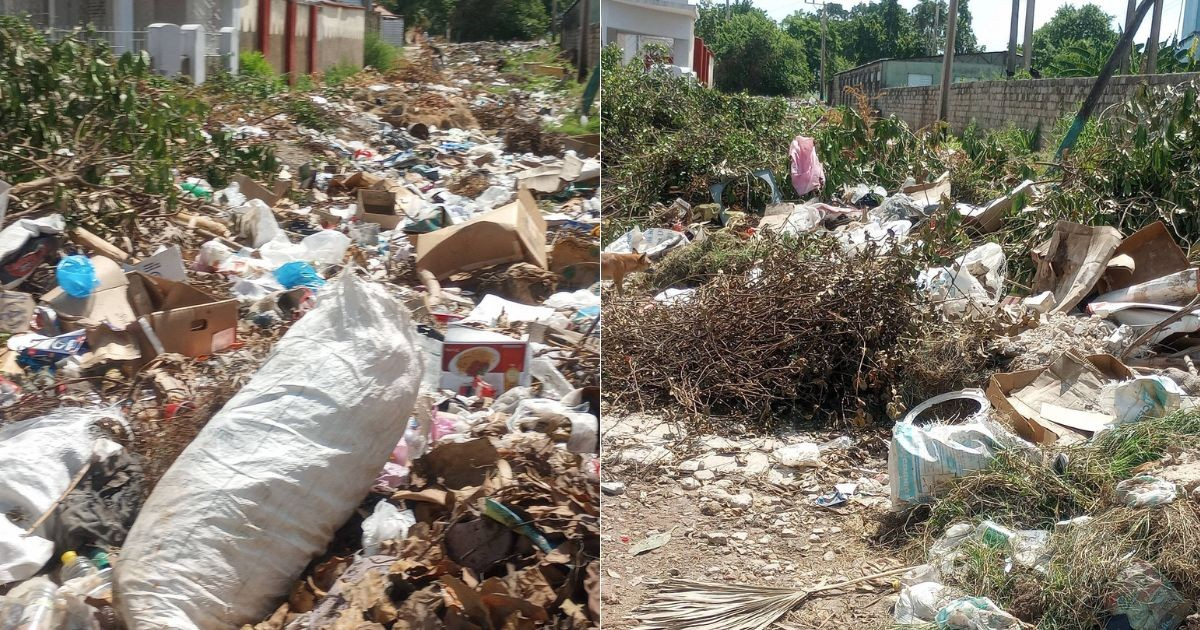
A Camagüey local, Telma Oliva, took to Facebook to express her frustration about the Camujiro landfill, located between 10th and 9th streets in the city, where trash has not been collected for two months. The accumulation has grown so severe that it now blocks an entire street, making passage impossible.
"We have no choice but to expose the filth we live in on social media because only then do they pay attention," Oliva wrote, sharing photos depicting heaps of plastic bags, decomposing cardboard boxes, containers, household waste, branches, and other debris piling up near residential buildings.
Oliva also highlighted the potential health hazards due to the negligence: "This dump in Camujiro between 10th and 9th occupies an entire street, blocking traffic. It's been 2 months since they collected the garbage, perhaps waiting for an outbreak of leptospirosis, dengue, or hepatitis to decimate the community, which might push for a solution."
Community Outcry and Official Excuses
In response to the official justification of fuel shortages, Oliva pointed out that the problem extends beyond just diesel: "So the excuse is a lack of fuel, which we know, but there aren't [...] wheelbarrows, etc., to prevent this situation."
The post sparked numerous comments confirming the widespread issue. One user noted, "The saddest part is the whole city is like this. On General Gómez Street, I counted 9 garbage dumps, including one next to the Amalia Simoni Children's Circle."
Another comment described a dire situation next to a health facility: "The dump next to the Camagüey Nephrology Institute, where patients with dialysis and other conditions are treated, is deplorable. It's been over 6 months since any solid waste has been collected there, and nothing is done."
Historical Context and National Crisis
The problem is not new. Since October 2025, persistent trash heaps have been reported on various streets in Camagüey, and in July 2026, a fire in a dump on Las Palmas Street alarmed residents. By mid-August, those in neighborhoods like La Marina and Prieto reported over four years living with overflowing sewage and accumulated garbage.
This crisis is part of a national collapse linked to fuel shortages and the degradation of equipment and machinery. This month, Holguín residents also reported a massive dump near a primary school, showing the problem spans multiple provinces.
The health situation adds urgency. In April 2026, Camagüey authorities acknowledged a "notable increase" in suspected hepatitis A cases in the main municipality. That summer, the Ministry of Public Health warned of a nationwide dengue epidemic risk.
Oliva concluded her post with a pointed reference to the official rhetoric: "There's no such thing as a safe neighborhood, productive neighborhood, participative neighborhood," ironically alluding to the government’s community management program while residents live amid towering piles of trash.
FAQs on Camagüey's Waste Crisis
What has caused the garbage crisis in Camagüey?
The crisis is attributed to fuel shortages, equipment deterioration, and broader national issues impacting waste management.
How are residents responding to the trash problem?
Residents, like Telma Oliva, are voicing their frustrations on social media, highlighting the health risks and urging for immediate action.
What health risks are associated with the garbage accumulation?
The uncollected trash poses risks of leptospirosis, dengue, and hepatitis outbreaks, exacerbating public health concerns.