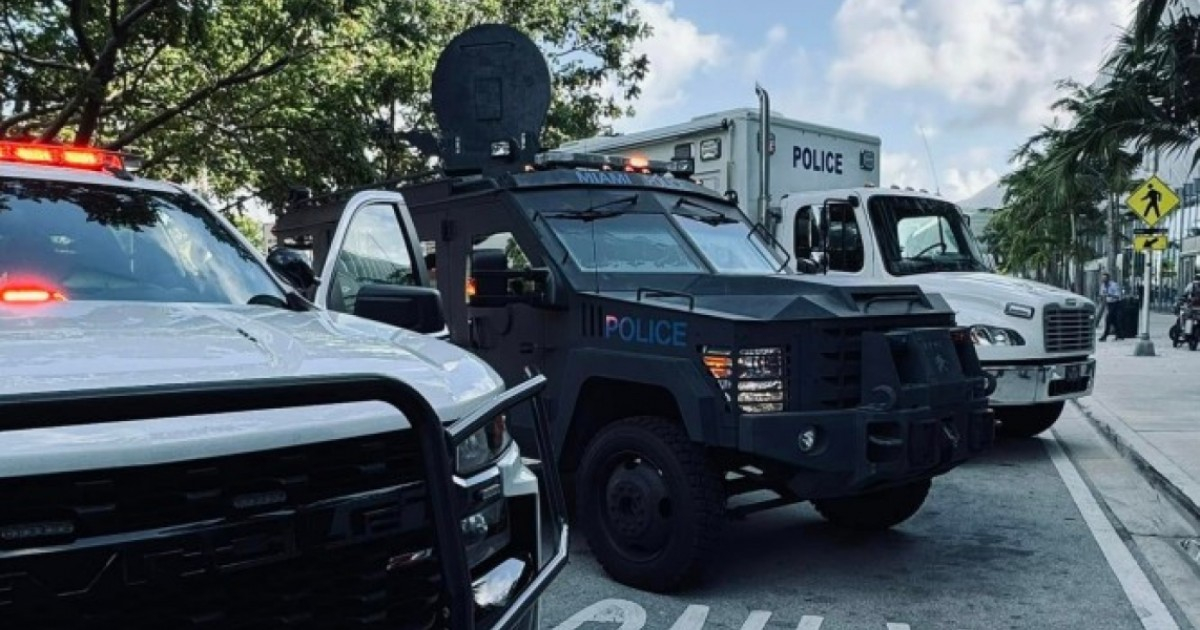
A recent report from the Florida Department of Law Enforcement highlights that the Miami Police Department is leading Miami-Dade County in the number of migrant arrests under the 287(g) agreements with Immigration and Customs Enforcement (ICE). The report underscores that the majority of those detained are Cuban nationals.
According to Univision 23 Miami, the report covers the period from August 2025 to August 23, 2026, during which 15,000 migrants were apprehended statewide in Florida under these agreements.
In Miami alone, there were 451 arrests, with 131 individuals, approximately 29% of the total, identified as being of Cuban descent.
The state report clarifies that those arrested face federal immigration charges or have committed a crime.
Notably, 35% of these arrests took place following the election of Democratic Mayor Eileen Higgins, who has voiced her opposition to local police acting as immigration enforcement agents.
In December, she openly criticized the 287(g) agreement previously signed by the city of Miami and federal immigration authorities, which permits local police to function as ICE agents. "There is no justification for our Miami Police Department to undertake the duties of federal immigration authorities," she asserted at the time.
Higgins assured that under the leadership of the new police chief, sworn in this June, "everyone in this city—regardless of immigration status—will be treated with dignity, respect, and humanity." However, official statistics appear to contradict this stance.
Leading the department is Cuban-American Edwin Lopez, who stated that his main priority "is not enforcing anything related to immigration," although he acknowledged the need to review current agreements.
Within Miami-Dade County, the Sheriff's Office ranks second in arrests, with 256 detentions. Meanwhile, the Hialeah Police Department reported only nine arrests under these agreements.
Law enforcement agencies in various cities, including Alachua and Aventura, as well as the FIU Police Department and the Miami-Dade Public Schools Police Department, reported no migrant detentions.
Statewide, the Florida Highway Patrol (FHP) recorded the highest number of arrests, with 8,986 detentions during the analyzed period. The Broward County Sheriff's Office reported just 30 arrests.
The 287(g) program enables local and state authorities to collaborate with ICE in identifying, questioning, and transferring individuals suspected of violating immigration laws after receiving federal training. Miami approved its 287(g) agreement in June 2025.
ICE arrests of Cuban nationals surged by 463% between late 2024 and early 2026, according to an analysis by the Cato Institute.
ICE's office in Miami has led the nation in migrant detentions, averaging 120 arrests daily and totaling over 41,310 detentions from January 2025 to April 2026.
In July, ICE processed nearly 6,000 individuals in detention centers within the Miami area.
Understanding Miami's Migrant Arrests
What is the 287(g) program?
The 287(g) program allows local and state law enforcement agencies to collaborate with ICE in identifying, questioning, and transferring individuals suspected of immigration violations, following federal training.
Why are Cuban nationals predominantly arrested in Miami?
Cuban nationals form a significant portion of the migrant population in Miami, leading to their higher representation in arrests under the 287(g) agreements.
How has the Miami Police Department's role in immigration enforcement changed?
Despite the Miami Police Department's involvement in the 287(g) program, the current leadership, under Mayor Eileen Higgins and Police Chief Edwin Lopez, has expressed a commitment to treating all residents with dignity, irrespective of their immigration status, though official actions may not fully align with this stance.