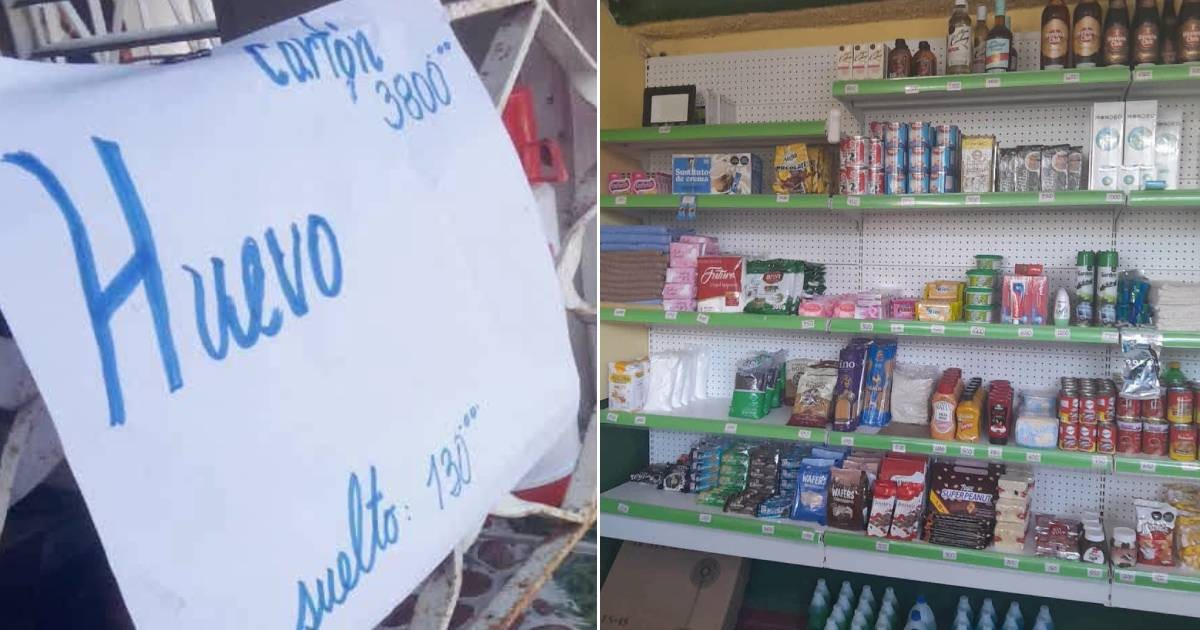
Authorities in Villa Clara released a comprehensive report this week highlighting pricing violations discovered across various neighborhoods in Santa Clara. According to the official "Soy Villa Clara" social media page, these infractions have led to measures ranging from forced sales to temporary shutdowns of businesses.
The initiative is part of a provincial campaign launched in early August after the Provincial People's Power Council approved Agreement No. 127, which imposed maximum price caps on essential food items, allowing a maximum commercial margin of 30%.
These price caps include 110 Cuban pesos per egg, 2,500 pesos per liter of oil, 3,465 pesos per kilogram of powdered milk, and 410 pesos per pound of refined sugar. However, reports show a systematic disregard for these limits. In the Universidad and Capiro-Santa Catalina neighborhoods, inspectors found eggs priced at 4,200 and 3,800 pesos each, nearly forty times the official cap. Consequently, forced sales were mandated until the products were depleted.
In the Condado neighborhood, non-state actors in the food service sector were found selling wet towels at 850 pesos each, powdered milk at 3,800 pesos per kilogram, and oil at 4,000 pesos per liter, exceeding the provincial maximum by 60%. Additionally, refined sugar was being sold at 550 pesos per pound.
Severe Violations in Escambray
The Escambray neighborhood recorded some of the most severe violations. An independent worker in the food service industry was caught selling refined sugar at 650 pesos per pound—58% above the cap—and two-kilogram chickens at 3,500 pesos.
The manufacturing industry TCP identified as "Sakenaf" was accused of selling refrigerators and solar panels at 280 dollars each without the necessary commercial authorization.
Electronic Payment Refusals Lead to Closures
In the Camacho neighborhood, a non-state food business was selling 500-gram detergent for 800 pesos. Meanwhile, in the Centro neighborhood, a sales point known as "el +barato" faced temporary closure for refusing to accept electronic payments, prompting a notice to the business owner.
Two local development projects also faced penalties: "Sanadez" for selling gasoline at exorbitant prices, and "AyeralMpaz" for misinformation about the price of 500-gram detergent, leading to a corrective forced sale of 20 packages.
The official report urged citizens to report irregularities with the slogan "Your complaint is power. If you see price gouging, evasion of electronic payments, or any deceit, report it. Together we can stop the speculators."
The sanctions are based on Decree Law 91 of 2024 and Decree 30 of 2021, which include fines, confiscation, forced sales, license suspensions, and establishment closures.
This inspection campaign has also extended to other provinces such as Matanzas, Havana, Sancti Spíritus, Artemisa, Guantánamo, and Santiago de Cuba.
The backdrop to these actions is an annual inflation rate of 20.70% recorded in July 2026, exacerbated by the regime's decision in June to lift national price caps on high-demand imported goods—such as chicken, oil, powdered milk, pasta, and sausages—through Resolution 150/2026 by the Ministry of Finance and Prices, followed by the removal of the rice cap in July.
Understanding Price Regulation in Cuba
What measures are being enforced against price violations in Villa Clara?
The measures include forced sales, temporary business closures, fines, confiscation of goods, and suspension of business licenses.
Why are these price caps important in Villa Clara?
Price caps are important to control inflation and ensure that essential goods remain affordable for the population amidst economic challenges.
How does the public report pricing irregularities?
Citizens are encouraged to report any price gouging or evasion of electronic payments through the campaign's slogan "Your complaint is power."