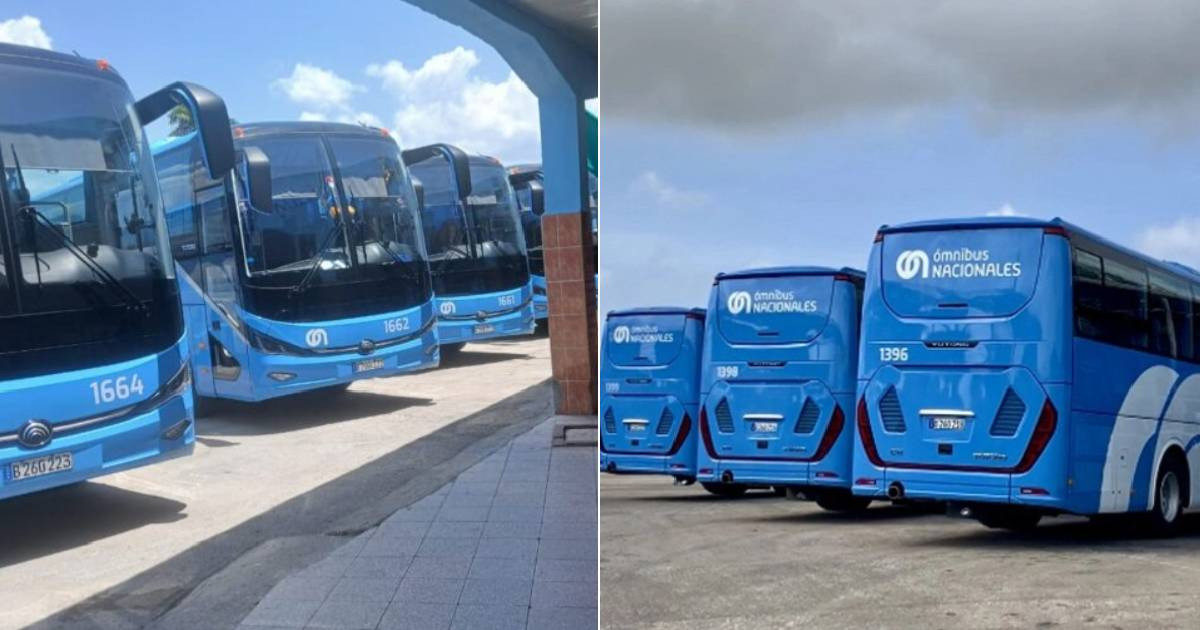
This week, the provinces of Holguín and Las Tunas welcomed four new buses each from the Chinese brand Yutong. These buses are designated for the route to Havana and are part of a 20-bus acquisition by the Ministry of Transport, funded by the Transportation Development Fund.
In Holguín, the handover took place on Wednesday at the José María Pérez Capote terminal. Eliécer González Aguilar, head of the National Bus Enterprise Unit (UEB) in the province, announced that the buses would serve the Holguín-Havana route, departing on Mondays, Wednesdays, and Fridays at 8:00 pm, as reported by Radio Angulo, the provincial broadcaster.
Each bus seats 44 passengers, but only 42 tickets will be sold. The remaining seats are reserved for driver rest during the journey.
The delivery in Las Tunas occurred on Friday, with Osbel Lorenzo Rodríguez, the first secretary of the Provincial Committee of the Communist Party, handing over the keys to experienced drivers.
Yosvani Cedeño Tomas, director of the UEB Ómnibus Nacionales in Las Tunas, emphasized that the new buses replace older ones that have been in service for a decade, according to the official news outlet Tiempo 21. "For now, these buses will cover the Las Tunas-Havana route and vice versa, accommodating 42 passengers with features like mobile phone chargers at every seat, cameras, televisions, and other comforts," noted Cedeño.
The director also highlighted the efficiency of these buses, pointing out that they consume half the fuel of existing models on long routes. "Additionally, they have low oil consumption and come with a minimum five-year guarantee for spare parts," he added.
The introduction of these eight units comes amid the most severe interprovincial transport crisis Cuba has faced in years. By the end of 2025, only 219 of 558 interprovincial buses were operational, which is a mere 39% of the total fleet.
Since June, the Ministry of Transport has reduced National Bus frequencies to three weekly departures between Havana and provincial capitals. Las Tunas was one of the hardest hit, operating a single nighttime service to the capital since February, due to widespread route suspensions caused by fuel shortages.
The Ministry itself admitted in early August that its ticket allocation system, implemented in June, facilitated corruption, prompting a return to in-person sales through Viajero agencies.
The collapse of the transport system has deep roots. National bus production plummeted by 97.5% over seven years, from 473 units manufactured in 2019 to just 12 projected for 2026, according to economist Pedro Monreal.
Since 2005, more than 9,000 Yutong buses have been in circulation in Cuba, making the island the primary international market for the Chinese company.
The batch of 20 buses, along with 200 electric vehicles for dialysis services, arrived at the Mariel Special Development Zone in mid-May. These deliveries to eastern Cuba offer a temporary relief, yet remain inadequate against the vast accumulated shortfall.
Understanding Cuba's Transportation Crisis
Why are new Yutong buses significant for Holguín and Las Tunas?
The new Yutong buses mark a crucial addition to the transport infrastructure in Holguín and Las Tunas, offering a much-needed boost to a struggling interprovincial service severely impacted by fuel shortages and an aging fleet.
What challenges does the Cuban transport system face?
Cuba's transport system is grappling with a significant crisis due to fuel shortages, an outdated fleet, and a drastic decline in bus production. These issues have led to reduced service frequencies and increased reliance on a limited number of operational buses.
How is the Ministry of Transport addressing corruption in ticket sales?
In response to corruption issues in the ticket allocation system, the Ministry of Transport has reverted to in-person ticket sales through Viajero agencies, aiming to improve transparency and accessibility for passengers.