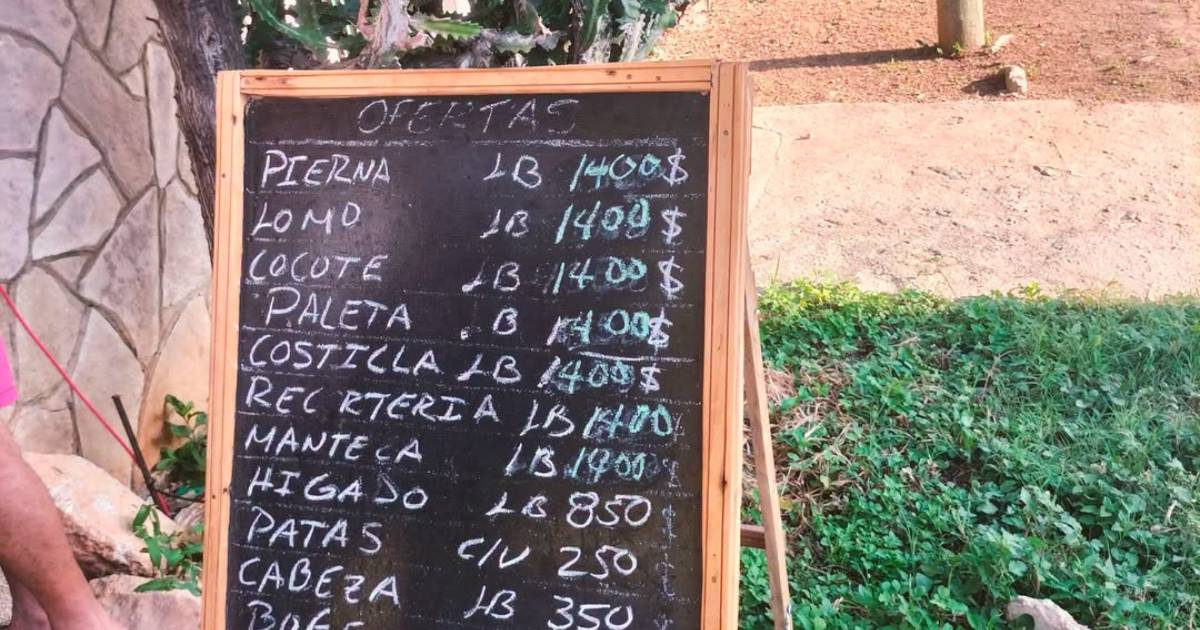
A chalkboard from a butcher shop, captured in a photograph this past Saturday and shared on Facebook by user Yoryany Veranes, reveals the alarming cost of pork in Cuba. The price for a pound of leg, loin, neck, shoulder, ribs, and trimmings has hit 1,400 Cuban pesos, while lard has reached 1,900 pesos per pound. This image paints a stark picture of the ongoing food crisis plaguing the island.
The photo ignited a heated discussion on social media, highlighting the dramatic price increases that have turned pork—once the most accessible protein source for Cubans—into a luxury item for many.
The Harsh Reality of Pork Prices in Cuba
The same board lists cheaper pork cuts and byproducts: liver at 850 pesos per pound, lungs at 600 pesos each, feet at 250 pesos each, and head at 350 pesos per pound.
Veranes remarked on the situation when sharing the photo: "This is open for debate because many of us look at these prices and wonder, 'Where am I supposed to find the money for this?'"
Despite the challenges, she acknowledged that some manage to purchase pork when it briefly becomes more affordable: "As unbelievable as it may seem, eating pork has become a luxury."
A Grim Contrast: Income vs. Food Costs
The disparity between income and food prices is staggering. As of early 2026, the official average monthly salary in Cuba was 7,074 pesos, roughly equivalent to 12-15 dollars on the informal exchange market. At 1,400 pesos per pound of pork, an average worker would need to allocate their entire salary to buy just five pounds of pork each month.
Research from 2026 suggests that an individual needs about 96,000 pesos monthly to meet basic needs in Cuba, leaving the average wage at merely 7% of this requirement.
Soaring Inflation and Informal Market Prices
In July 2026, the official annual inflation rate reached 20.70%, according to the National Office of Statistics and Information. Food and non-alcoholic beverages led the surge, rising 26.36% year-over-year and accounting for 63.18% of the monthly consumer price index increase.
Informal market prices far exceed these official figures. On the eve of the viral post, Cubans reported pork selling for between 1,500 and 1,900 pesos per pound, cooking oil at 6,000 pesos per liter, eggs at 4,200 pesos per carton, and chicken at 11,300 pesos per package.
Another trending image this Saturday showed a store board listing rice at 330 pesos, powdered milk at 1,700 pesos, and chicken breast at 10,500 pesos, illustrating the widespread nature of the food crisis.
Government Price Caps Fall Short
In an effort to control the runaway prices, several municipal and provincial governments attempted to set price ceilings in August 2026: Matanzas capped chopped chicken at 500 pesos per pound, the Isle of Youth at 620 pesos, and Villa Clara imposed limits on eggs and oil.
Nevertheless, actual market prices remain well above these caps, partly due to the regime's decision in June to lift restrictions on chicken and oil, contributing to the subsequent price hikes.
"We're not here to judge anyone," Veranes concluded, urging followers to share the prices they encounter in their respective provinces, emphasizing that each family must navigate these challenges based on their financial situation.
Understanding Cuba's Food Price Crisis
Why are pork prices so high in Cuba?
Pork prices have skyrocketed in Cuba due to inflation, supply shortages, and economic mismanagement by the government, turning this staple food into a luxury item for many Cubans.
How does the average Cuban salary compare to food prices?
With an average monthly salary of about 7,074 pesos, or 12-15 dollars, many Cubans struggle to afford basic foods, as these prices are disproportionate to their income.
What measures have been taken to control food prices in Cuba?
Local governments attempted to set price caps on certain goods, but these have been ineffective as actual market prices remain significantly higher, exacerbated by the lifting of previous restrictions.