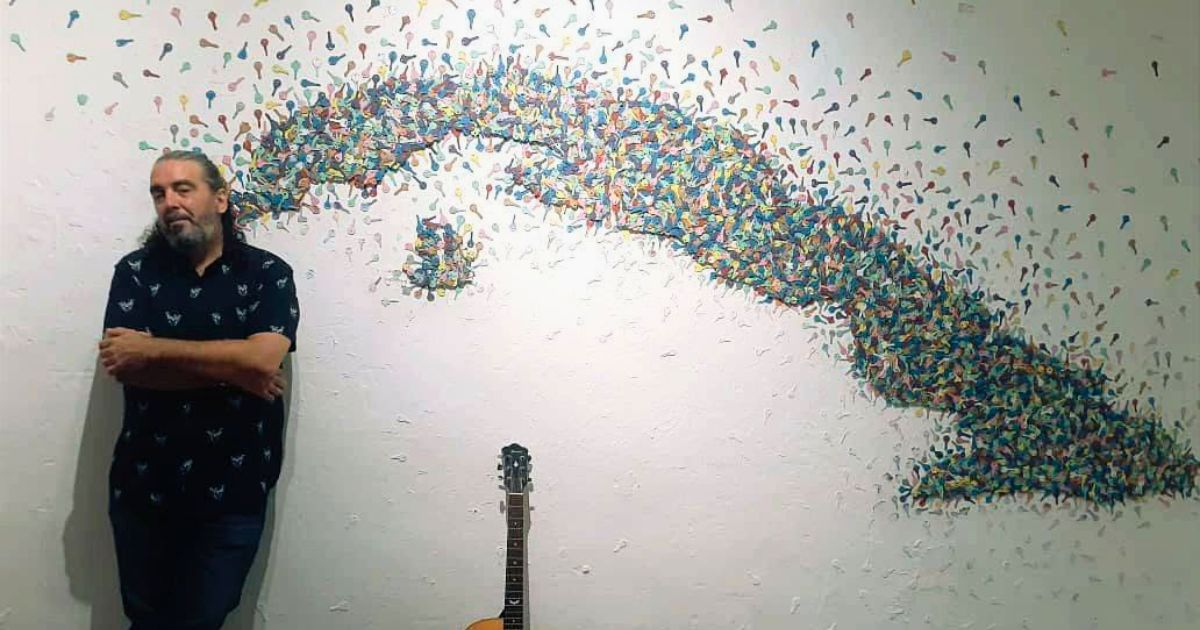
The Cuban troubadour Ariel Díaz shared a powerful message on Facebook this Friday, proclaiming the ultimate collapse of Cuba's revolutionary project. His words, strikingly candid coming from someone within the system, read: "Everything is over. We've reached the point of no return. The pillars that weakly held up the country and the indispensable mystique of the Cuban Revolution have crumbled after years of weakening due to both external and internal factors."
Díaz, a well-known figure in Cuban music with over two decades of artistic career, speaks not as an outsider, but from within the very structure he now deems to be in ruins.
The statement opens with a stark warning: "I'm not here to be optimistic, I'm here to be realistic. I know criticism will come from all sides, but I lack the talent to pretend." What follows is a catalog of losses spanning political, cultural, athletic, and symbolic realms.
The Fall of the Tropical Socialist Mask
"The mask of Tropical Socialism has fallen to the ground. We have failed. In the end, the enemy has defeated us," Díaz writes, drawing a historical parallel that strikes at the heart of the official narrative: "Just as when we lost the Apostle, years of sacrifice for a Free Cuba from Spain were cast into the wasteland of the Pseudo-republic. Today, without Fidel Castro's leadership, the Mambises will not march into Santiago again."
One of the most impactful sections is his recounting of Cuba's historical allies, listed one by one as absent: "We've been massacred, divided, forgotten, abandoned. The allies who benefited so much from our boundless solidarity now look the other way, cowardly, enslaved, and deaf." Nations like Angola, Ethiopia, Grenada, Vietnam, Algeria, Nicaragua, Venezuela, Namibia, Guatemala, Chile, Argentina, Bolivia, China, and Russia are named as those who turned their backs on the island.
A Portrait of Exhaustion
Díaz paints a picture of a Cuba exhausted on all fronts: "Extinguished, without million-ton harvests, without young people mobilized to the fields, […] not winning at baseball, against the ropes in boxing, without serves in volleyball, without checkmates, […] without the Varadero festival, without neighborhood cinemas, without leftist Trova, without 7:30 adventures, without Vicente, without Santiago, without Corina, without Alden." The portrayal concludes with a brutal sentence: "We are an old woman, hunched over, with peeling walls, scavenging through the world's trash to survive."
This text is not an isolated incident. Officially endorsed singer-songwriter and deputy Raúl Torres acknowledged on Facebook days earlier that "the people are there, expending their last breath and reflux of trust in the revolution's leaders," though without breaking with the system. Meanwhile, Silvio Rodríguez has criticized the Cuban economic model several times in 2026, yet continues to defend the Revolution. Díaz's message goes significantly beyond both.
These voices of disillusionment arise amid the worst economic crisis Cuba has faced in decades: power outages exceeding twenty hours daily, a recurring electrical generation deficit surpassing 2,000 MW, and an accumulated contraction of over 15% since 2020. The Food Monitor Program reported that more than 90% of Cuban households struggle to access essential goods.
Díaz concludes his post with a metaphor that reverses the Swiss hero myth: "In the end, William Tell relinquished the crossbow, and his son missed the shot, piercing his father's forehead." The imagery suggests that the Revolution ended up destroying precisely what it promised to protect, and the failed shot wasn't from the enemy, but from within.
Insights into Cuba's Current Economic and Social Crisis
What does Ariel Díaz's statement signify for Cuba?
Ariel Díaz's statement reflects a profound disillusionment with the Cuban revolutionary project and highlights the perceived collapse of the country's socialist foundations.
How is Cuba's current economic situation described?
Cuba is facing severe economic challenges, including prolonged power outages, a significant electric generation deficit, and a notable contraction in GDP, compounded by a scarcity of essential goods.
Who else has expressed criticism of the Cuban system?
In addition to Ariel Díaz, figures like Raúl Torres and Silvio Rodríguez have voiced concerns about the Cuban economic model and the challenges facing the country, albeit without fully renouncing the revolutionary ideals.