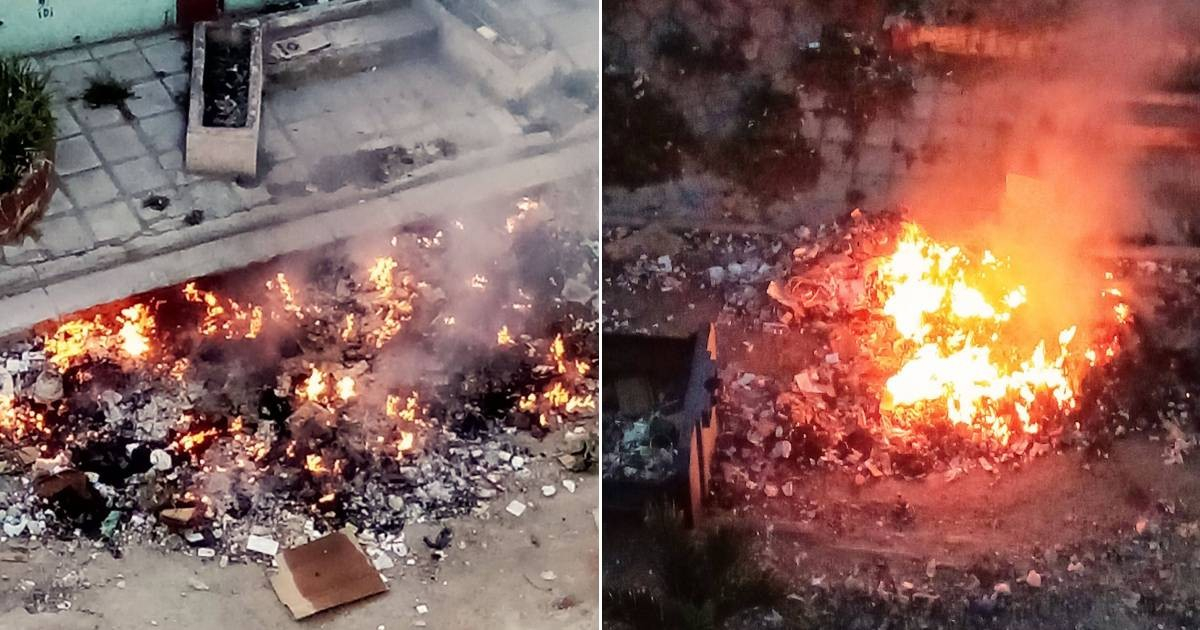
A Cuban woman took to Facebook to spotlight the burning of a nearby landfill that began Thursday afternoon and persisted into the night while the area was left without electricity, polluting the neighborhood's air.
"Right now, once again, the flames have erupted at the landfill near our home. It started in the afternoon and it's now nighttime, and we are without power," the user wrote. She emphasized that this is not an isolated incident but a recurring issue that authorities fail to address.
According to her account, 176 families are breathing in black, toxic smoke from the burning waste. "It's not just an unpleasant smell; it's poison entering through our windows, into the lungs of our children and elders," she warned.
The situation worsens because residents cannot shut their doors or windows for protection due to the extreme heat, which allows the smoke to infiltrate regardless. "We can't close doors and windows as we'd suffocate from the heat, and the smoke gets in everywhere," explained Hernández Rodríguez.
In her post, the author demands a genuine environmental inspection and concrete measures from CITMA—the Ministry of Science, Technology, and the Environment. "We're not asking for privileges; we're demanding our most basic right: to live in a healthy environment. The law supports us, and CITMA is obligated to act," she insisted.
This complaint surfaces amid an escalating waste management crisis that has intensified across the island in August. Recently, reports have emerged of garbage overflowing at Trillo Park in Centro Habana, accumulations in San Miguel del Padrón and Las Tunas, and a massive dump site next to a primary school in Holguín.
The collapse has structural roots: in Havana, only 44 out of 106 garbage trucks were operational in 2026, while the capital generates between 24,000 and 30,000 cubic meters of solid waste daily, with as much as 23,814 m³ left uncollected each day.
Waste burning is not merely a matter of odor or discomfort. In February 2026, the Cuban Neuroscience Center warned that waste combustion releases at least 30 toxic compounds—such as dioxins, furans, carbon monoxide, fine particles PM2.5, and heavy metals—that can cross the blood-brain barrier, impair memory, affect children's cognitive development, and trigger neurodegenerative diseases.
Despite the severity, the government's responses have been inadequate. CITMA Minister Armando Rodríguez Batista stated in February that the government "does not encourage or promote" open-air waste burning, but acknowledged that the practice leads to pollution and harms public health, without announcing any concrete solutions.
Hernández Rodríguez concluded her post with a question that echoes the desperation of hundreds of Cuban families: "How long must we fall ill in silence? How long must we wait to be taken seriously?"
Key Issues and Government Response on Waste Management in Cuba
What is causing the waste management crisis in Cuba?
The crisis stems from structural problems, including a shortage of operational garbage trucks and a significant amount of uncollected waste generated daily.
What health risks are associated with waste burning in Cuba?
Burning waste releases toxic compounds that can harm memory, cognitive development in children, and trigger neurodegenerative diseases.
How has the Cuban government responded to the waste burning issue?
The government has acknowledged the problem but has not provided concrete solutions to prevent open-air waste burning.