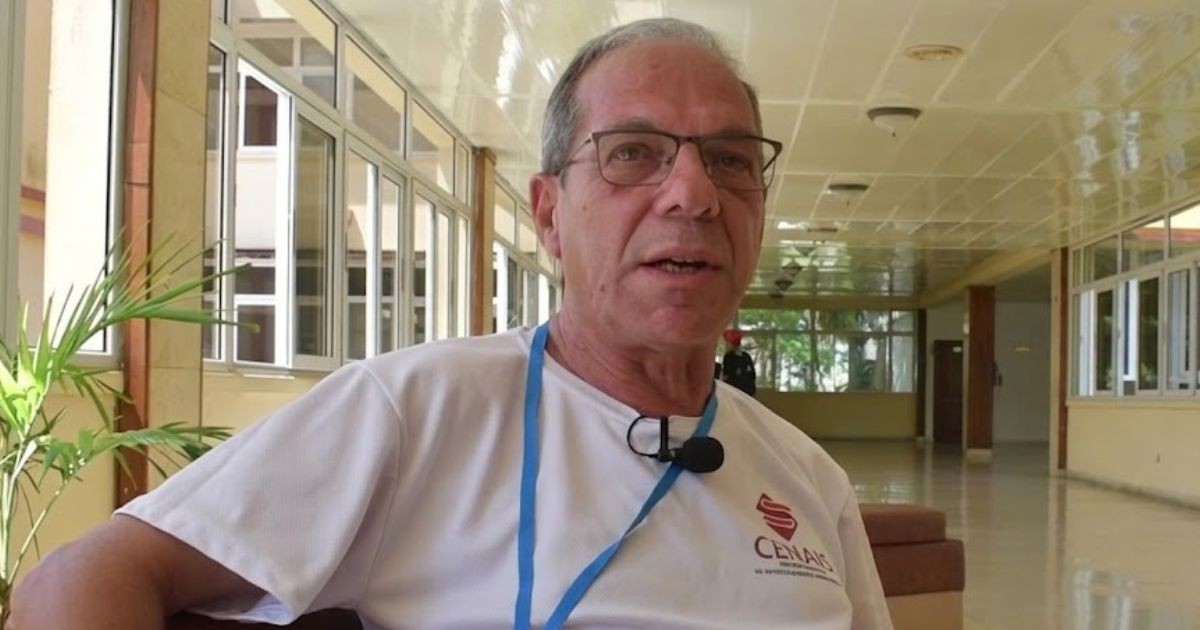
Enrique Diego Arango Arias, head of Cuba's National Seismological Service, has openly dismissed the official explanation from ETECSA regarding the false earthquake alert that took the nation by surprise on Tuesday, August 18. In a personal statement posted on Facebook, Arango Arias suggested the incident was a deliberate act.
The state-run telecommunications company had accepted responsibility for the event on Friday, August 21, attributing it to a "technical-human error" by their experts during network tests. However, they failed to clarify who authorized the test or what specific measures would be implemented to prevent a recurrence. This explanation did not sit well with many citizens, who remained skeptical.
"I am not convinced by ETECSA's explanation for the false earthquake alert on August 18," Arango Arias wrote, adding, "I have the flaw of speaking my mind, and if someone doesn't like it, I apologize."
Questioning the Error
The scientist laid out five reasons for doubting the technical error claim. Firstly, he pointed out the timing: "Such an incident has never occurred in Cuba, and it's too coincidental that it happened when the population is already under extreme stress for known reasons." Secondly, he noted the global increase in seismic activity, making the alert "entirely believable" to Cubans.
As a third point, he referenced recent events in Venezuela and Colombia, where similar alerts were triggered by significant earthquakes, resulting in substantial loss of life and damage. On June 24, 2026, two massive earthquakes with magnitudes of 7.2 and 7.5 struck northern Venezuela less than a minute apart, leading to Android Earthquake Alerts being sent to millions of phones in the region. In Colombia, a natural disaster occurred on August 10.
The fourth point raised suspicions: "Phones have various built-in alerts, such as crisis, seismic, and wireless emergency alerts, yet it was the seismic alert that was triggered." Lastly, he considered the political climate: "The country is under constant attack, aiming to overthrow the government. We are under daily surveillance by drones that have even breached national territory."
Concluding Malintent
Based on these five factors, Arango Arias concluded that the alert was a deliberate act, possibly orchestrated to create chaos among the population or to test a method for future use. He did, however, acknowledge the possibility of an error: "If it truly was a technical-human error, I apologize. Nevertheless, the alert resulted in chaos across nearly the entire country, not just in isolated areas as reported."
Arango Arias clarified a technical detail unknown to many Cubans: "This seismic alert functions once an earthquake has already occurred; it is not a prediction tool. It operates independently of data from seismological stations. Cell phones act as seismic sensors, and when a significant number of phones detect vibrations, the alert is triggered." This explains why CENAIS and Civil Defense could confirm immediately on August 18 that no real earthquake justified the alert received on mobile devices.
Public Outcry
The public reaction was swift and intense. Comedian Ulises Toirac publicly criticized ETECSA, and many Cubans demanded explanations from the state company. Before ETECSA's admission of guilt, Google had denied any involvement from its Android alert system in Cuba.
Arango Arias emphasized that his analysis was a professional responsibility: "I conducted this analysis due to the direct connection of this situation with my role as head of the National Seismological Service and the ongoing international seismic activity and its impact on the Cuban population."
Understanding the Seismic Alert Controversy in Cuba
What caused the false seismic alert in Cuba?
The false alert was attributed by ETECSA to a "technical-human error" during network testing, although this explanation has been questioned by the head of the National Seismological Service, suggesting it might have been a deliberate act.
How did the public react to the false alert?
The public reaction was intense, with many demanding explanations from ETECSA and expressing skepticism over their official explanation.
Why does Enrique Diego Arango Arias doubt ETECSA's explanation?
Arango Arias provided five reasons, including the timing of the incident and the political context, to suggest the alert was deliberate rather than accidental.
What is the functionality of the seismic alert system according to Arango Arias?
The alert system triggers after an earthquake occurs, not as a predictive measure. Mobile phones act as sensors to detect vibrations, which then prompts the alert.