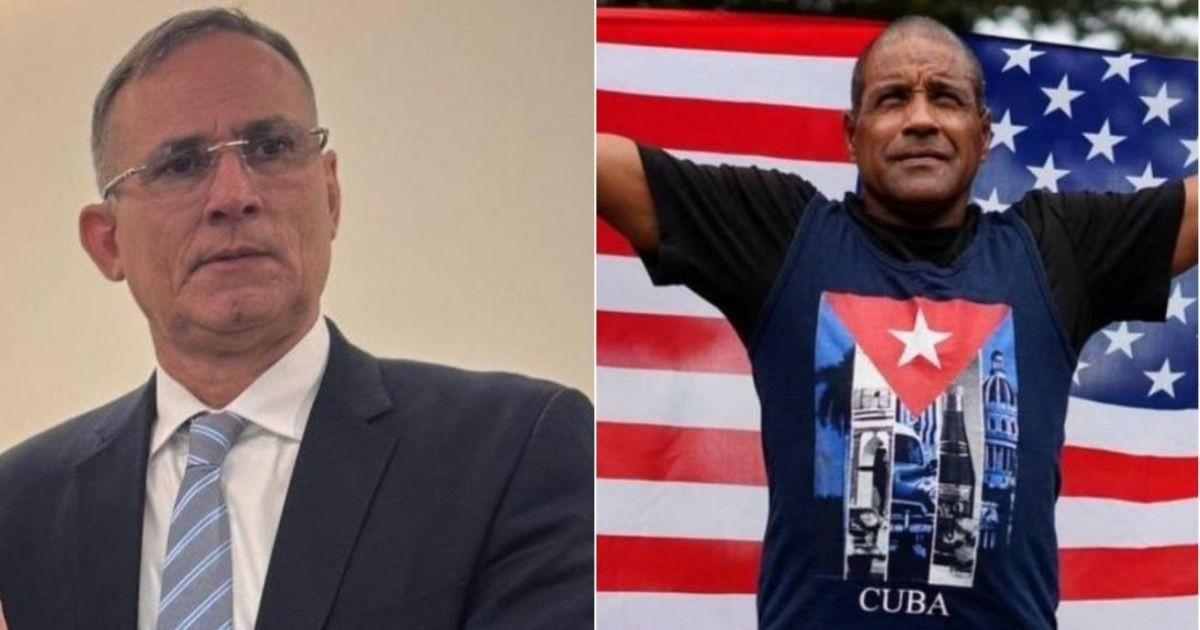
José Daniel Ferrer García took to Facebook to publish a detailed post accusing Daniel Llorente Miranda, also known as "the man with the flag," of being manipulated by the Cuban political police in a scheme aimed at sowing discord within the opposition and tarnishing the image of the exiles.
The controversy arose from a TikTok video shared by Llorente, where he was seen in Cuba beside a rental car adorned with two Cuban flags—absent was the American flag that made him famous—claiming he returned to the island without facing any repercussions.
It's important to recall his past actions: on May 1, 2017, he boldly ran with an American flag in front of Raúl Castro at the Plaza de la Revolución, challenging the regime.
"Here I am in Cuba with my little car, waving two Cuban flags, no American flag, no provocations. I came on my own, no one summoned me, no one said anything," Llorente declared in the video, adding that his purpose is to bring the "message of salvation" of Jesus Christ to the Cuban people.
Ferrer’s Critique
In stark contrast, Ferrer offered a radically different interpretation of Llorente's return. According to the founder of the Patriotic Union of Cuba (UNPACU), Llorente met with State Security officials during his visit, who treated him with coffee, water, and air conditioning, leading him to revise his stance and claim that "the bad guys aren't so bad," while criticizing the exiles, the opposition, and the U.S. government.
"Does a cup of coffee erase Mazorra? Did the air conditioning make him forget 100 and Aldabó? Can courteous treatment during a conversation turn the henchmen of the dictatorship into good people?" Ferrer wrote, referencing the detention centers where Llorente was held following his audacious act on May 1, 2017, when he disrupted the official parade at the Plaza de la Revolución with a massive American flag.
Political and Moral Contradictions
Ferrer addressed Llorente's proclamations about the salvation of Cuba through Jesus Christ, clarifying that "announcing Christ is one thing, but using His name while promoting the Antichrist that enslaves the Cuban people is another."
"Llorente today seems more akin to Judas Iscariot than to a good Christian proclaiming Jesus," Ferrer emphasized, highlighting the political and moral contradictions of speaking in the name of Christ while downplaying the repressive nature of the tyranny and attacking the exiles, the opposition, and those advocating for democratic change in Cuba.
An Isolated Heroic Act
The opposition leader believes regime manipulators convinced Llorente that the United States was ungrateful to him, suggesting he deserved a medal, a mansion, and a lifelong pension. "Then they tell him they always knew he was a brave and talented man, destined by God to save Cuba, and that they can help him," Ferrer explained.
Finally, Ferrer called for reflection on isolated heroic actions, which can be genuine or driven by emotions, personal ambitions, a quest for fame, resentments, financial needs, or shifting interests.
"Democratic movements must judge individuals by their history, not just by spectacular moments. True reliability is built over years: enduring sacrifices, organizing, forming teams, supporting others, defending political prisoners, visiting persecuted families, mobilizing citizens, and maintaining integrity when there are no cameras or applause," Ferrer asserted.
Llorente's Return to Cuba
Daniel Llorente Miranda, the Cuban political activist who in 2017 challenged the regime by running with an American flag in front of Raúl Castro at the Plaza de la Revolución, has returned to Cuba as an ordinary tourist.
Llorente himself announced his return in a TikTok video this week, where he appeared on a street next to a rental car he picked up at the airport.
"With my little car, with two Cuban flags. No American flag, no provocations," he stated at the beginning of the video.
The shift is difficult to comprehend: the same man who was exiled from the island, who crossed the Darién Gap with his son, and who slept in his car in Tampa now appears in Havana, declaring he does not intend to provoke anyone.
Llorente recounted entering the country without any issues: "I came, no one summoned me, no one said anything. Everyone told me I wouldn't be allowed in... well, I tell them no. I left like any Cuban returning to their country, for a visit."
According to him, the silence of the authorities has its own logic. The regime, he says, calculated that acting against him would backfire: "They said: if we call Daniel, we can't tell him he can't enter because he's Cuban, we can't say that. And if we say anything, it becomes a scandal, people find out."
The most puzzling change is not merely his physical return but the accompanying narrative. Llorente now identifies himself as a prophet and Christian messenger. "I didn't come as the flag man; I came as Moses," he asserts in the video. His declared mission is to deliver the "message of salvation" to Cubans under the motto "Jesus Christ, Cuba is your home."
Understanding José Daniel Ferrer and Daniel Llorente's Conflict
Who is José Daniel Ferrer?
José Daniel Ferrer is the founder of the Patriotic Union of Cuba (UNPACU), a prominent opposition leader in Cuba known for his critical stance against the Cuban regime.
What is Daniel Llorente's significance in Cuban activism?
Daniel Llorente gained recognition for his daring protest on May 1, 2017, when he ran with an American flag in front of Raúl Castro at the Plaza de la Revolución, challenging the Cuban regime.
Why is Llorente's return to Cuba controversial?
Llorente's return to Cuba is controversial because it contradicts his previous stance as a regime critic, and he has now taken on a narrative that seems to align with the regime's interests, according to critics like Ferrer.