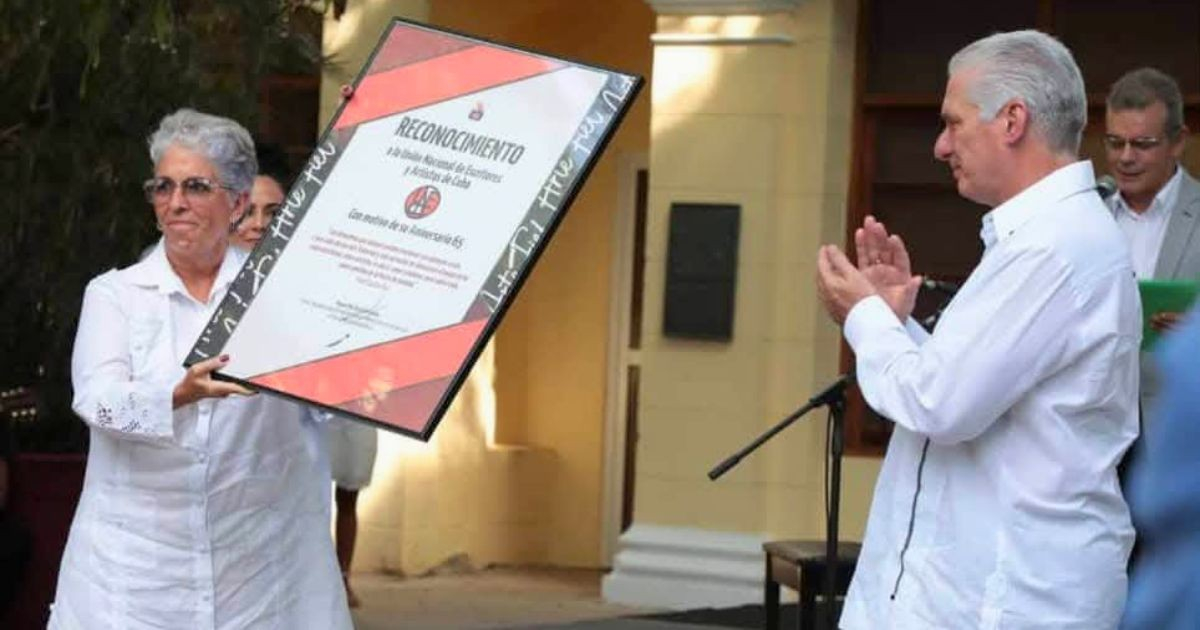
As Cuba faces daily blackouts exceeding 20 hours, a currency collapse with the peso plummeting to over 670 per dollar, and a historic high of 1,415 protests and critical civic actions in July alone, the government found a peculiar way to celebrate last Friday. They gathered the "intellectual and artistic vanguard of the country" in the garden of the Union of Writers and Artists of Cuba (UNEAC) to mark its 65th anniversary with speeches of allegiance, revolutionary merit awards, and artworks inspired by the Castro legacy.
The event was led by Miguel Díaz-Canel, acting as both President of the Republic and First Secretary of the Communist Party, alongside Culture Minister Alpidio Alonso and UNEAC President Marta Bonet de la Cruz. The ideological machinery was well-represented with several officials from the Ideological Department of the Central Committee, led by Yuniaski Crespo Baquero.
The day commenced with the National Anthem, a recorded voice of Nicolás Guillén reciting "Se acabó," and a segment from Fidel Castro's famous "Words to the Intellectuals" speech from 1961, which forever defined the boundaries of Cuban culture: "Within the Revolution, everything; against the Revolution, nothing." Sixty-five years later, UNEAC still adheres to this doctrine.
The Ceremony and Its Honorees
The highlight was the awarding of the "Loyal Art" distinction to nine notable figures: Miguel Barnet, Abel Prieto, Nancy Morejón, Verónica Lynn, Frank Fernández, Lesbia Vent Dumois, Santiago Alfonso, Digna Guerra, and Luis Morlote. Speaking on behalf of the group, Vent Dumois echoed the sentiments the regime sought: "We were here, are here, and will remain here as long as life grants us energy and lucidity. The Homeland will always need our contribution, and the people need the sense of service that we learned as the sweetest duty of a revolutionary."
The event also featured a series of artistic gifts for specific recipients. A screen-printed work, number 1 in the series, was symbolically given to General Raúl Castro Ruz — though Díaz-Canel received it due to the elder leader's absence. Additionally, a piece by artist Janette Brossard, inspired by Fidel Castro's centenary, was presented to Díaz-Canel himself. Gifts for the family, indeed.
UNEAC's Reciprocal Recognition
In return, Díaz-Canel awarded UNEAC a commendation for "its dedication to Cuban art and literature and the defense of the Revolution." This mutual admiration society continues its six-decade spin of servility.
UNEAC's history is not just applause. In September 2024, the organization expelled intellectual Alina Bárbara López Hernández for "activities against the revolution," prompting writer Jorge Fernández Era to resign in solidarity.
This anniversary display unfolds as the nation struggles, yet it does not forgo tributes to Fidel Castro. According to the Cuban Conflict Observatory, quoted by Infobae, July 2026 saw the highest number of protests and critical civic actions in recent memory. CEPAL projects a GDP decline of 6.5% in 2026, though independent economists fear it could be worse.
The evening concluded with a concert by Pancho Amat and the Cabildo del Son, featuring works by Nicolás Guillén, Pablo Milanés, and Ignacio Piñeiro, among others. Music for the loyal, as UNEAC continues to exalt Fidel Castro while the people brace for the next blackout.
Understanding Cuba's Cultural and Economic Crisis
What is the significance of the UNEAC event led by Díaz-Canel?
The UNEAC event, led by Díaz-Canel, symbolizes the regime's effort to showcase loyalty and revolutionary values through cultural and artistic expressions, despite the severe economic and social crisis in Cuba.
Why is the Cuban peso collapsing, and what are its implications?
The Cuban peso is collapsing due to economic mismanagement and the failure of socialist policies. This collapse leads to inflation, reduces purchasing power, and exacerbates the living conditions of ordinary Cubans.