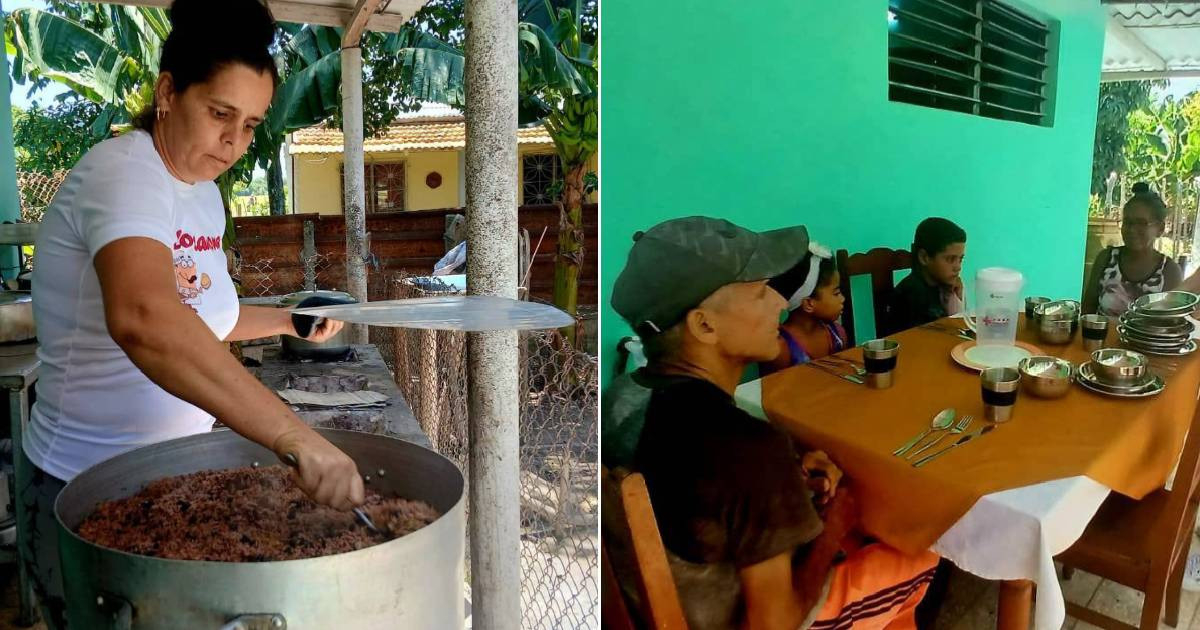
A pioneering Community Dining Home has been launched in Ciego de Ávila, marking the first of its kind in the Zaragoza community, district 49, within the main municipality. Unlike traditional models, this facility is managed by a private worker rather than being state-operated.
The initiative is spearheaded by Los Ramones, a self-employed project associated with the commercial sector. It aims to support 10 individuals facing vulnerability, including five bedridden recipients who will benefit from home-delivered meal services.
The inauguration ceremony was attended by Bárbara Guerra Pérez, a member of the Provincial Bureau of the Cuban Communist Party, along with provincial government officials and representatives from the Commercial Business Group. They characterized the opening as "a work of boundless love," as highlighted by Fidel Cruz Pérez, director of Ciego de Ávila’s Commercial Business Group, on his Facebook page.
During the event, a cooking module donated from China was received, along with a refrigerator and food storage thermoses provided by self-employed workers in the commerce sector, according to sources.
This establishment is the first step in a broader provincial plan to open 16 similar facilities across Ciego de Ávila. Plans include three in the main municipality and others in Ciro Redondo, Chambas, Majagua, Florencia, Venezuela, and Morón.
Expanding Non-State Family Assistance Systems
This effort is part of a broader initiative to integrate the Family Assistance System (SAF) into the non-state sector, enabled by Agreement 10418 from the Council of Ministers and Resolution 14/2026 from the Ministry of Internal Commerce, published in the Extraordinary Official Gazette No. 85 on August 4.
The regulation allows micro-enterprises, self-employed workers, state entities with employee cafeterias, and non-profit institutions to manage SAF establishments, explicitly including community dining homes in rural or hard-to-reach areas.
Economic Pressures Drive Shift to Private Management
This policy is part of a suite of 176 economic measures announced in June, designed to transfer historically state-held activities to the private sector due to the government's fiscal incapacity to sustain them.
The backdrop to this shift is a severe food crisis. In May, the Food Monitor Program reported nearly 97% of Cubans lack adequate food access, with about 34% of households experiencing hunger.
The crisis is particularly dire among the elderly, the primary demographic served by SAF, with 55.6% of those over 60 reporting complete loss of food access.
In March, the government admitted it lacks sufficient funds to support all SAF applicants, whose numbers have grown from about 59,000 in 2023 to an expected 67,000 by mid-2025.
Interior Commerce Minister Betsy Díaz Velázquez defended the shift to private management, emphasizing that "even with non-state management, beneficiaries will be locally defined by social policy groups."
Understanding the Community Dining Home Initiative in Cuba
What is the purpose of the Community Dining Home in Ciego de Ávila?
The Community Dining Home in Ciego de Ávila aims to provide meals to vulnerable individuals, including bedridden recipients, managed by a private worker rather than the state.
How is the Community Dining Home initiative connected to the broader Family Assistance System?
The initiative is part of expanding the Family Assistance System to the non-state sector, allowing private entities to manage community dining homes in rural areas.
Why is the Cuban government shifting towards private management for social programs?
Due to fiscal constraints and a severe food crisis, the government is transferring some traditionally state-managed activities to the private sector to ensure sustainability.