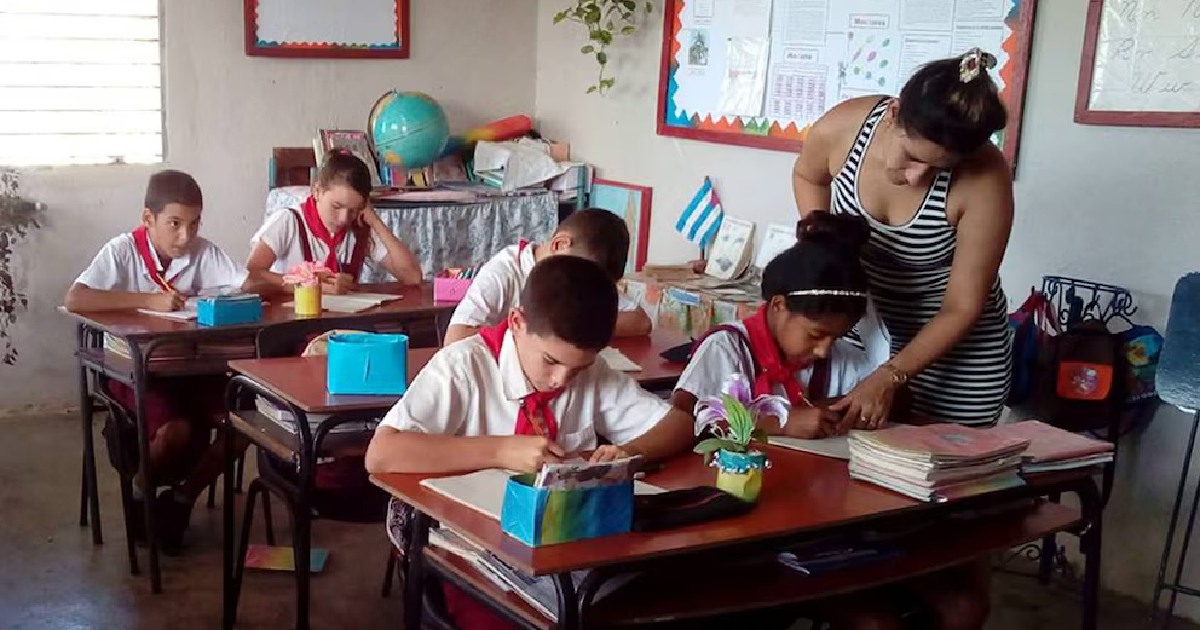
A teacher from Urbano Noris, in Holguín province, has directly confronted Miguel Díaz-Canel, highlighting that educators in her area have not received their salaries for over three months, dating back to May.
The complaint appeared as a comment on the Cuban leader's Facebook page, where he had posted about preparations for the school year.
Díaz-Canel's post read: "Enormous efforts are being made to ensure classrooms open on September 1st, despite the #GenocidalBlockade. My thanks to teachers, administrators, families, and all institutions involved in this endeavor. We will not give up."
María Luisa Casal Castillo, identifying herself as a teacher from Urbano Noris, responded with a grievance: "President, among all those things you express gratitude for, the teachers of Urbano Noris in Holguín, Oriente, would be immensely grateful if we were paid. You might be unaware that we haven't been paid since May... Sometimes actions fill the humble population with nostalgia."
This disparity between official rhetoric and the harsh reality of months without pay encapsulates a crisis not confined to Holguín's educators alone.
The Ongoing Struggle of Cuban Educators
In July, teachers from the Vicente Chávez Mixed School in Vertientes, Camagüey, reported being unpaid for two months, with the sole official explanation being "there is no money." Despite this, educators and staff continued working under "terrible" conditions to avoid abandoning their students.
"A school so large, with many teachers, and the same number of teachers don't have a plate of food today. But 'there is no money' is always the answer... There is no money, no shame, no dignity, no respect," stated Yerenis Cabrera León, daughter of one of the school's employees.
Government's Salary Adjustment Falls Short
At the end of July, the regime approved Resolution 18/2026 from the Ministry of Labor and Social Security, setting new base salaries for teachers between 6,130 and 7,735 CUP monthly, effective from July 1st and payable in August.
However, this increase is meaningless for those who haven't received previous wages.
Additionally, with the informal exchange rate at about 673 Cuban pesos per dollar, the new maximum salary of 7,735 CUP translates to just $11.5 monthly, far below a basic basket estimated between 25,000 and 50,000 CUP. Cubans reacted to the announcement with mockery, encapsulated in the phrase: "Now they can buy the carton of eggs and the oil in the same month."
Systemic Issues Plague Cuban Education
The Cuban educational system also suffers from a structural deficit of at least 24,000 teachers nationwide—12.5% of teaching positions—due to migration, a shift towards the private sector, and historically low wages.
As the 2026-2027 school year is set to begin on September 1st, Cubans have responded to Díaz-Canel's message with criticism, describing the situation as "a lot of will and few resources," highlighting power outages, water shortages, lack of uniforms, and difficulties in providing food for children.
Key Questions on Cuba's Educational Crisis
What prompted the teacher from Holguín to challenge Díaz-Canel?
The teacher from Holguín challenged Díaz-Canel because educators in her area hadn't received their salaries since May, despite official claims of efforts to support schools.
How has the Cuban government responded to the salary issue?
The Cuban government approved a resolution to increase base salaries for teachers, but many educators have not received previous wages, making the increase largely ineffective.
What broader challenges does the Cuban education system face?
The Cuban education system suffers from a significant teacher shortage due to migration, low wages, and inadequate resources, compounded by economic hardships faced by teachers and their families.