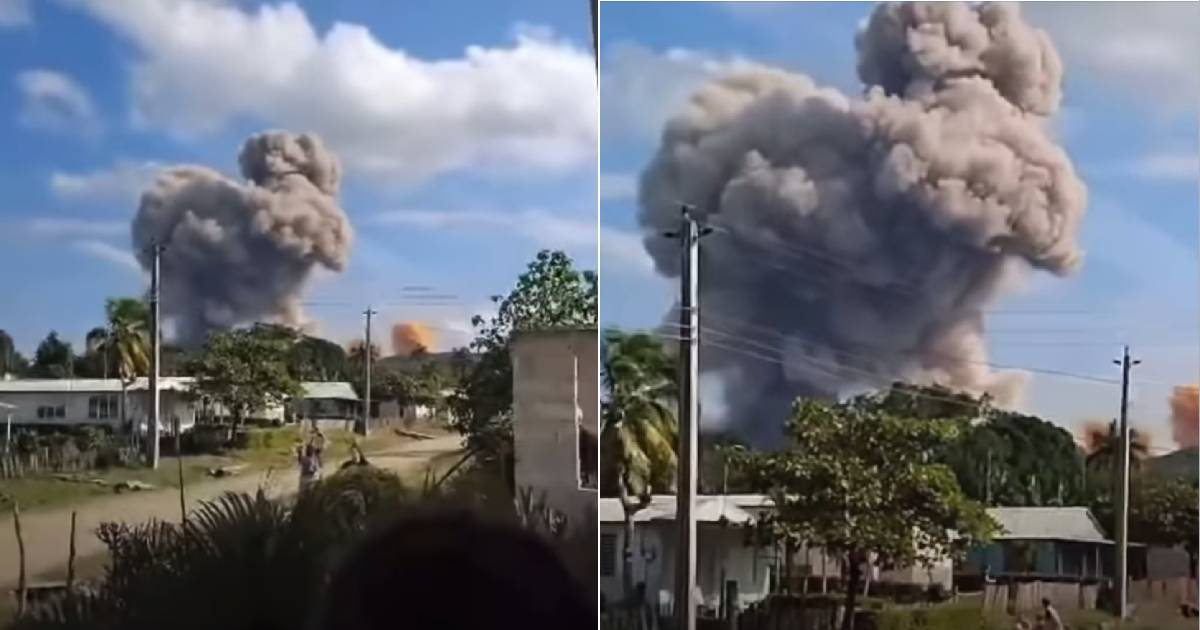
Unauthorized civilians who entered the military base in Melones, Holguín, stumbled upon decomposing bodies within the tunnels where the explosion occurred on January 7, 2025. Despite the Revolutionary Armed Forces (FAR) claiming for over a year that recovery was impossible due to the conditions, the discovery contradicts their statements about the inability to retrieve the remains of the 13 deceased soldiers.
This revelation, brought to light about a month ago by an independent investigation by elTOQUE, includes testimonies from victims' families and local sources. The findings raise serious questions about the authorities' actions following one of Cuba's most severe military tragedies in recent years and, crucially, why families still await the remains of their loved ones.
The Explosion and Its Aftermath
The explosion and resulting fire in the military warehouse claimed the lives of 13 soldiers, including four officers and nine young men fulfilling their Mandatory Military Service. It took Cuban authorities nine days to officially declare them deceased, citing the "extreme complexity" of the terrain, gas build-up, high temperatures, and the risk of further collapses as barriers to recovery efforts. However, the remains were never returned to the families.
Civilians Entered Searching for Weapons
Daliha González Almaguer, sister of Frank Antonio Hidalgo Almaguer, a 19-year-old recruit who died in the explosion, confirmed to elTOQUE journalist Marleidy Muñoz that a group of civilians gained access to the restricted area in search of abandoned weapons and materials. What they discovered inside the tunnels challenges the authorities' longstanding explanations.
"Some young men entered the area where the fire occurred looking for weapons, munitions, and other items left after the explosion, and they found bodies in a state of decomposition," González Almaguer recounted. Her family initially learned about the discovery from community members. After demanding answers, representatives from the FAR visited her home and acknowledged the finding of human remains, although they have yet to confirm whether Frank Antonio's remains are among them.
Families Left in Limbo
Gretel María Franco, mother of Leinier Jorge Sánchez Franco, another recruit who perished at just 18 years old, received similar communication from FAR representatives over a month ago, yet has not received further explanations.
"There are several rumors that they found everyone and that a wall collapsed on the fifth day of the search, halting operations. But they have not been able to provide any information," she told elTOQUE. The discrepancy between what authorities stated after the explosion and what civilians have now uncovered leaves families with a painful question: If civilians could enter and find the bodies, why did military officials claim for over a year that recovery was impossible?
So far, the FAR has not publicly addressed these concerns.
Young Explorers Detained
The civilians who entered the military facility have been detained and remain incarcerated, according to victims' families and community sources consulted by elTOQUE. The police have only stated that the case is under investigation, providing no details about possible charges or the detainees' whereabouts. Although the unauthorized entry into a military installation and search for weapons are distinct issues from the discovery of the remains, it was this incursion that revealed the presence of human remains potentially linked to the tragedy.
Ongoing Distrust and Calls for Justice
The families' mistrust of the official narrative did not begin with this discovery. González Almaguer emphasized that they received conflicting information from the start regarding when recovery efforts would begin. "At first, they told us it would be after 72 hours, that it was impossible before then. Later, they claimed they would enter after four days to retrieve the bodies. None of it was true. They never went in to look for them," she lamented.
Her family also refused to allow authorities to use Frank Antonio's photo in official communications or the posthumous tribute organized after the tragedy. Other families have publicly decried the lack of answers since 2025. Julio César Guerrero Batista, father of recruit José Carlos Guerrero García, questioned in January 2025 whether all necessary searches and investigations had been carried out to clarify what happened. "I want my son's body! I want answers and justice!" he demanded at the time.
More than a year and a half later, that demand remains unmet. elTOQUE reached out to the Revolutionary Armed Forces for their perspective on the discovery of the bodies and the civilians' detention, but received no response by the time of publication. There has also been no public information regarding the identification of the remains or their return to the families.
The new finding thrusts families back to the unresolved questions they have been asking since January 2025. It is no longer just about understanding what triggered the explosion or why nine recruits ended up trapped in a military warehouse. Now, they also demand to know why civilians could reach bodies that the FAR claimed they could not recover for over a year.
Key Questions About the Melones Tragedy
Why did it take so long to discover the remains?
The Revolutionary Armed Forces cited difficult conditions, such as extreme terrain complexity and safety concerns, as reasons for not accessing the site sooner. However, recent civilian discoveries challenge this explanation.
What actions have the families taken in response to the findings?
Families have demanded answers from authorities, insisting on the return of their loved ones’ remains and questioning the FAR's handling of the situation. They continue to seek justice and clarity about the events leading to the tragedy.
Have the authorities responded to the new findings?
As of now, the FAR has not publicly addressed the discovery of the remains or the detention of the civilians involved, nor have they provided updates on the identification or return of the bodies.