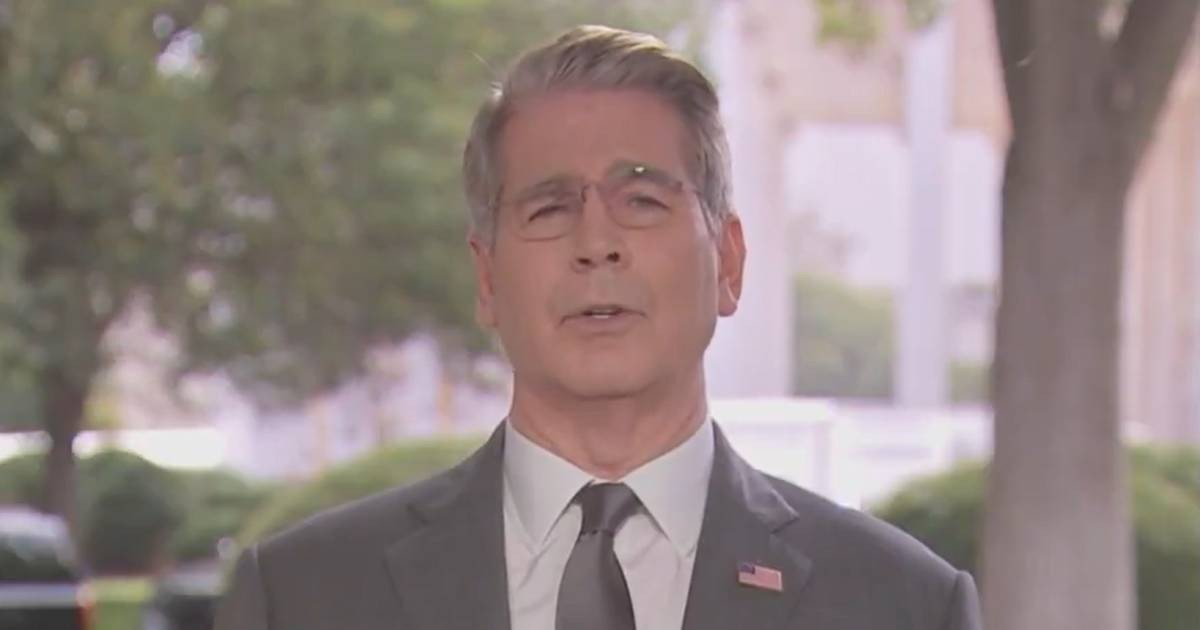
On Thursday, U.S. Treasury Secretary Scott Bessent asserted that Washington's economic pressure campaign against the Cuban regime is currently yielding results. In an interview with CNBC, he defended the strategy favored by the Trump administration for its potential application against Iran.
"We saw success in Venezuela once the blockade was in place. It's proving effective in Cuba right now, and it will work in Iran. We intend to bring down this regime," Bessent stated during the interview, according to a segment shared by Clash Report on X.
The secretary also outlined a two-pronged approach aimed at Iran, involving a naval blockade coupled with an aggressive new round of economic sanctions.
"We have the blockade, and we are prepared to implement the toughest sanctions in history," Bessent told CNBC, as reported by Reuters. A press conference is scheduled for Monday where he plans to detail these measures.
Implications for Global Energy Markets
Bessent's comments come amid ongoing tensions with Iran and concerns over the Strait of Hormuz, a critical conduit for global oil trade. He also noted that financial markets might be misinterpreting the potential outcomes of America's strategy. He believes that maximum economic pressure could actually decrease the likelihood of a large-scale military conflict.
The Treasury Secretary directed part of his remarks toward China, a major purchaser of Iranian oil. He expressed optimism that Beijing has incentives to cooperate with Washington to reopen the Strait of Hormuz and bring down energy prices.
According to Reuters, China buys more than 80% of the oil Iran exports via maritime routes, based on 2025 data from analysis firm Kpler. "It's time for our allies and the rest of the world to make a choice," Bessent emphasized.
Cuba: A Case Study in Maximum Pressure
Bessent's reference to Cuba is significant as he frequently uses the island nation to illustrate the Trump administration's economic pressure tactics. Just days prior, in an interview with Newsmax, he acknowledged that "Cuba lasted a long time" under economic pressure, addressing questions about how long a regime can endure under sanctions.
Comparing the Cuban case to Venezuela, Bessent noted, "Venezuela lasted a long time. It collapsed immediately when we imposed the blockade." Now, by stating on CNBC that the strategy "is working in Cuba," Bessent explicitly points to Cuba as evidence that Washington believes its maximum pressure policy is weakening the regime.
These statements are part of a broader pattern. In March, during a Fox Business interview, Bessent predicted a "slow-motion regime change" in Cuba following the capture of Nicolás Maduro by U.S. forces. By May, he warned sanctions could "increase or decrease" based on the Cuban government's conduct, a policy he described as a "carrot and stick" approach. In July, he intensified his rhetoric, describing Havana, along with Moscow and Caracas, as a "hellscape of deprivation."
Intensifying Sanctions and Their Impact
The Trump administration's maximum pressure campaign against Cuba has ramped up throughout 2026, with over 240 sanctions targeting the financial sources and economic structures linked to the Cuban military apparatus. One of the most notable actions was Executive Order 14404, signed on May 1, formally blocking the military conglomerate GAESA and its subsidiaries while imposing secondary sanctions on foreign companies engaging in significant transactions with sanctioned Cuban entities.
However, this U.S. offensive coincides with a severe economic and energy crisis directly affecting the Cuban population, who face widespread power outages, shortages of fuel, food, and medicine, and a substantial decline in public services.
The Cuban regime has consistently rejected Washington's claims of an impending collapse or political change. In March, Deputy Foreign Minister Carlos Fernández de Cossío asserted that regime change was "off the table."
Bessent's recent remarks highlight a starkly different perspective from Washington: the Trump administration now views Cuba not only as a target of its maximum pressure policy but also as a public example to validate that this strategy is producing outcomes and can be replicated against other adversaries such as Iran.
Understanding U.S. Sanctions on Cuba
How effective are U.S. sanctions on Cuba?
The U.S. Treasury Secretary claims that the sanctions are currently effective, citing Cuba as an example of the success of America's economic pressure strategy.
What is the impact of the sanctions on the Cuban population?
The sanctions have coincided with a severe economic and energy crisis in Cuba, leading to power outages, food and medicine shortages, and a decline in public services.