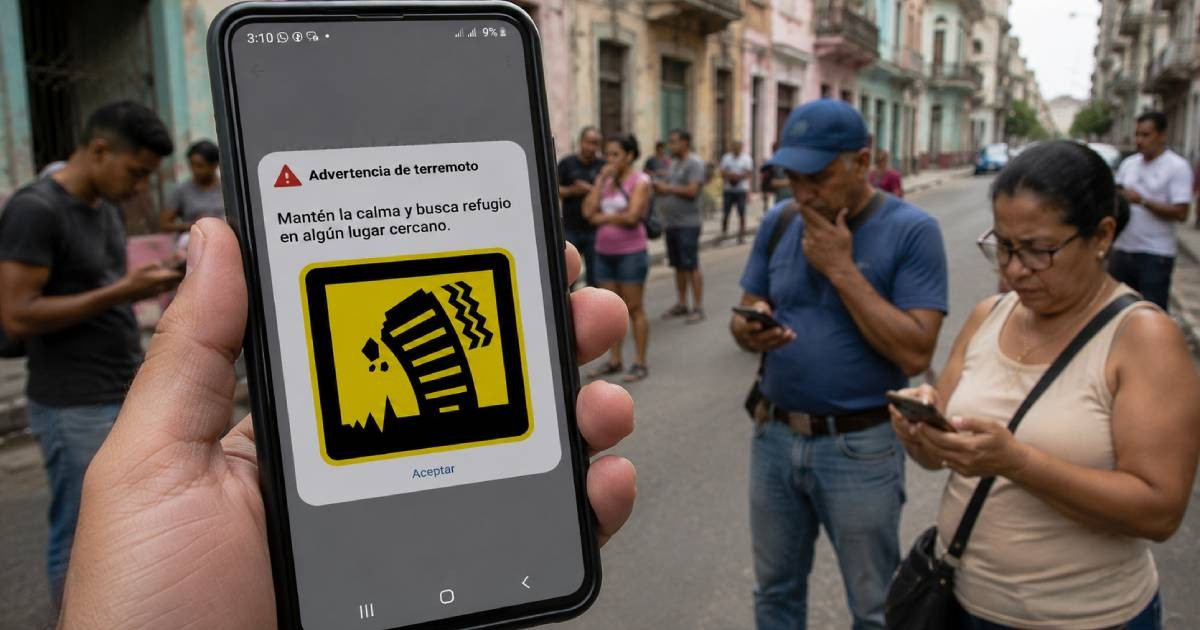
On Thursday, Google firmly denied any involvement in the false earthquake alert that stirred panic across several Cuban provinces on Tuesday, August 18.
In a statement to Martí Noticias, a Google spokesperson clarified, "These claims are incorrect. The Android Earthquake Alerts System neither detected an earthquake nor sent alerts in Cuba."
This statement counters the narrative spread by official regime media, such as Cubadebate, which initially blamed Google's Android seismic detection system for the alert mishap.
Suspicion Falls on ETECSA
Google's denial has intensified suspicions surrounding ETECSA, the state-owned telecommunications monopoly and the sole cellular network operator in the country.
A source, requesting anonymity due to fear of retribution and claiming to hold a senior management position at ETECSA, disclosed to Martí Noticias that the alert originated from an internal test conducted at the Technology Center located at 19 and B in El Vedado, Havana.
According to this account, the test was intended to be confined to a controlled environment, but the technicians lost control of its scope. "It was initially planned to appear in a test environment, but it got out of hand for the Core Network specialists involved," the source stated.
Details of the Internal Test Leak
The same source reported that following the incident, State Security personnel arrived at the technology center and held meetings with ETECSA officials until late at night. Allegedly, they ordered the deletion of messages related to the incident from several internal WhatsApp groups.
Martí Noticias noted that it could not independently verify these claims, and two ETECSA executives allegedly responsible for the test refused to answer phone calls.
Insight from Telecommunications Enthusiasts
Telecommunications enthusiast group Cell Mapper Cubano shared on X a screenshot of an Android device's alert history showing an "ETWS Test Message" received at 3:04 PM on Tuesday, followed precisely one minute later by an "Earthquake Alert" advising people to seek shelter.
ETWS, short for Earthquake and Tsunami Warning System, is an international standard that allows mobile network operators to broadcast emergency messages directly from network antennas to all compatible devices in an area, without needing mobile data or internet connectivity.
This detail is crucial: several users reported receiving the alert without active data or Wi-Fi, something technically incompatible with Google's system, which requires connectivity, but perfectly feasible with an ETWS broadcast controlled by the network operator.
Impact Across Cuban Provinces
The alert on Tuesday reached phones and tablets in Havana, Mayabeque, Matanzas, Ciego de Ávila, Camagüey, Las Tunas, Holguín, Granma, and Santiago de Cuba, causing evacuations and panic-stricken scenes.
The National Center for Seismological Research confirmed that none of its 24 stations had recorded any significant seismic activity, and the United States Geological Survey also did not report any earthquake on the Island.
As of Thursday, ETECSA has not publicly explained whether a test was conducted, who authorized it, why it affected nine provinces, or what measures will be taken to prevent a recurrence.
Understanding the False Earthquake Alert in Cuba
What did Google say about the false earthquake alert in Cuba?
Google stated that the claims of its system being responsible are incorrect and that the Android Earthquake Alerts System did not detect or send any alerts in Cuba.
Who is suspected to be responsible for the false alert?
Suspicion has fallen on ETECSA, the state-run telecommunications monopoly, as a source suggested the alert originated from an internal test that went beyond its intended scope.
What is ETWS and how does it work?
ETWS stands for Earthquake and Tsunami Warning System, an international standard enabling mobile operators to send emergency messages directly to devices in an area without requiring internet or mobile data.