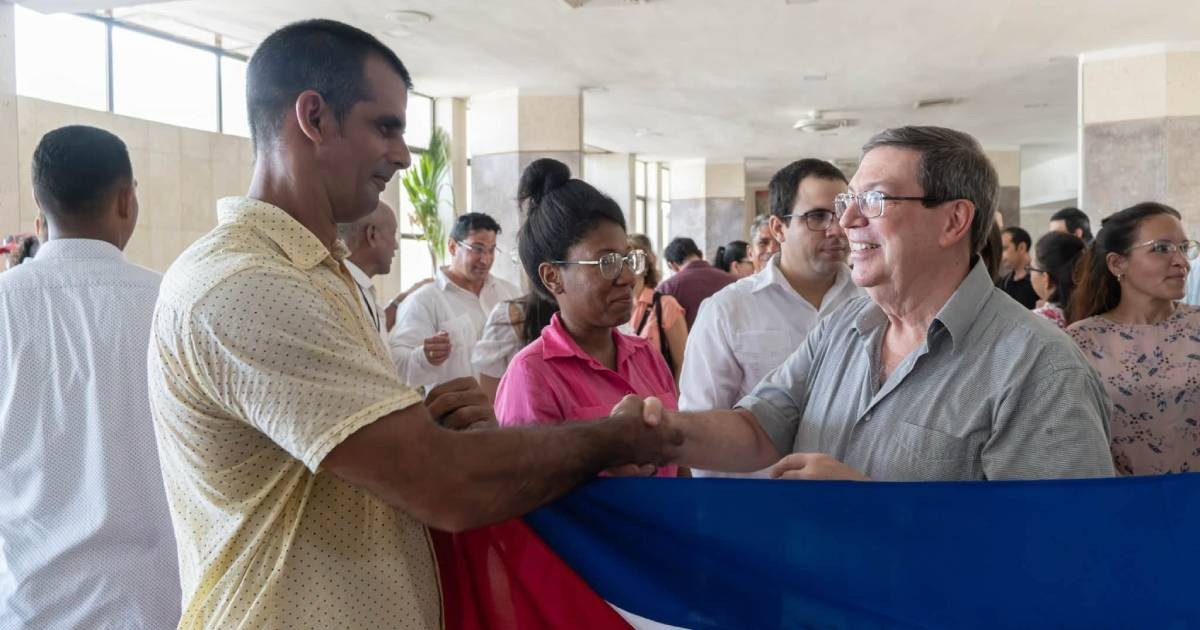
This Wednesday, the Cuban government hosted an official ceremony in Havana to welcome back ten embassy officials who were forced to leave the Dominican Republic. The expulsion was framed as a "job well done," with the Cuban authorities blaming the United States for Santo Domingo's decision.
The event was orchestrated by the Ministry of Foreign Affairs (MINREX) and led by Minister Bruno Rodríguez Parrilla and Vice Minister Josefina Vidal Ferreiro. Vidal defended the officials, without addressing reports of alleged Cuban surveillance activities during the Santo Domingo 2026 Central American and Caribbean Games.
"We welcome them with pride, convinced that they fulfilled their responsibilities during their mission," Vidal stated, according to a social media report from the Cuban Foreign Ministry.
The vice minister accused the Dominican Republic of acting "without any justification," attributing the decision directly to U.S. pressure.
"It is a response to the pressures from the U.S. government amid their ongoing escalation against Cuba," Vidal explained.
However, the Dominican Republic has not publicly stated that Washington was behind the action, nor has it officially explained the reasons for demanding the departure of the Cuban officials.
Diplomats Return with "Medal on the Chest"
The tone of defiance continued when Cuban Vice Consul in the Dominican Republic Odín Ysla Hernández, one of those forced to return, spoke at the event. He described the expulsion as an "imperial maneuver" aimed at diminishing the nation's prestige, asserting that he and his colleagues returned with "a job well done."
Ysla even referred to the expulsion as "a medal on the chest."
The official rhetoric avoided any mention of suspicions that emerged in the Dominican Republic regarding Cuban agents' activities during the Games, coinciding with several members of the Cuban sports delegation choosing to stay in the country.
Expulsion Amidst Athlete Desertions
On August 13, the Dominican government informed the Cuban mission that nine officials had to leave the country within seven days. Cuba claims ten were affected.
Invoking Article 9 of the Vienna Convention on Diplomatic Relations, the Dominican Republic declared the officials persona non grata without needing to publicly explain the reasons. This decision also impacted the officials' families, resulting in approximately 21 people leaving the country.
Cuban Ambassador Ángel Custodio Arzuaga Reyes was not among those expelled, and the embassy remained operational, avoiding a diplomatic break between the two nations.
The decision, however, came during a particularly awkward time for Havana. An investigation by Diario Libre suggested that Dominican authorities detected Cuban agents infiltrating facilities related to the Central American and Caribbean Games, some allegedly in uniforms of other delegations. The purpose was reportedly to monitor the Cuban delegation members and identify those considering defection.
The Dominican government has not officially confirmed that these alleged operations were the reason for the diplomats' expulsion.
Five Athletes Choose to Stay in the Dominican Republic
At least five Cuban athletes left their delegation during the Games and stayed in the Dominican Republic. Two of them have already begun procedures with the National Office for Refugees (CONARE), while the others are preparing to regularize their immigration status.
José Alberto Fernández, president of the Cuban Association in the Dominican Republic, recently claimed that surveillance over the delegation was substantial, suggesting that without such controls, more athletes and coaches might have chosen to flee.
The controversy has also reached Washington. Cuban-American Congressman Carlos Giménez praised the Dominican Republic's decision, thanking Santo Domingo for standing on the "right side of history."
In contrast, Havana chose to turn the officials' return into a politically charged ceremony: they were welcomed with "pride," their expulsion labeled a "medal," and the U.S. was blamed, yet suspicions about Cuban agents' activities during the Games, coinciding with five athletes leaving the official delegation, were left unaddressed.
Understanding the Diplomatic Tensions between Cuba and the Dominican Republic
Why were the Cuban diplomats expelled from the Dominican Republic?
The Dominican Republic declared the Cuban diplomats persona non grata under Article 9 of the Vienna Convention, though the specific reasons were not publicly disclosed. Reports suggest alleged surveillance activities by Cuban agents during the Central American and Caribbean Games may have played a role.
How did the Cuban government respond to the expulsion of their diplomats?
The Cuban government held an official ceremony to welcome the diplomats back with pride, framing their expulsion as a "job well done" and blaming U.S. pressure for the Dominican Republic's decision.
What was the impact of the expulsion on Cuban athletes?
The expulsion coincided with the defection of at least five Cuban athletes during the Games, who have since sought to regularize their status in the Dominican Republic.