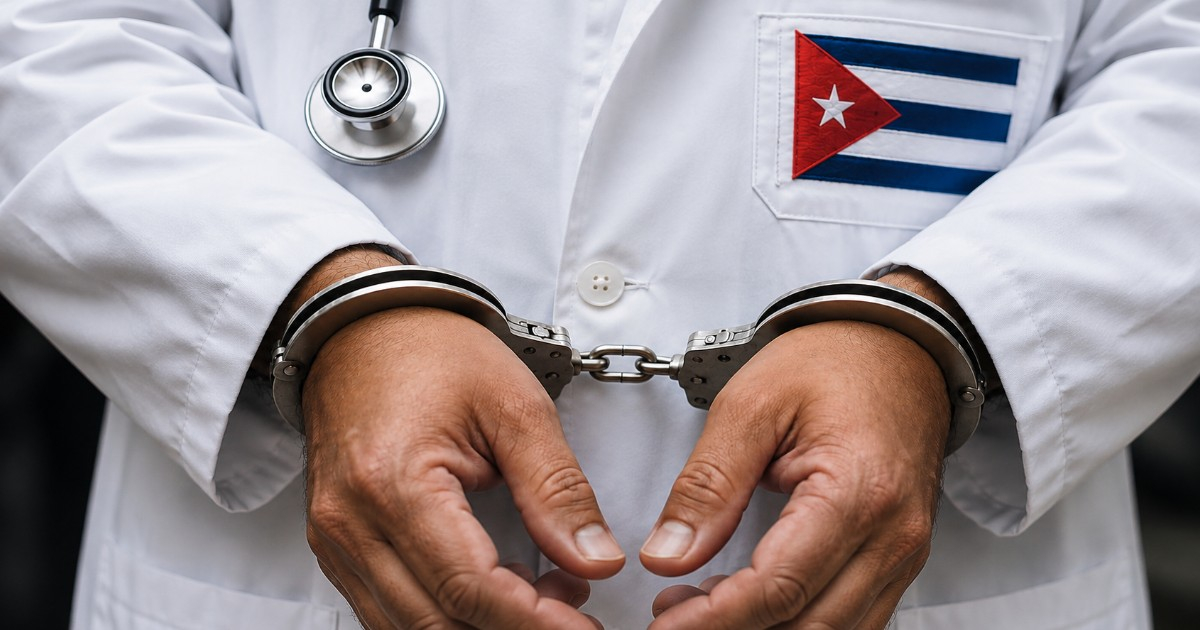
A recent report sheds light on the harsh realities faced by members of the Cuban medical brigades. Compiling various accounts, contracts, regulations, and economic data, the document suggests a disturbing pattern of forced labor, surveillance, movement restrictions, withheld wages, threats, and punishments targeting professionals sent abroad.
Prisoners Defenders and Consorcio Justicia unveiled the platform "Cuban Medical Brigades" on Tuesday, an initiative that compiles both historical and current information about Cuban missions across 209 countries and territories. This resource provides access to agreements, contracts, payments, regulations, testimonies, and potential rights abuses.
The organizations argue that the legal, economic, and disciplinary measures imposed on these professionals create a system resembling forced labor and modern-day slavery. They cite ambiguous or non-existent contracts, income confiscation, surveillance, personal life restrictions, penalties, and family separation as evidence.
The platform features 209 Country Reports, identifying 53 active missions as of June 2026, with approximately 25,724 professionals involved. It also keeps records of 9,646 individuals classified as "deserters." The authors clarify that the active personnel count is based on available national estimates and is not a unique official census.
Compelling Testimonies and Coercive Contracts
The investigation is supported by 1,402 testimonies gathered since 2018—1,185 protected and 217 public, covering experiences in 60 countries. All statistical percentages in the report are derived solely from the 1,185 protected testimonies.
Among those testimonies, 89.79% revealed they were forced to participate in the mission or accepted due to coercive circumstances. When asked about voluntariness, 77.72% stated their participation was not voluntary. Furthermore, 32.41% claimed they never received a contract, while another 36.20% said they signed one but never received a copy.
The report also highlights the issue of surveillance; 40% reported that their passports were confiscated upon arrival in the host country, and 77.64% claimed they were monitored by Cuban officials or their affiliates.
Surveillance and Control Over Personal Lives
Surveillance and personal life control are significant issues. A staggering 81.18% reported restrictions on their movement within the country, 75.27% said they couldn't stay overnight outside their assigned lodging without permission, and 68.69% indicated a curfew was in place.
Moreover, 85.32% were required to attend political meetings. Surveillance among peers was also documented, with 67.76% instructed to monitor fellow professionals, 77.97% had to report suspicions of a colleague planning to leave the mission, and 64.64% participated in acts of repudiation against those who did.
Long Hours and Low Wages
The testimonies show an average of 5.75 workdays per week and 9.91 hours per day. Including extra duties, Prisoners Defenders estimates an average total workload of 71.89 hours weekly. Additionally, 60.84% were forced to inflate service statistics artificially, a practice reported in 42 of the 60 countries involved in the testimonies.
Another 65.32% engaged in political tasks among the host country’s population, and 63.97% contributed part of their salary to official Cuban organizations. The average net income reported by professionals during missions was $462.29 monthly. The economic analysis of the testimonies suggests workers received around 15% of the amount promised by the host country, while the Cuban state and intermediaries retained or demanded a return of approximately 85%.
Threats and Separation from Home
Questions about threats and violence included both direct experiences and situations witnessed involving other colleagues. Under these criteria, 75.78% reported threats, 21.86% mentioned physical violence attributed to officials or conducted with their approval, and 43.12% experienced sexual harassment.
The report also addresses the so-called "Eight-Year Law," although this term doesn't reflect the official name of a single law. This mechanism combines legal, migratory, and administrative practices applied to those who leave a mission or refuse to return. Article 176 of the Penal Code prescribes sentences of three to eight years for certain public officials who abandon a mission, with two to five years for public employees.
Until the new Migration Law takes effect on November 1, 2026, Law 1312 remains in force. A significant 91.14% of protected testimonies indicated they were warned that leaving the mission would mean not being able to return to Cuba for eight years.
International Scrutiny and Legal Challenges
Prisoners Defenders emphasizes that international statements vary in legal nature and shouldn't all be described as "UN sentences" or "convictions." The report references UN Special Procedures communications on Cuban medical missions' conditions, Children's Rights Committee concerns over family separation, ILO statements, CIDH and REDESCA reports, and European Parliament resolutions.
The CIDH noted in 2026 that certain situations, when evaluated individually, could constitute forced labor and, in some cases, trafficking. The organization also documented issues related to contracts, document retention, wages, surveillance, and movement restrictions.
The platform lists five European Parliament resolutions between 2021 and 2026. Among these, in 2021, the Eurochamber condemned human and labor rights violations against Cuban healthcare workers abroad, while in 2025, an amendment labeled the brigades as "modern slavery" and "forced labor."
The Cuban government dismisses allegations of modern slavery and human trafficking. Miguel Díaz-Canel denies exploitation, asserting that professionals participate voluntarily, while authorities frame the missions as a solidarity program and "the most noble face of the Revolution."
Prisoners Defenders challenges this narrative, asserting that the documented economic and disciplinary structure contradicts such claims. The organizations call for the elimination of penalties related to mission abandonment, transparency in contracts, free contracting and direct payment, passport retention, and unrestricted return to Cuba, alongside independent complaint and audit mechanisms in host countries.
These demands align with CIDH recommendations on voluntariness, direct payment, freedom of movement, and independent inspections.
Understanding Cuban Medical Brigades and Human Rights Concerns
What are the main allegations against the Cuban medical brigades?
The primary allegations include forced labor, surveillance, movement restrictions, withheld wages, threats, and punishments against healthcare professionals sent abroad.
How is the Cuban government responding to these accusations?
The Cuban government rejects these accusations, with officials like Miguel Díaz-Canel asserting that participation is voluntary and framing the missions as a solidarity program.
What measures are being recommended to address these issues?
Recommendations include eliminating penalties for mission abandonment, ensuring transparency in contracts, allowing free contracting and direct payment, and implementing independent complaint and audit mechanisms in host countries.