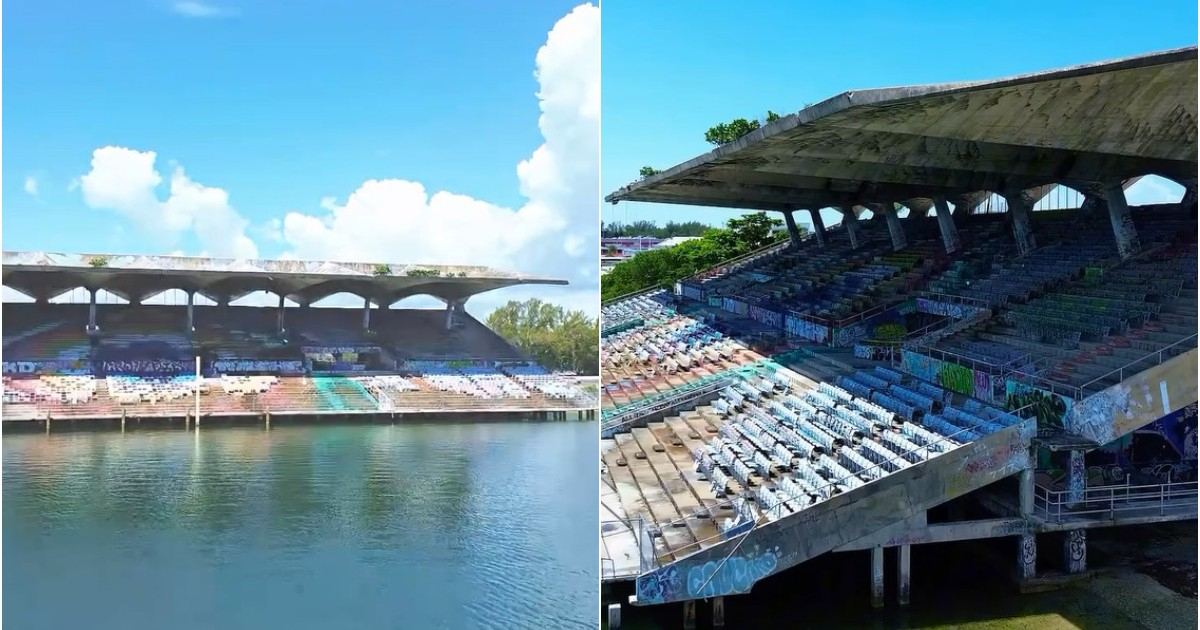
In a decisive move, Miami voters endorsed a proposal on Tuesday that allows the city to partner with a private firm to renovate the historic Miami Marine Stadium. This iconic venue, located on Virginia Key, has languished for over 30 years.
Preliminary results indicated robust support, with about 68.70% in favor and 31.30% opposed. This marks a significant win for those who have long advocated for preserving this architectural landmark, originally designed by a Cuban exile.
Known as Item 172, this measure permits Miami to enter a management agreement of up to 40 years with Global Spectrum L.P., a subsidiary of Oak View Group. The agreement would cover the stadium and the adjacent area dubbed "Flex Park."
Under the approved plan, the city stands to receive 93% of gross event revenue and 85% of sponsorship income. The total cost for the restoration is estimated to range from $65 million to $85 million.
The Cuban Legacy Behind Miami's Marine Stadium
The stadium is a testament to the vision of Hilario Candela, a Havana-born architect who fled Cuba in 1960. At 27, he designed a structure that defied conventional building norms: a 99-meter cantilevered concrete roof without a single supporting column—the longest of its kind globally at the time. Opened in December 1963, the stadium could seat 6,500 and was the nation's only venue dedicated to high-speed powerboat racing.
Over the years, the stadium became a cultural hub, hosting the filming of Elvis Presley's "Clambake" in 1967 and performances by luminaries like Gloria Estefan, Ray Charles, Whitney Houston, and the Beach Boys. In 1972, President Richard Nixon and Sammy Davis Jr. shared the stage at a campaign rally.
The site also held celebrations for Our Lady of Charity of El Cobre, cherished by the Cuban-American community.
Although Hurricane Andrew in 1992 led to its closure, later engineering assessments confirmed no real damage to the structure. Nevertheless, it remained fenced off and covered in graffiti, even after its inclusion in the U.S. National Register of Historic Places in 2018.
Hilario Candela passed away in January 2022 in Coral Gables at 87, without witnessing the restoration of his creation, though he advocated for it throughout his life.
Miami Commissioner Damian Pardo, who spearheaded the commission process, emphasized the site's symbolic significance: "It encapsulated an incredibly unique era in Miami's history, connecting deeply with all city residents. It's a place that resonates personally with Miami."
Ongoing Struggles for Reopening
Efforts to restore the stadium have repeatedly fallen short. In 2018, a $42 million restoration plan was announced but never materialized.
In September 2025, another attempt faltered when then-CEO of Oak View Group, Tim Leiweke, faced allegations of bid manipulation in Texas. After OVG paid $15 million in penalties, Leiweke was pardoned by President Trump in December 2025, allowing the process to resume.
Even Gloria Estefan, who performed there in the 1980s with the Miami Sound Machine, led a campaign in 2013 to revive the venue.
In July of this year, Emi Guerra, co-founder of Breakwater Hospitality Group and associated with the selected consortium, compared the site's potential to Denver's Red Rocks Amphitheatre, emphasizing that the city would retain full ownership of the stadium and the land.
Donald Worth, co-founder of Restore Miami Marine Stadium, who started the preservation campaign in 2008 when city officials planned its demolition, remarked, "The architecture amazes; the history gives it soul. It's a magical place, and so many in Miami have unforgettable memories there."
Frequently Asked Questions about the Miami Marine Stadium
What is the history behind the Miami Marine Stadium?
The Miami Marine Stadium, designed by Cuban architect Hilario Candela, was opened in 1963 and became the only venue in the U.S. dedicated to high-speed powerboat racing. It has hosted numerous cultural events and performances over the years.
What are the financial details of the restoration plan?
The estimated cost for restoring the stadium is between $65 million and $85 million. The city will receive 93% of event revenue and 85% of sponsorship income under the new management agreement.
Who is responsible for the stadium's management moving forward?
Global Spectrum L.P., a subsidiary of Oak View Group, will manage the Miami Marine Stadium under a potential 40-year contract with the city of Miami.