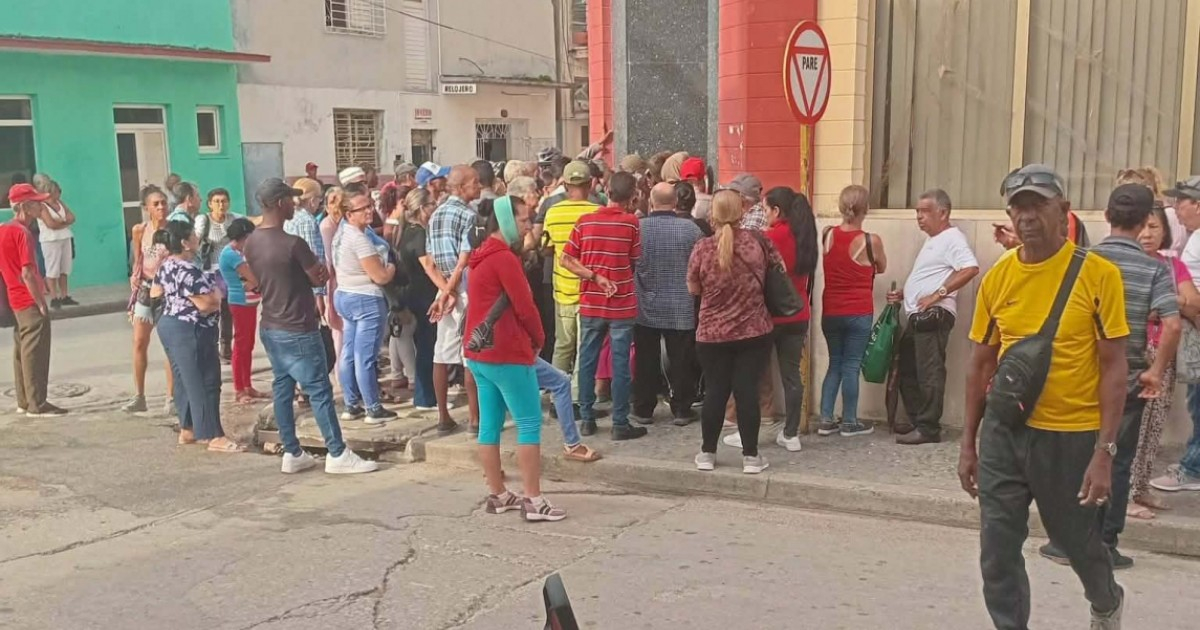
On Tuesday, Cuban writer Manuel García Verdecia took to Facebook to highlight the ongoing struggle retirees in Holguín face each month to collect their pensions. Long lines stretch outside bank branches, while those relying on postal offices find themselves unable to receive their payments due to a lack of funds.
"Retirees expecting to get paid at the post office couldn't do so because the money wasn't deposited. As for the banks, it's the same story every month—a sea of desperate faces," García Verdecia wrote.
The post, aptly titled "PAYDAY," includes images depicting crowds of people gathered outside BANDEC (Banco de Crédito y Comercio) and Banco Popular de Ahorro branches in Holguín. These photos reveal elderly individuals mingling with others under the scorching sun, their expressions marked by anxiety and exhaustion.
The writer concluded his criticism with a question that encapsulates the growing frustration: "Is there any official who cares about this never-ending cycle of anxiety and confusion that repeats every month?"
This scenario is far from isolated. It represents a monthly ordeal for over 1.7 million Cuban retirees, who strive to access a meager pension of 4,000 Cuban pesos—equivalent to less than $10 at the current informal exchange rate in 2026—while the cost of basic necessities ranges from 12,000 to 30,000 pesos per person.
On the same day, the Banco Popular de Ahorro in Sierra de Cubitas, Camagüey, remained shuttered for several days, leaving seniors without access to their pensions.
In Santiago de Cuba, some branches can only serve about 50 retirees daily, forcing many to start lining up as early as 6 p.m. the previous day.
Banking System Collapse Worsens
The collapse of the Cuban banking system has been worsening for months. As of May, more than half of the country's ATMs were out of service or empty. Banks operate with limited hours—in Camagüey, from 9:00 a.m. to 1:00 p.m. Monday through Friday—and frequent power outages disrupt customer service.
In April, retirees in Havana described it as a "miracle" to receive their funds amidst the chaos and crowding at bank branches.
The regime has acknowledged the issue in a piecemeal fashion. In June, authorities in Granma admitted they lacked over 400 million pesos needed to pay their more than 111,000 retirees that month. As an emergency measure, in July, the Central Bank expanded the "Caja Extra" scheme, allowing private businesses and micro-enterprises to pay pensions with their cash, receiving state compensation within 72 hours—a mechanism economists criticize for its risks and limitations.
In February, Finance and Prices Minister Vladimir Regueiro Ale assured that pension payments were "guaranteed in the budget," though he conceded the system faced "significant challenges." However, the monthly reality on Cuban streets contradicts this assurance.
The crisis has also paved the way for corruption: In Ciego de Ávila, a postal worker was sentenced to four years in prison for telling retirees "there's no cash" while embezzling their funds. In San Luis, Pinar del Río, the theft of over three million pesos intended for pensions left more than 1,110 retirees unpaid.
Understanding Cuba's Pension Crisis
What challenges do retirees in Holguín face when collecting pensions?
Retirees in Holguín face long lines at banks and often find that postal offices have not received the necessary funds to distribute pensions.
How does the Cuban banking system's collapse affect retirees?
The collapse results in many ATMs being out of service, limited bank operating hours, and frequent power outages, all of which hinder retirees' ability to access their pensions.
What measures has the Cuban government taken to address pension payment issues?
The government introduced the "Caja Extra" scheme, allowing private entities to pay pensions, but this solution has been criticized for its risks and limitations.