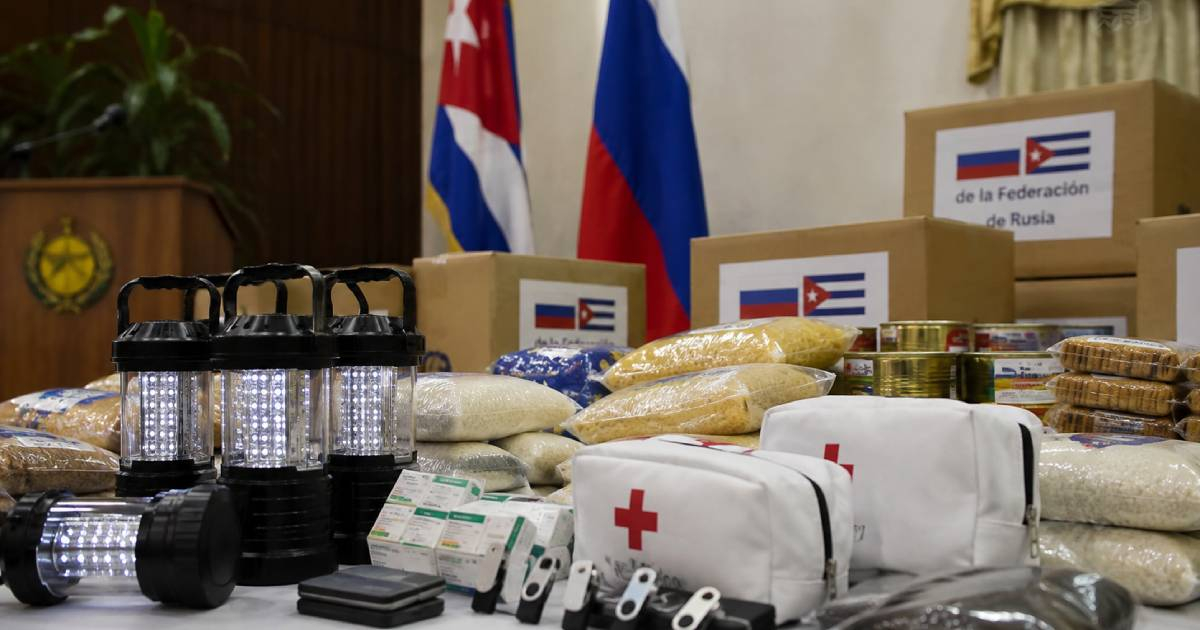
A delegation from the Russian Civic Chamber recently arrived in Havana, delivering a humanitarian aid package to Cuba, which included food, sweets, portable flashlights, USB drives, and first-aid kits. This assistance comes at a crucial time as the Cuban population grapples with severe shortages of basic goods and continuous power outages.
According to the state-run media outlet Prensa Latina, which cited Russkiy Mir.ru, the aid was given during a meeting with officials from the Cuban Institute of Friendship with the Peoples (ICAP).
The Russian delegation's visit coincided with activities organized by the Cuban regime to commemorate the 100th anniversary of the birth of dictator Fidel Castro, marked on August 13.
Significance of Flashlights in Cuba's Energy Crisis
Among the donated items, the inclusion of portable flashlights is particularly noteworthy given Cuba's current circumstances. The nation is mired in a severe energy crisis, with power generation deficits exceeding 2,000 MW, leading to blackouts that can last most of the day in certain regions.
In such a dire scenario, a simple flashlight has become an essential tool for many families to navigate the long nights without electricity.
Nikita Anisimov, a member of the Russian Civic Chamber and the Public Council of Rossotrudnichestvo—the Russian federal agency for humanitarian cooperation abroad—emphasized during the meeting that Moscow will continue to support Havana.
"Russia stands with Cuba and will keep backing it in all international forums where our country's NGOs participate," Anisimov stated.
Acknowledgment of Cuba's Dire Needs
On the Cuban side, ICAP's First Vice President Noemí Rabasa expressed gratitude for the donation and acknowledged the severe shortages currently faced by the population. Rabasa admitted that Cubans "lack basic products such as medicines, fuel, and food."
This acknowledgment is significant amidst an economic crisis that has rapidly worsened living conditions on the island. While the regime frequently blames U.S. sanctions for the situation, economists and critics also highlight decades of inefficiency, lack of structural reforms, and economic mismanagement.
The ICAP, which hosted the ceremony, was sanctioned by the U.S. Department of the Treasury last June under Executive Order 14404, identifying it as a Cuban government agency.
Ongoing Russian Support Amidst Cuba's Struggles
Russia's aid delivery adds to other donations made in 2026, illustrating Havana's growing reliance on allies to address shortages in essential sectors. Just four days prior, Russia donated three ambulances designated for medical services in Havana, Matanzas, and Santiago de Cuba.
In April, Moscow also provided a donation of medicines, and earlier in the year, shipments of fuel and crude oil were announced to help alleviate the island's severe energy crisis.
Beyond humanitarian aid, cooperation extends to investment projects. During the Russian-Cuban intergovernmental commission held between March and April, both governments discussed investments exceeding $1 billion in sectors like energy, transportation, and industry.
The successive donations highlight the close political and economic ties between Havana and Moscow, while also exposing the extent of Cuba's internal needs. This paradox is hard to ignore: while Cuban authorities present these deliveries as international solidarity, the very composition of the aid underscores a crisis where food, medicine, and fuel are scarce, and even a flashlight becomes vital for enduring prolonged power outages.
Understanding Russia's Aid to Cuba
What items were included in Russia's humanitarian aid to Cuba?
The aid package from Russia to Cuba included food, sweets, portable flashlights, USB drives, and first-aid kits.
Why are flashlights significant in the current Cuban context?
Flashlights are crucial in Cuba due to the severe energy crisis and frequent power outages, making them essential for families to cope with long periods without electricity.
How is Russia contributing to Cuba beyond humanitarian aid?
Russia is also involved in investment projects with Cuba, discussing over $1 billion in sectors such as energy, transportation, and industry as part of their intergovernmental cooperation.