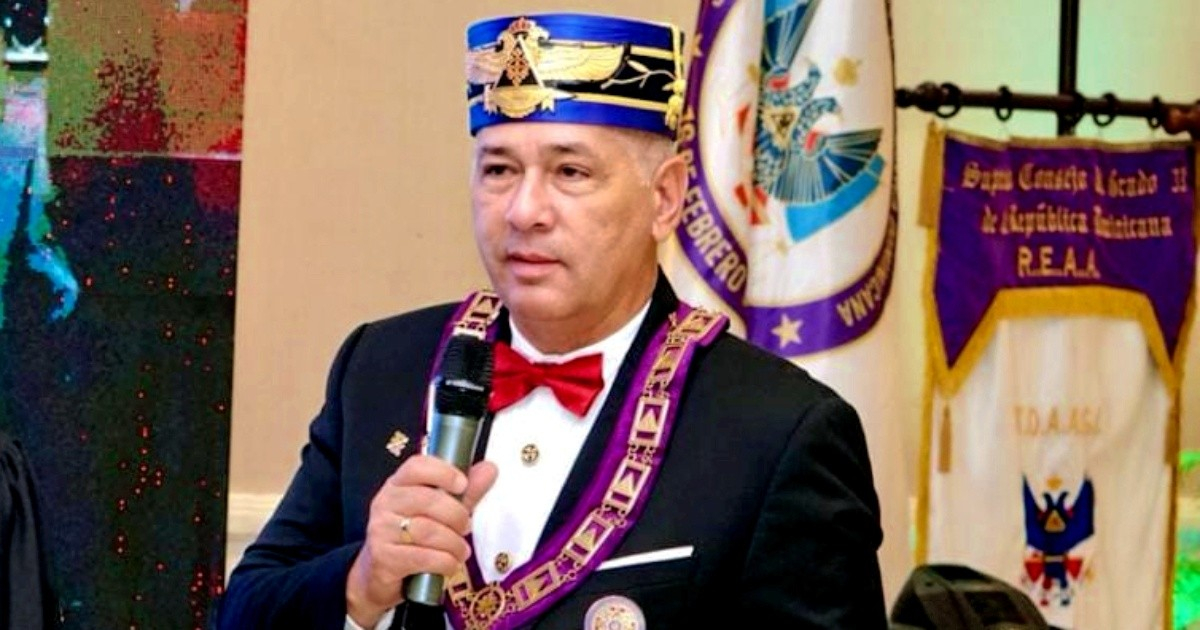
José Ramón Viñas Alonso, the Sovereign Grand Commander of the Supreme Council of the 33rd Degree for the Republic of Cuba, is set to appear before a criminal investigator this Tuesday at the Infanta and Manglar police station in Havana. He is accused of the alleged crime of "disobedience," as reported by the independent news outlet Cubanet.
The summons was handed to Viñas Alonso's wife on Monday by an officer of the Revolutionary National Police (PNR) at their home.
The document specifies that the Masonic leader must present himself at 2:00 p.m. to "Captain Andy," identified as the criminal investigator for the Department of Crimes against State Security.
Masonic Brotherhood Rallies in Support
Before the scheduled appearance, dozens of Masons gathered around the police station under the banner "Masonry is to be respected."
A call circulated among members of the order captured the community's sentiment: "The regime attacks again! All brothers will be there with him, supporting him."
This summons follows ten days after over a hundred Masons convened at the Supreme Council headquarters—known as the "Scottish Cathedral" in Central Havana—to support Viñas Alonso and protest what they denounced as direct interference from the Ministry of Justice (MINJUS) in the internal affairs of the institution.
Sergio Rafael Vidal Águila, a Mason, described the situation as unprecedented: "This is an event without precedent in the world."
MINJUS and Its Attempts at Intervention
On August 7, more than a hundred Masons stood their ground in Havana against a new attempt at state intervention. That day, the Director of Associations of MINJUS, Miriam García Mariño, appeared at the "Scottish Cathedral" with two officials, demanding that Viñas Alonso relinquish his position, claiming the agency would appoint an interim replacement until new elections.
A Mason in attendance, who requested anonymity, recounted García Mariño's bluntness: "She stated that no explanations were needed, that this was the court's decision, and that Masons must respect the country's laws."
The response was swift. Videos obtained by Cubanet captured chants such as "Out," "No more interference," and "Masons decide Masonic matters."
García Mariño and her entourage left visibly upset, while the regime deployed political police forces in the vicinity.
The Supreme Council's lawyer, Roberto Ortega, pointed out that there was no mandate supporting such a measure.
A Conflict Rooted in 11J Protests
The clash between the regime and the Supreme Council has deep roots.
The conflict dates back to July 2021, when the High Chamber of the Rite approved an open letter to Miguel Díaz-Canel, condemning the "combat order" issued during the July 11 protests.
Since then, Viñas Alonso has faced ongoing pressure and interrogation.
In July 2025, MINJUS issued Resolution 342/25, refusing to recognize him as the sovereign grand commander, citing that he had exceeded the term limit of nine years. The Supreme People's Court upheld this resolution with a final ruling.
Simultaneously, the regime launched criminal proceedings against Masonic leaders: Viñas Alonso was accused of alleged "currency trafficking" for exchanging 100 dollars in the informal market and remains under house arrest.
The Supreme Council's Grand Chancellor, writer Ángel Santiesteban Prats, faced similar charges in June 2026.
The Regime's Candidate and Legal Maneuvers
MINJUS aims to install Lázaro Faustino Cuesta Valdés at the helm of the Supreme Council, who, according to Masons, was removed from his duties upon reaching 80 years in February 2025 and later expelled by the High Chamber of the Rite.
In Cuba, Law 54 on Associations grants MINJUS extensive oversight powers over all fraternal and religious organizations, requiring them to provide copies of minutes and obtain approvals for any internal reforms, under threat of fines or closure.
Viñas Alonso has reported that State Security agents have repeatedly threatened him with imprisonment if he refuses to resign from his position.
Key Questions about the Cuban Masonic Leadership Crisis
What are the charges against José Ramón Viñas Alonso?
José Ramón Viñas Alonso is accused of "disobedience" by the Cuban authorities, which is seen as a move to suppress dissent within the Masonic community in Cuba.
How has the Masonic community responded to the charges?
The Masonic community has rallied in support of Viñas Alonso, gathering in large numbers to protest what they see as government interference in their internal affairs.
What is the significance of the 11J protests in this context?
The 11J protests are relevant as the initial conflict between the Cuban regime and the Masons began after the Masonic Rite condemned the government's actions during the July 11 protests.