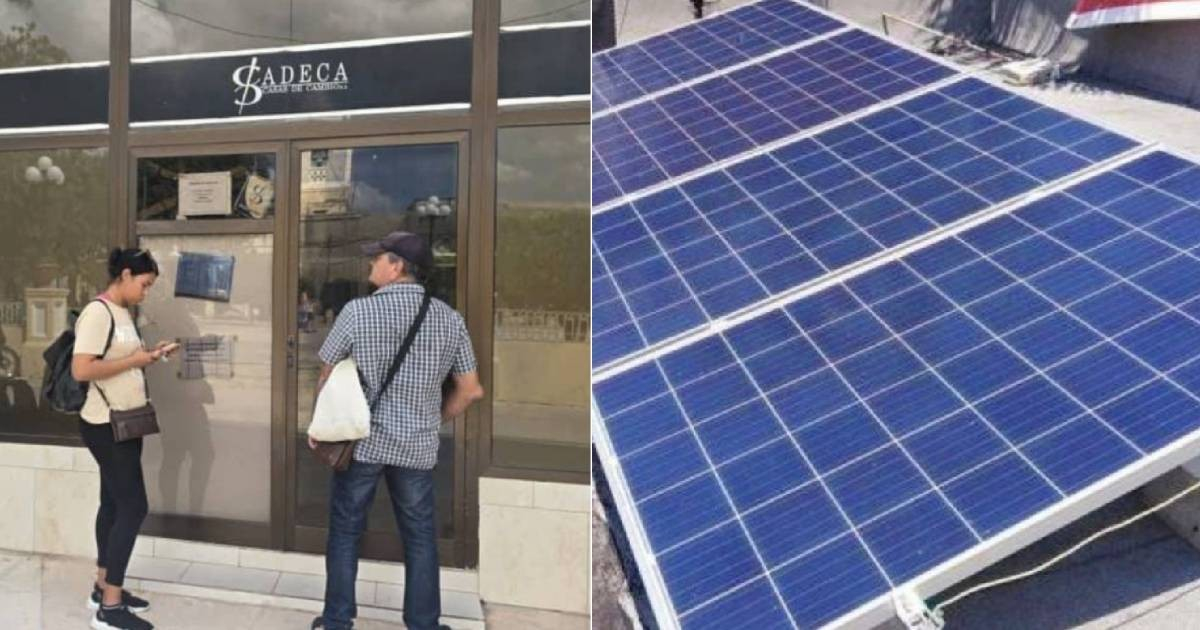
This past Monday, Facebook user L. Eduardo Domínguez shared an insightful analysis that juxtaposes seven economic promises made by the Cuban regime with the harsh realities faced by the island's residents. His review spans from foreign currency stores to the ongoing electricity crisis.
"Today, I just want to jog your memory a bit, in case the higher-ups forget what they promised," Domínguez wrote as he delved into the major failures of Cuba's economic policies from 2019 to 2026.
The Illusion of Foreign Currency Stores
The first target of Domínguez's critique is the establishment of stores operating in Freely Convertible Currency (MLC). In July 2020, the state-run newspaper Granma quoted officials from Tiendas Caribe and CIMEX, who assured that only 72 stores would sell mid- to high-end goods without affecting the supply of products in Cuban pesos. However, what transpired was quite the opposite: essential goods like chicken, cooking oil, and hygiene products vanished from peso markets and appeared only in stores requiring foreign currency.
The pledge that revenue from these foreign currencies would replenish peso markets also fell through. "Markets in CUP were never restocked," notes Domínguez, highlighting that the MLC stores themselves eventually faced shortages as the regime expanded dollar-only sales. By May 2025, at least 80 stores operated exclusively in dollars, far exceeding the promised limit.
Partial Dollarization and Its Consequences
The issue of dollarization presents an even starker contrast. In October 2020, then-Economy Minister Alejandro Gil stated on the Mesa Redonda program that "Cuba will not dollarize its economy" and described MLC stores as "necessary but temporary." Years later, the regime admitted to a "partial and temporary dollarization" as the dollar infiltrated commerce, services, telecommunications, and even fuel.
The Impact of Economic Reforms
Domínguez also scrutinizes the Ordenamiento Task of December 2020, which aimed to "subsidize people, not products." The removal of universal subsidies, coupled with inflation reaching 24.88% year-on-year by the end of 2024 (as reported by the National Office of Statistics), left workers and pensioners without true economic support. The UN linked this reform to worsening food shortages on the island.
Failed Policies on Import Substitution and Infrastructure
The long-standing slogan of import substitution, reiterated at every Communist Party congress for decades, is similarly criticized. Cuban agricultural and industrial production plummeted by over 30% and 50%, respectively. Today, Cuba imports more than 80% of its food, spending nearly $2.5 billion annually.
The ETECSA "tariff hike" of May 2025, which capped peso recharges at 360 monthly and introduced dollar plans, was defended by company executives as a move towards "self-financing" to modernize infrastructure. Over a year later, ETECSA continues to rake in millions, while mobile services suffer from frequent disruptions exacerbated by power outages and the energy dependency of cellular towers.
Unfulfilled Renewable Energy Projects
The final point of the analysis addresses the 2024 announcement of 92 photovoltaic solar parks, projected to generate 2,000 MW. Energy and Mines Minister Vicente de la O Levy assured in December of that year that daytime electricity demands would be met by June 2025. However, the reality in 2026 shows a different picture: the National Electric System reports deficits exceeding 2,000 MW, with Havana experiencing blackouts lasting 30 to 40 hours, and up to 70 hours in other provinces, alongside at least six total system failures this year.
Domínguez concluded his post with an open invitation: "Leave other unfulfilled promises in the comments, and I'll add them." Comments quickly flooded in, with users sharing their own recollections of long-standing shortages and agreeing that the regime's strategy has always been to "make us lose track of time" with recycled resolutions that never result in tangible improvements.
Understanding Cuba's Economic Challenges
What are the Freely Convertible Currency (MLC) stores in Cuba?
MLC stores in Cuba sell goods in foreign currencies instead of the local currency. They were initially intended to offer mid- to high-end products without impacting local currency markets, but have led to shortages in peso markets.
How has dollarization affected the Cuban economy?
Dollarization has led to a partial shift in the economy, with more transactions occurring in dollars across various sectors, despite initial promises of it being a temporary measure. This shift has further complicated economic conditions for residents relying on Cuban pesos.
What was the purpose of the Ordenamiento Task in Cuba?
The Ordenamiento Task aimed to restructure the economic model by subsidizing individuals instead of products. However, it led to increased economic hardships due to inflation and the removal of universal subsidies without adequate support systems in place.