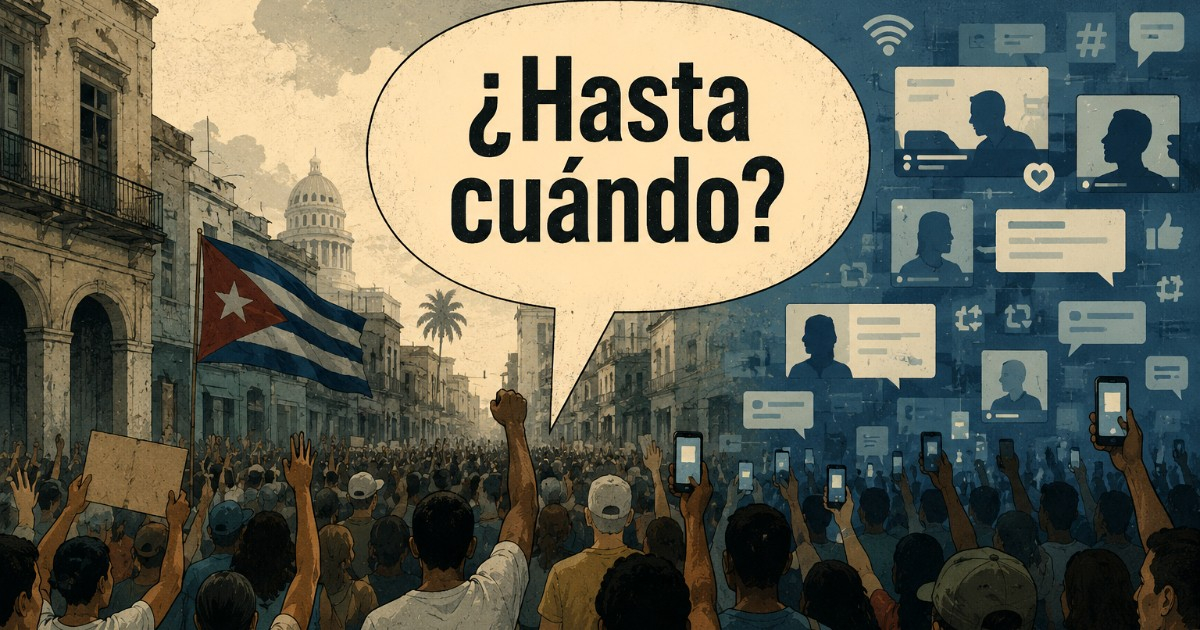
The youth group 'Out of the Box Cuba' disclosed on Monday that during a police summons involving two of its members, State Security officers warned them that even uttering the phrase "how long?" could be considered a crime of incitement.
The revelation, shared on the group's official account on X, highlights the extent to which the regime has criminalized the simplest expressions of public discontent. They aggressively pursue anyone daring to voice opposition to its enduring hold on power.
"One of the most shocking aspects of Betty and Abel's summons was being told that even a 'how long?' could be seen as incitement. The logic escapes the minds of these oppressors. Freedom of speech is merely a dream," the group wrote.
The individuals in question, Amanda Beatriz Andrés Navarro ("Betty") and Abel Alejandro Andrés Navarro, siblings and group members, were detained for over eight hours on July 2 at the Revolutionary National Police station on Aguilera Street, in the 10th of October municipality, Havana—a duration the group criticized as exceeding the legal limit.
On that same day, in what the group described as a coordinated operation, Anna Sofía Benítez Silvente and Pastor Rolando Pérez Lora were also summoned to the Alamar station, seemingly to prevent the activists from attending an event at the residence of the U.S. Embassy's chief of mission, Mike Hammer.
During the questioning, potential charges such as "incitement to commit a crime," "defamation," and "denigration of heroes" were mentioned. The harassment persisted: in mid-July, a State Security agent threatened Abel again, the same officer who had interrogated him weeks earlier.
The caution surrounding the phrase "how long?" is significant. This question frequently appears in comments and posts by Cubans on social media, reflecting widespread frustration with prolonged blackouts, shortages, and the worsening living conditions.
The Cuban Conflict Observatory recorded 107 street protests in June 2026—the highest monthly figure to date, with 82 in Havana alone—and over 1,400 instances of conflict in July, including 72 in-person protests.
'Out of the Box Cuba' emerged in January 2026 in the Cerro district of Havana, founded by four young individuals in their twenties: Karel Daniel Hernández Bosques, Amanda Beatriz Andrés Navarro, Abel Alejandro Andrés Navarro, and Mauro Reigos Pérez.
The group employs art, theater, and social media videos to foster critical thinking and challenge state indoctrination, recognized by their red caps emblazoned with the slogan "Make Cuba Great Again."
Since their inception, they have faced increasing reprisals: phone disabling in March, family summons in April, and prolonged interrogations in July. In May, Mike Hammer met with group members, and Secretary of State Marco Rubio publicly expressed support, raising their international profile and seemingly intensifying the regime's pressure.
The legal framework supporting these threats is the 2022 Cuban Penal Code, where Article 268.1 penalizes public incitement to commit a crime with six months to a year in prison, intensified when social media is used. Article 124 punishes propaganda against the constitutional order with up to ten years in prison.
Amnesty International warned that this code has entrenched severe restrictions on freedom of expression and enabled the criminalization of critical online content.
In response to the group's post, one user captured the sentiment of many: "Let's make it viral. Let's do everything that annoys the dictatorship, which is nearly everything."
Understanding Cuba's Repressive Regime
What triggered the police summons of 'Out of the Box Cuba' members?
The summons was part of a coordinated operation by State Security to prevent the group's members from attending an event at the U.S. Embassy's chief of mission's residence and to intimidate them over their activism.
Why is the phrase "how long?" significant in Cuba?
The phrase "how long?" is commonly used by Cubans on social media to express frustration and dissatisfaction with the country's prolonged blackouts, shortages, and declining living standards.
How has the Cuban regime responded to public dissent?
The regime has criminalized expressions of dissent, using legal frameworks to prosecute individuals for incitement and other charges, thereby attempting to suppress any opposition and maintain its power.