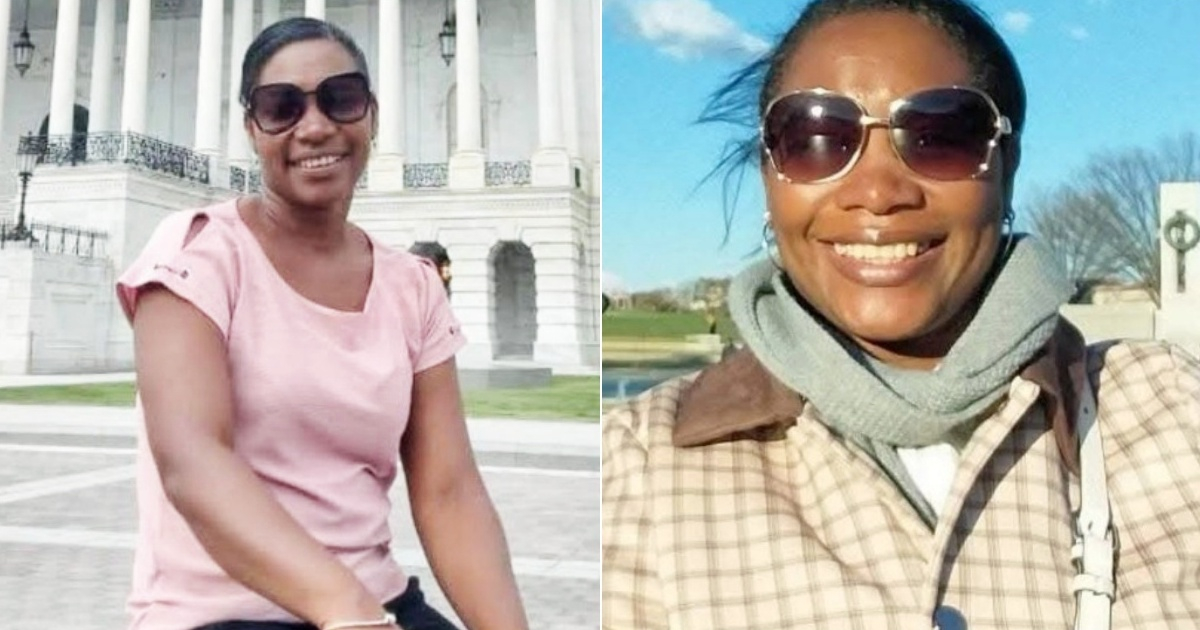
Katrina Castro-Menéndez, a 41-year-old former judge from Matanzas, Cuba, has been held at the Broward Transitional Center since June 12. Six agents from U.S. Immigration and Customs Enforcement (ICE) apprehended her in a vehicular sting as she left her residence in Cooper City, Florida. Her situation was detailed in an interview with El País conducted at the detention facility.
Accusations from the Department of Homeland Security
The Department of Homeland Security (DHS) claims that Castro-Menéndez is inadmissible on two counts: allegedly seeking immigration benefits through "fraud or willful misrepresentation" and purportedly being affiliated with the Communist Party of Cuba (PCC).
The immigration court file in Miami notes, "Under penalty of perjury, you failed to disclose your connection with the Communist Party while serving as a criminal judge at the Municipal People's Court of Centro Habana."
Katrina denies these charges. At the age of 23, she began her career as a judge, while PCC statutes indicate most members join after age 30. El País verified with three other Cuban judges that being in the PCC is not a mandatory requirement for the judicial position.
"The prosecutor will never prove I was a member, just as I can't prove I wasn't. They also claim I needed to be in the party to be a judge, which is false. This is an inconsistency," she asserted.
A Journey Far from Power
Raised in rural Matanzas, Castro-Menéndez studied law at the University of Havana. After graduation, she was appointed to the Cárdenas court as part of her social service, earning 190 pesos a month, equivalent to about seven dollars. "No one wanted to work there because of the salary," she recalls.
The penalties she imposed never exceeded 12 months and were confined to minor offenses: "It was the man who stole a bike from the corner or the one who took fruits from a grocery store." She never handled cases involving political protests.
She left her position in 2014, worked as a lawyer at the Centro Habana Collective Law Firm, and in 2019, traveled to Mexico to pursue a Master's in Human Rights. On August 13, 2021, she presented herself at an Arizona border crossing and was released with an I-220A status, affecting over 500,000 Cubans in the U.S.
Discrepancies in Documentation
The legal issue stems from two conflicting forms. The first, an asylum application, filed by a law firm charging $3,000, stated she had no political affiliations. "I saved cent by cent, cleaning floors, without buying anything for my daughter," Katrina said.
In the second form, a residency application under the Cuban Adjustment Act, Katrina truthfully declared that she had been part of the Committees for the Defense of the Revolution (CDR) and the Federation of Cuban Women (FMC), organizations automatically joined by Cubans over 14 and sanctioned by Secretary of State Marco Rubio. She also acknowledged her membership in the University Student Federation (FEU). This honest declaration became the basis for the fraud accusation.
The Immigration Court Hearing
On August 5, Katrina appeared before the immigration judge in Miami without legal counsel. When asked directly by the judge, she responded, "No, I have not been part of the Communist Party in any country in the world."
She also addressed the discrepancy between forms: "I didn't lie, I went through the process with that lawyer, who never interviewed me, only asked why I was applying for asylum. I had no idea something was wrong with my process."
A Family Separated and an Uncertain Future
Her husband, Deyni Rojas González, and her 15-year-old daughter are unable to visit her in Broward due to their lack of residency or citizenship. They also cannot communicate via video call anymore, as the father's parole program benefits expired.
Katrina's case contrasts with that of former judge Melody González, deported to Cuba in September 2025 after 484 days in detention, who was listed as a repressor for sentencing young dissidents. The Broward facility also held the daughter of Cuban General Ulises Rosales del Toro and currently houses Adys Lastres Morera, sister of the executive president of GAESA. According to July reports, over 1,600 Cubans received deportation orders in June.
From detention, Katrina rehearses the difficult conversation she fears having with her daughter: "How do I tell her we are returning to a country where electricity is out for three days in a row? A country where people only get up to breathe because there's nothing else to do?"
Key Questions About Katrina Castro-Menéndez's Case
What are the charges against Katrina Castro-Menéndez?
She is charged with seeking immigration benefits through fraud or willful misrepresentation and alleged affiliation with the Communist Party of Cuba.
Why is her case controversial?
The controversy arises from discrepancies between her asylum and residency applications, and the claim that being part of the Communist Party was a requirement for her judicial role, which she denies.
How does this case highlight the broader deportation issues faced by Cubans in the U.S.?
It underscores the complexities and challenges of navigating U.S. immigration laws, especially for those with inconsistent documentation or perceived political ties in Cuba.