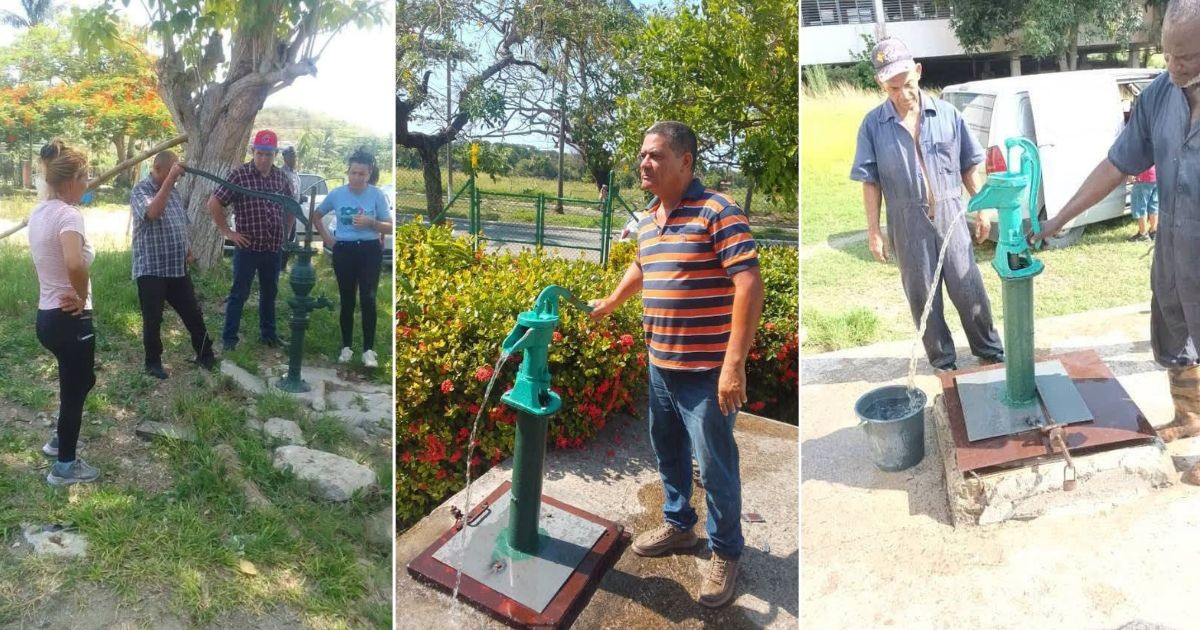
Officials in Eastern Havana have begun installing 20 manual water pumps as part of an effort to mitigate the ongoing water supply issues in the area. This initiative aims to benefit over 3,000 residents in its initial phase.
The project was announced by the municipal government of Eastern Havana on social media, presenting this approach as an "innovative manual pumping system" with the headline: "Updates from Eastern Havana: We Keep Moving Forward!"
The announcement stated: "In our pursuit of solutions to reduce the impact of water shortages on our community, we are pleased to announce the installation of a new manual pumping system in Eastern Havana."
Authorities claim that the first phase will include 20 pumps, directly improving the daily conditions for more than 3,000 individuals. The local government hailed this installation as "a significant step" in their commitment to addressing regional issues, adding, "We do not stop; we continue working to ensure the well-being of our citizens."
However, the portrayal of these pumps as a "novelty" sparked widespread criticism and sarcasm among residents and social media users. Many questioned how a manual device, used for decades, could be considered progress.
"We're back to the Stone Age, drawing water by hand," one person commented. Another asked, "So what’s the plan? Bring two buckets and keep hauling water? Or did I misunderstand?"
The situation for residents in high-rise buildings in Eastern Havana was also a major concern. Some pointed out that after manually extracting water, neighbors would have to carry it up multiple flights of stairs, a daunting task for the elderly and vulnerable, especially during blackouts that disable elevators.
"It's like filling a bucket and then climbing five floors; they’re training Eastern Havana residents for Everest," another comment joked.
Criticism was also aimed at the authorities' choice of words. "What mediocrity to call manual pumps, used since colonial times, an innovative system," someone remarked.
"I'm 64 years old, and when I was a child, my grandparents in the countryside already had this 'new invention'... no words," another shared.
While some acknowledged that the pumps might serve as an emergency measure, they rejected their portrayal as a permanent solution.
"It's a temporary fix to the current problem but not innovative. We need permanent solutions for the water supply, both fresh and saltwater, in Eastern Havana," one user pointed out.
Others used the announcement to highlight specific supply issues in areas like Alamar, Cojímar, La Cabaña, and the Pan American Village, urging for long-term fixes to leaks, breakdowns, and pumping interruptions.
Manual pumps have previously emerged as a stopgap in other parts of the capital. At the end of July, authorities dispatched six manual pumps to El Cotorro, alongside water tanker mobilizations and the use of school cisterns as reservoirs.
Problems persisted into August, with a recent malfunction in the Gato System disrupting supplies in Eastern Havana and other city areas. Consequently, carrying water in buckets has become a daily routine for many families.
This announcement comes amid an ongoing water crisis in Havana. In May, the National Institute of Hydraulic Resources (INRH) reported that 376,055 residents lacked regular water access, with over 309,000 affected by power outages halting electric pumps.
By July, company experts raised the figure to over 500,000 affected Havanans.
Understanding Havana's Water Crisis and Solutions
Why are manual water pumps being installed in Eastern Havana?
The manual water pumps are being installed as a temporary measure to alleviate the ongoing water supply issues affecting over 3,000 residents in the area.
What criticisms have been raised about the manual pumping system?
Critics argue that labeling manual pumps as "innovative" is misleading, considering they are an outdated technology. Concerns also focus on the practicality of manually transporting water, especially in high-rise buildings.
How widespread is the water crisis in Havana?
The water crisis in Havana is significant, with over 500,000 residents affected by supply issues as of July, exacerbated by power outages that impact electric water pumps.