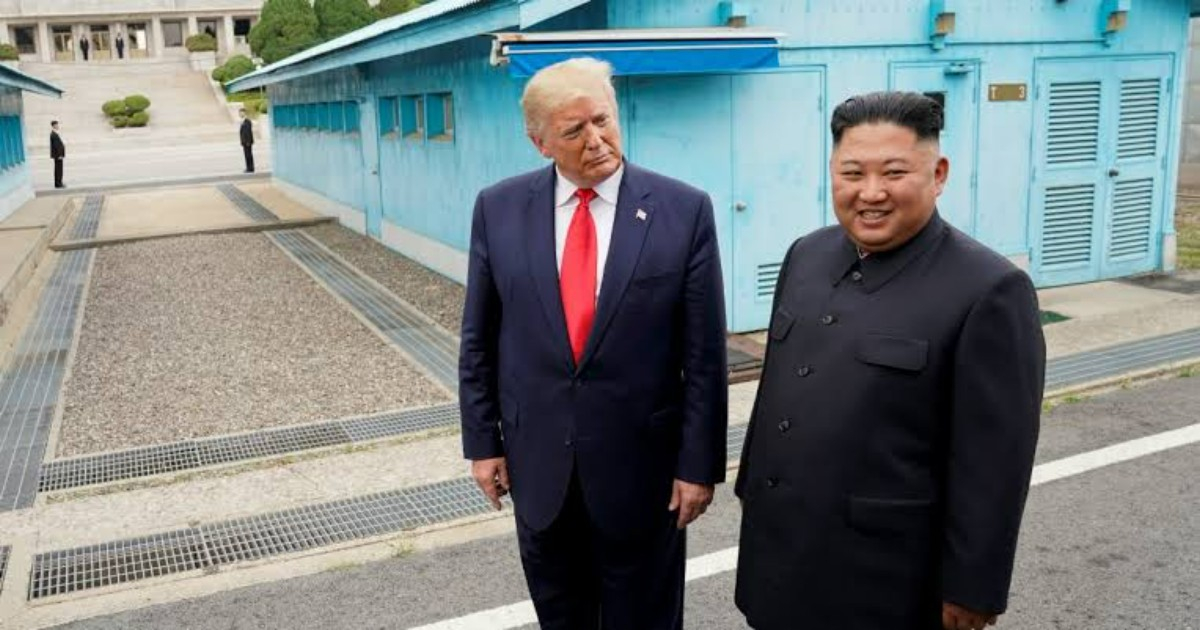
On Sunday, Donald Trump declared that he instructed Secretary of Defense Pete Hegseth to significantly scale back joint military exercises between the United States and South Korea. He cited his "excellent relationship with Kim Jong-un" as the primary justification for this decision.
The Republican leader made this announcement on his social media platform, Truth Social, just a day before the planned start of the Ulchi Freedom Shield exercises. These drills, scheduled from August 17 to 27, involve around 18,000 South Korean troops and focus on modern threats such as drones, GPS signal interference, and cyberattacks.
In his statement, Trump asserted that these exercises send a "totally inappropriate and hostile signal" to a nation that, since his presidency began, has not been threatening and has shown respect.
The president also remarked that the United States bears a "significant portion" of the financial burden of these "expensive" exercises, a point he previously used during his first term to justify similar actions.
The announcement caught Seoul off guard, as they were not consulted, and they have traditionally viewed these exercises as crucial for maintaining joint operational readiness with Washington.
This development occurs amid heightened tensions on the Korean Peninsula: North Korea recently launched two ballistic missiles — one on August 6 from the Wonsan area toward the Sea of Japan, and the other on August 12, which traveled over 700 kilometers before landing in the sea. North Korea had warned of responding with a "new level of deterrence" against the exercises.
Trump also took the opportunity to disclose a diplomatic friction with Seoul, stating that he asked the South Korean government if they wanted to join Washington's efforts to denuclearize Iran, to which they responded, "No, thanks."
This decision aligns with Trump's previous term's approach: in June 2018, following the Singapore summit with Kim, he suspended key exercises like Freedom Guardian, labeling them "provocative" and "very costly," which alarmed allies and the Pentagon. Denuclearization talks eventually failed, and the exercises were resumed later on.
In his second term, Trump has rekindled a rapprochement with Pyongyang since February 2025, when he announced his intention to improve relations with North Korea, claiming he gets along "very well" with Kim Jong-un.
The scaling down of the Ulchi Freedom Shield exercises is seen as Trump's renewed attempt to use military drills as diplomatic leverage with Pyongyang, potentially paving the way for a new round of negotiations with the North Korean regime.
Key Questions on Trump's Military Exercise Decision
Why did Trump decide to reduce military exercises with South Korea?
Trump cited his "excellent relationship with Kim Jong-un" as the main reason for reducing the joint military exercises, suggesting that these drills send an inappropriate signal to North Korea.
What is the Ulchi Freedom Shield?
The Ulchi Freedom Shield is a set of joint military exercises between the United States and South Korea, involving around 18,000 South Korean troops and focusing on modern threats such as drones and cyberattacks.
How did Seoul react to the announcement of reduced exercises?
The announcement surprised Seoul as they were not consulted. Historically, South Korea considers these exercises essential for maintaining joint operational readiness with the United States.