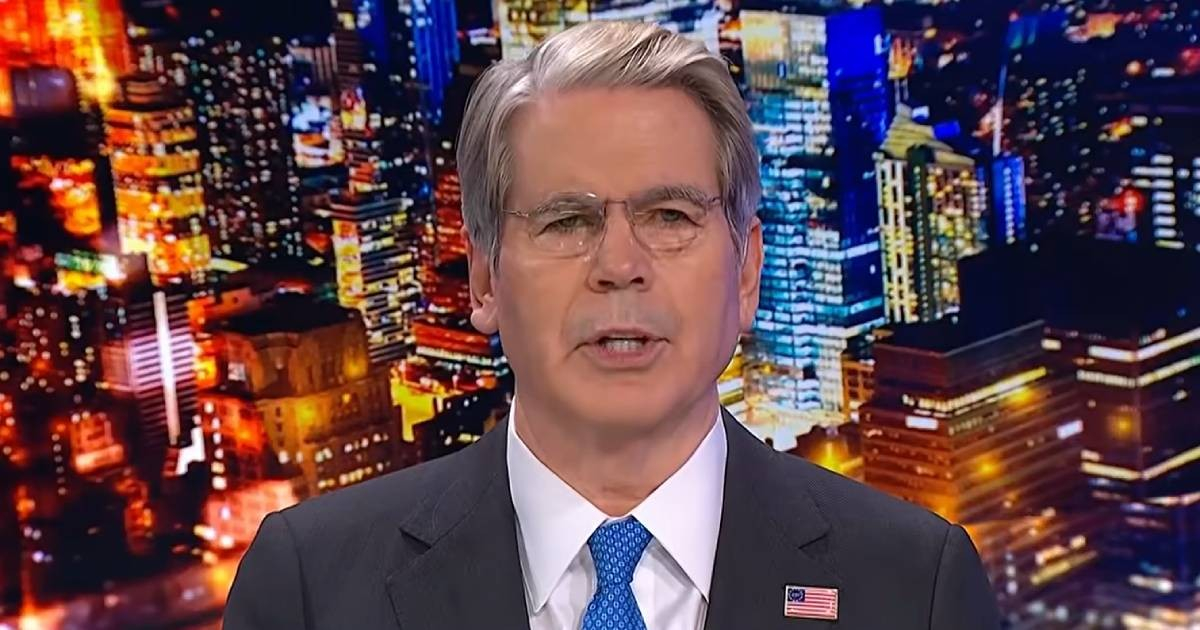
Scott Bessent, the United States Treasury Secretary, has once again spotlighted Cuba in discussions about Washington's economic pressure strategies, drawing comparisons between the Cuban regime's long-standing survival under sanctions and similar situations in Venezuela, as well as the Trump administration's tactics against Iran.
During an appearance on Newsmax's "Rob Schmitt Tonight" on Thursday, Bessent used the cases of Cuba and Venezuela to address skepticism about how long a government can withstand severe economic restrictions.
"People say, well, Cuba lasted too long. Venezuela lasted too long. Venezuela collapsed immediately when we imposed the blockade," Bessent remarked.
The mention of the island came as Bessent defended a dual-strategy approach against Tehran, combining unprecedented economic isolation with a naval blockade of the Strait of Hormuz. His statements acknowledged Cuba's resilience under prolonged U.S. pressure, yet he asserted that the measures against Iran would be of a different magnitude.
Bessent announced that Washington would implement "unprecedented measures in the history of economic isolation" against Tehran next week, complementing the naval blockade that he said restricts traffic through Iranian ports.
Cuba had been brought up earlier in the conversation in a different context. When host Rob Schmitt inquired about the rise of socialism within the Democratic Party, Bessent cited Cuba as an example of the failure of such political and economic models.
"Show me where it has ever worked, whether it's the Soviet Union, Cuba, or Venezuela. With these policies, you always end up with less," he stated.
Bessent's references to Cuba are not isolated incidents. Since taking office, he has frequently mentioned the island in discussions on sanctions, the island's economic crisis, and the potential for political change.
In March 2026, during an interview with Fox Business, he predicted a "slow-motion regime change" in Cuba following Nicolás Maduro's capture, linking Cuba's future to the new political landscape in Venezuela.
Two months later, he warned that U.S. sanctions on Cuba "could go up or down" depending on Havana's actions, describing Washington's policy as a "carrot and stick" approach.
By late July, he intensified his rhetoric, including Havana, Moscow, and Caracas in what he called a "hellscape of deprivation," criticizing the political and economic models of those governments.
These statements come amid a sustained tightening of Trump's policy towards Cuba in 2026. In May, Executive Order 14404 introduced secondary sanctions against foreign companies engaging with sanctioned Cuban entities. In June, Secretary of State Marco Rubio designated CUPET as a sanctioned entity, and in July, Washington sanctioned the Port of Mariel and other entities linked to the energy sector.
In early August, the U.S. took further action, imposing new measures against five entities and eight individuals connected to Cuba. Since January 2026, over 240 sanctions have reportedly been applied against Cuba, according to reports gathered by this outlet.
Amid rising U.S. pressure, Havana has maintained its usual defiant rhetoric. However, even Miguel Díaz-Canel admitted in June that "creative resistance is not enough" to pull the country out of its deep crisis, characterized by blackouts, shortages, deteriorating public services, and prolonged economic contraction.
The Cuban government has also publicly rejected Washington's predictions of potential political change on the island. In March, Deputy Foreign Minister Carlos Fernández de Cossío told NBC News that regime change was "off the table," responding directly to Bessent's projections.
The Treasury Secretary's latest remarks once more position Cuba and Venezuela as benchmarks in the Trump administration's pressure strategy, this time asserting that the economic siege planned against Iran aims to reach an intensity that Washington claims would be unprecedented.
Insights on U.S. Economic Sanctions Against Cuba
How has Cuba managed to survive under prolonged U.S. sanctions?
Cuba has endured decades of U.S. sanctions by relying on a combination of internal economic measures, international alliances, and a resilient political ideology that emphasizes resistance. Despite significant hardships, the regime has maintained control and continued its governance model.
What are the potential impacts of increased U.S. sanctions on Cuba?
Heightened U.S. sanctions could exacerbate Cuba's economic challenges, leading to more severe shortages and potentially sparking greater public unrest. However, they may also reinforce the government's narrative of foreign aggression, which it uses to bolster domestic support.
Why does the U.S. continue to impose sanctions on Cuba?
The U.S. maintains sanctions on Cuba as part of a broader strategy to pressure the Cuban government into adopting democratic reforms and improving human rights. The sanctions are also intended to limit Cuba's ability to support other regimes that the U.S. views as adversarial.