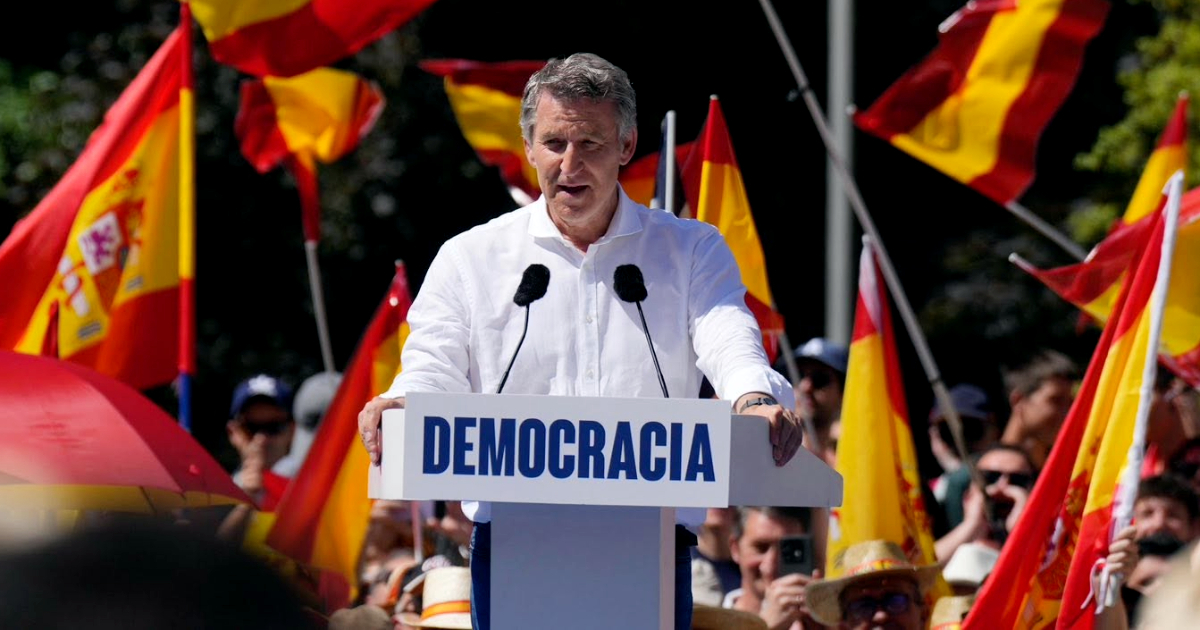
There's a noticeable shift in Spanish politics concerning Cuba. Recently, voices from Spain's right-wing factions have suggested a significant change: Spain should abandon its current approach to Havana and take a more proactive stance in promoting democratic change on the island.
Alberto Núñez Feijóo, leader of the Popular Party (PP), stated that should he become Prime Minister, Spain would collaborate with the United States to ensure "prosperity and freedom reach Cuba."
Feijóo criticized the current Spanish government, led by Pedro Sánchez, for supporting dictatorships like Venezuela. He emphasized the need for a different relationship with Cuba, recalling the historical ties between the two nations.
Proposals for Change
Almost simultaneously, Foro Madrid, affiliated with the Disenso Foundation linked to VOX, introduced a detailed proposal to alter Spain and the European Union's policies toward the Cuban regime.
The platform suggests tying relations with Havana to democratic progress, scrutinizing European cooperation, withdrawing public support for businesses involved with the military conglomerate GAESA, and increasing oversight on Cuban leaders' financial activities.
Although these positions come from various political entities and don't form a joint government agenda, their alignment raises a pertinent question: What might happen to Spain's policy on Cuba if the right-wing takes power in the 2027 general elections, barring an earlier election?
From Dialogue to Political Pressure
Under Pedro Sánchez's leadership, Spain has maintained a dialogue-based policy with Havana, promoting economic cooperation and defending the EU's engagement with Cuban authorities.
In October 2025, Spain restructured a significant portion of Cuban debt and reactivated a debt conversion program. The country also holds substantial commercial ties with Cuba.
However, the PP is signaling a potential shift. Since 2020, they've advocated for Spain to push the EU to suspend the Political Dialogue and Cooperation Agreement (PDCA) with Cuba, the main framework for EU-Cuba relations.
Feijóo's stance has notably evolved. As Galicia's president, he had a pragmatic relationship with Cuba, even visiting Havana in 2016 to meet officials. Now, he speaks of freedom for Cuba and collaborates closely with the United States.
VOX's More Aggressive Stance
Foro Madrid's report, "Cuba: A Criminal Regime Supported from Abroad," outlines a more aggressive approach from the VOX-affiliated space. It argues that Spain and the EU should halt resources aiding the regime's survival.
Proposals include preventing state-controlled Cuban institutions from accessing cooperation funds, withdrawing public support for GAESA-linked investments, increasing pressure for political prisoner releases, and linking relations with democratic progress in Cuba.
Additionally, it suggests Spain employ anti-money laundering tools and enhance coordination among law enforcement and intelligence services to tackle potential financial or criminal networks tied to the regime.
Potential PP-VOX Coalition
The 2027 general elections will reveal if this discourse shift remains in opposition or translates into Spanish foreign policy. A PP-led government, with or without VOX collaboration, could significantly alter Madrid-Havana relations.
While there isn't a unified PP-VOX program regarding Cuba, key points of convergence include a more critical stance towards the Cuban regime, emphasis on political prisoners and democratic transition, questioning current EU policy, and a readiness to collaborate with the U.S.
The actual change's extent would depend on the internal dynamics of a potential government. A solo PP government might pursue a different policy compared to one formed with VOX's support.
U.S. Involvement
Feijóo's mention of the United States is particularly notable. He emphasized that Spain should act "alongside the U.S." to secure freedom and prosperity for Cuba.
In February, Feijóo met with U.S. Secretary of State Marco Rubio, promising that Spain would again be a "reliable partner" for its allies.
The current U.S. ambassador to Spain, Benjamín León Jr., a Cuban-American appointed by Donald Trump, has also highlighted the Cuban issue in his diplomatic agenda.
León's presence in Madrid could facilitate closer Spanish alignment with Washington's strategy if Spain undergoes a political shift after the next elections.
For Cuba, this change would be significant due to Spain's profound economic, diplomatic, and human ties with the island, as well as its influence on EU policy towards Cuba.
Implications for the European Union
Spain alone cannot suspend the PDCA or dictate EU policy towards Cuba. However, a Spanish government keen on toughening relations might leverage its diplomatic influence to rally support among EU member states.
The PP has already suggested using the EU platform to increase pressure on Cuban authorities.
A shift in Madrid's stance could spark debates on the PDCA's future, European cooperation conditions, relations with Cuban state institutions, and Brussels' response to human rights violations.
This would elevate a Spanish political change to a broader issue for Havana.
Economic Repercussions
Spain has long restructured and forgiven substantial Cuban debt, supporting cooperation programs and hosting numerous businesses with Cuban interests.
A government embracing right-wing proposals might reassess future debt restructurings, public guarantees for business operations, and projects involving GAESA-related entities.
Cooperation mechanisms might be altered to ensure more resources reach independent organizations or the population rather than Cuban state structures.
This wouldn't necessarily end Spanish cooperation with Cuba but would redefine who receives resources, under what conditions, and with what level of Cuban state involvement.
Visible Signs of Change
There's still much to determine. The elections are yet to be held, a PP-VOX government remains hypothetical, and no common Cuban policy has been negotiated between the two parties.
However, political signals are accumulating.
Feijóo pledges to work with the U.S. for Cuban "prosperity and freedom." The PP calls for revising the EU-Cuba relations framework. Foro Madrid, from the VOX-affiliated space, proposes an even deeper strategy of economic, diplomatic, and financial pressure on the regime.
Each element has its dimension, but collectively they suggest a right-wing Spanish shift regarding Cuba and foreshadow a debate that could gain prominence if political change occurs in Spain.
For the Cuban regime, Spain's next elections could have far-reaching consequences beyond simply changing the interlocutor at La Moncloa.
The stakes include cooperation, financial and business relations, Spain's position within the EU, and the potential shift from dialogue with Havana to a coordinated strategy of greater pressure alongside Washington.
Potential Impact of a Right-Wing Spanish Government on Cuba
How might a right-wing government in Spain change its policy towards Cuba?
A right-wing government in Spain could adopt a more critical stance towards the Cuban regime, focusing on democratic transition and political prisoners, and aligning more closely with U.S. policies.
What role could the United States play in Spain's potential policy shift on Cuba?
The United States could be a key partner in Spain's potential policy shift, as Feijóo has emphasized acting alongside the U.S. to promote freedom and prosperity for Cuba.
What are the economic implications of a Spanish policy change towards Cuba?
A policy change could lead to reassessment of debt restructurings, public guarantees for business operations, and cooperation projects, potentially impacting Cuban state-controlled entities.