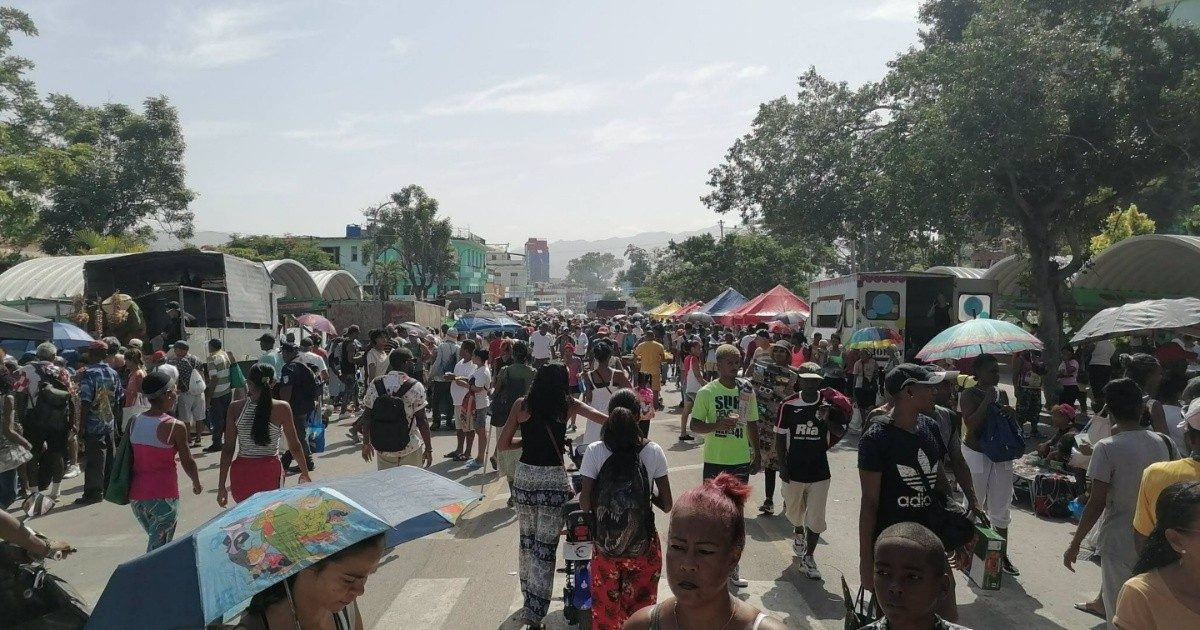
State-run TV Santiago shared a promotional post on Facebook about an Agricultural and Commercial Fair held on Victoriano Garzón Avenue in Santiago de Cuba, claiming that the "population is enjoying a variety of gastronomic, commercial, recreational, and cultural offerings, with options designed for all ages."
Officially, the event was part of the summer program "Summer With My People" and commemorations for the Centenary of Fidel Castro's Birth.
However, the state narrative clashed with the reality experienced by attendees, as comments from citizens on the same post dismantled the triumphant portrayal point by point.
A local identified as Leosdel Massó shared that he walked the fair from nine in the morning without finding a single stall accepting payment via bank transfer: "Where were the inspectors to ensure transfers were accepted because I personally walked from 9 a.m. and none accepted for reasons..."
Kenia Santray was more direct in questioning the language of the state media: "What enjoyment are they referring to... when you couldn't pay by transfer as usual... don't publish claiming the people are happy when that's not the reality."
Santray also criticized the officials responsible for enforcing consumer rights: "Do your job properly and criticize those who don't uphold consumer rights... I laugh and feel sorry for us ordinary people who suffer due to the incompetence of those appointed to ensure the well-being of the sacrificial people who only RESIST WITH CREATIVITY."
Another commenter, going by Cigarros Cigarros, summed up the issues succinctly: "In the end, high prices, no transfers accepted, and inspectors filling their bags. Publish that too."
Matos Matos was even more scathing, describing the post as "disrespecting human intelligence" and criticizing large gatherings linked to alcohol and social indiscipline: "It's a shame that image matters more than respect."
The refusal to accept bank transfers at fairs and markets is a chronic issue throughout Cuba: the official press admitted in July 2026 that only 3.77% of transactions in the country are digital, and in provinces like Sancti Spíritus, less than 10% of private businesses regularly accept electronic payments.
The regime has attempted to enforce compliance with fines up to 16,000 pesos and business closures. In Bayamo, five businesses were shut down for rejecting transfers just days ago, but the measure hasn't changed the widespread practice.
On top of payment issues, there are the prices. At a fair in Camagüey on August 14, meat was offered at 600 pesos per pound, a figure that official media called "affordable" despite representing nearly 20% of the monthly minimum wage. In Las Tunas, a July fair showcased eggs at 2,600 pesos per carton, and in June, basic food purchases exceeded 21,000 pesos at a neighborhood fair, more than three times the average monthly salary.
The removal of price caps on several basic products through Resolution 150/2026, approved last June, has further strained the population's finances.
This isn't the first time the regime has used fairs on Garzón Avenue as a showcase. In March 2026, authorities announced a mega food sale in Santiago precisely to "appease discontent," a formula that repeats without addressing underlying issues.
"All we do is RESIST WITH CREATIVITY," wrote Kenia Santray, summarizing in capital letters what the official propaganda prefers to ignore.
Understanding the Discontent Surrounding Santiago de Cuba's Fair
Why were attendees of the Santiago de Cuba fair dissatisfied?
Attendees were dissatisfied due to the refusal of vendors to accept bank transfers for payments, high prices, and lack of compliance with consumer rights by officials.
What measures has the Cuban regime taken to enforce digital payments?
The regime has imposed fines up to 16,000 pesos and closed businesses that refuse to accept digital payments, although these measures have not significantly changed the prevalent practices.
How do local prices at fairs compare to the average salary in Cuba?
Prices, such as 600 pesos per pound of meat or 2,600 pesos per carton of eggs, can represent a significant portion of the monthly minimum wage, often exceeding the average monthly salary by several times.